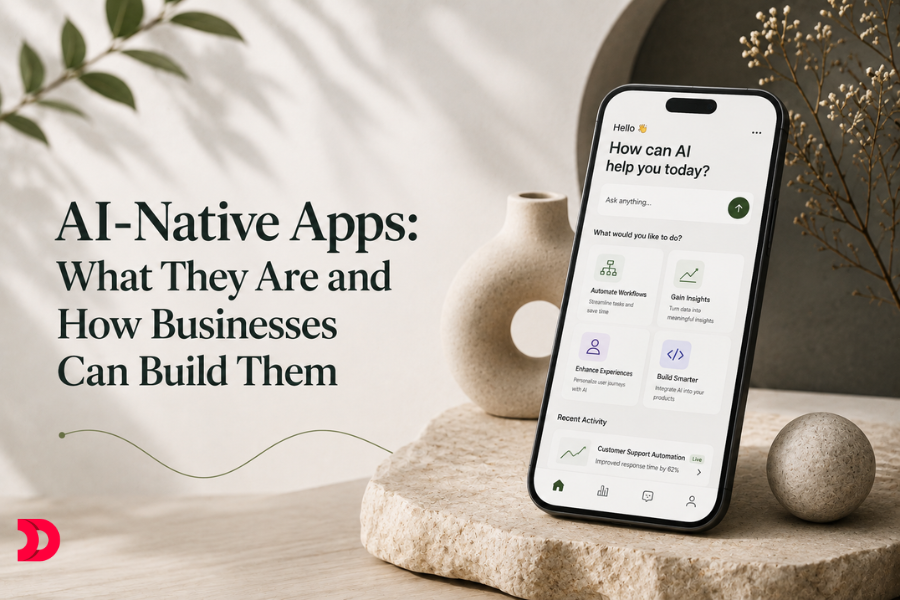
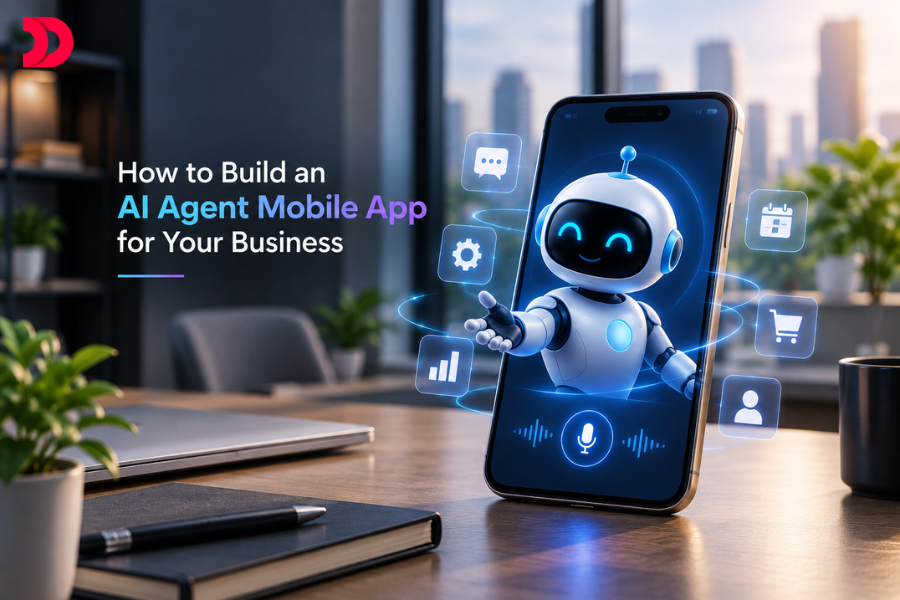
What if your mobile app could understand what customers need and take the next step for them?
That is the idea behind an AI agent mobile app. Instead of making users move through multiple screens, search for information and complete every action manually, an AI agent can understand a request, work with relevant business data and help complete the required task.
For example, a customer could ask an ecommerce app to find a suitable product within a specific budget. The AI agent can understand the requirements, search available products, compare relevant options and guide the customer toward a purchase. In another business, the same concept could help employees check customer records, schedule appointments, manage orders or retrieve internal information.
This is why businesses across different industries are exploring AI agent development. The focus is moving from simply adding AI to an application toward creating mobile experiences that can understand user intent and support complete business workflows.
If you are considering building an AI agent mobile app, the right approach starts with understanding the business problem, selecting the right AI capabilities and designing the technology around the users who will actually use the product.
Quick Answer: How Do You Build an AI Agent Mobile App?
To build an AI agent mobile app, first identify a business process where users or employees spend time searching, communicating, making repetitive decisions or completing several connected tasks. Then define what the AI agent should understand, what information it can access and which actions it is allowed to perform.
The development team can then design the mobile experience, select suitable AI models, build the backend and agent architecture, connect APIs and business data, implement security controls and test the application with real world scenarios.
For most businesses, starting with a focused MVP is a practical approach. The first version can solve one important workflow and then expand as the business understands user behaviour, performance and the value created by the AI agent.
The overall development cost depends on the mobile platforms, AI capabilities, integrations, backend requirements, security, design and expected scale. Working with an experienced AI app development company can help define these requirements before development begins.
What Is an AI Agent Mobile App?
An AI agent mobile app is a mobile application that uses an AI agent to understand a user’s goal and help complete one or more tasks within defined permissions.
This is different from simply adding an AI chatbot to an application.
A chatbot might answer a customer’s question about an order. An AI agent could understand that the customer wants to change the delivery date, check the order information, review available delivery options and initiate the required request through the connected system.
The difference is the ability to work with context, information and tools.
An AI agent can receive an instruction, determine what information is required, access approved systems and decide which available action should be taken. The application still controls the agent’s permissions, business rules and access to sensitive information.
This makes agent based mobile applications particularly useful for workflows that involve several connected steps.
Why Are Businesses Building AI Agent Mobile Apps?
The main reason to build an AI agent app is to make a business process easier for users or employees.
Traditional mobile applications are usually designed around predefined journeys. A customer may need to search, select filters, open a product page, compare options and then complete a transaction.
With an AI agent, the customer can describe the goal in their own words.
For example, a customer using an ecommerce application could ask, “I need a waterproof jacket for hiking in cold weather. Show me suitable options within my budget.”
The agent can interpret the requirements and use the application’s product information to provide relevant recommendations.
The same approach can work inside business applications. A sales employee could ask the app to summarise recent activity for a particular customer. A logistics manager could request information about delayed shipments. A service technician could ask for the maintenance history of a particular machine.
The value is not simply that AI can communicate with users. The value comes from connecting that intelligence with useful business processes.
Where Can AI Agent Mobile Apps Be Used?
AI agent technology can be applied across many industries because the underlying idea is not tied to one particular type of business.
In ecommerce, an agent can assist with product discovery, recommendations, order questions and customer service. In healthcare applications, it can help users navigate appointment related workflows and access approved information. Financial applications can use agents to explain account information or help customers complete supported service requests.
Real estate applications can use AI to understand property requirements and present suitable listings. Travel platforms can use agents to help users create itineraries and manage booking related tasks. Logistics applications can use them to support shipment tracking and operational workflows.
Some common business applications include:
- Customer support and service assistance
- Ecommerce product discovery
- Sales and lead qualification
- Appointment and booking workflows
- Logistics and delivery operations
- Real estate search and customer assistance
- Employee productivity and internal knowledge
The strongest opportunity usually comes from a specific workflow where users already spend considerable time searching, comparing, entering information or moving between different systems.
What Features Should an AI Agent Mobile App Have?
The right feature set depends on what the business expects the agent to accomplish. A customer facing application may focus heavily on conversation and personalisation, while an internal business application may require deeper integrations and approval workflows.
Natural Language Interaction
Users should be able to explain what they need without having to learn complicated application navigation.
The interaction can happen through text, voice or both. The agent should understand the context of the conversation and respond according to the application’s purpose.
For example, a travel app could understand a request for a weekend trip, ask for missing information and then present suitable options without requiring the user to complete several separate search forms.
Context and Personalisation
An agent becomes more useful when it can understand relevant context.
Depending on the permissions provided by the business, this may include previous interactions, customer preferences, account information, current tasks or transaction history.
Personalisation should always be connected to appropriate access controls. The agent should only use information that it is authorised to access.
API and Business System Integration
AI agents become significantly more valuable when they can work with existing business systems.
A mobile application may need to connect with CRM software, inventory platforms, booking systems, payment services, ERP software or internal APIs.
The AI agent can determine which approved tool is relevant to the user’s request, while the backend controls the actual access and execution.
Voice Capabilities
Voice interaction can make an AI mobile application more convenient for users who need quick or hands free assistance.
For example, a field employee could ask for customer information while travelling between appointments. A sales representative could request a summary of a customer account without manually searching through multiple screens.
Voice should be added when it solves a genuine user need rather than simply being included as an AI feature.
Human Approval
Complete autonomy is not necessary for every workflow.
For sensitive operations, the agent can prepare the action and request approval before executing it. This can be useful for financial transactions, refunds, account changes or other activities where additional review is required.
This approach allows businesses to automate repetitive work while maintaining human control over important decisions.
How to Build an AI Agent Mobile App Step by Step
A successful AI agent application begins with a clear business objective. Choosing an AI model before understanding the workflow can lead to unnecessary complexity and higher development costs.
1. Identify the Business Problem
Start by examining what customers or employees currently struggle with.
Look for processes that involve repetitive questions, manual data entry, information searches, multiple applications or several connected steps.
For example, a property platform may receive customer requests containing several requirements such as location, budget, property type and preferred amenities. An AI agent can understand these requirements and help narrow down suitable properties.
The use case should have a measurable objective. You may want to reduce response time, improve customer satisfaction, increase conversions or reduce manual work.
2. Define What the Agent Should Do
The next step is to define the agent’s role.
Decide what questions it can answer, what information it can access, which tools it can use and which actions it can perform.
You should also define situations where the agent must stop and ask for human assistance.
This creates a clear boundary for the system and makes development, testing and security planning easier.
3. Design the Mobile User Experience
An AI agent should become part of the complete mobile experience rather than simply appearing as a chat screen.
Traditional mobile components still have an important role. Product cards, maps, forms, buttons, search results and confirmation screens can work alongside conversational AI.
For example, a user could ask an AI agent to find nearby restaurants, while the application displays the results on a map and lets the user select an option through the standard interface.
The best experience depends on the task and the expectations of the target users.
4. Select the AI Model
The AI model should be selected according to the requirements of the application.
Response quality, reasoning capabilities, context handling, speed, privacy requirements, multimodal support and operating costs can all influence the decision.
Some applications may require advanced reasoning, while simpler workflows may work effectively with a smaller and faster model.
Testing different approaches during development can help determine which model provides the right balance between quality, speed and cost.
5. Design the AI Agent Architecture
The architecture connects the mobile application with the AI system and business infrastructure.
A simplified workflow looks like this:
User request → Mobile app → Backend → AI agent → Approved data or tools → Result or action
The backend plays an important role because it can handle authentication, permissions, business rules, API access and logging.
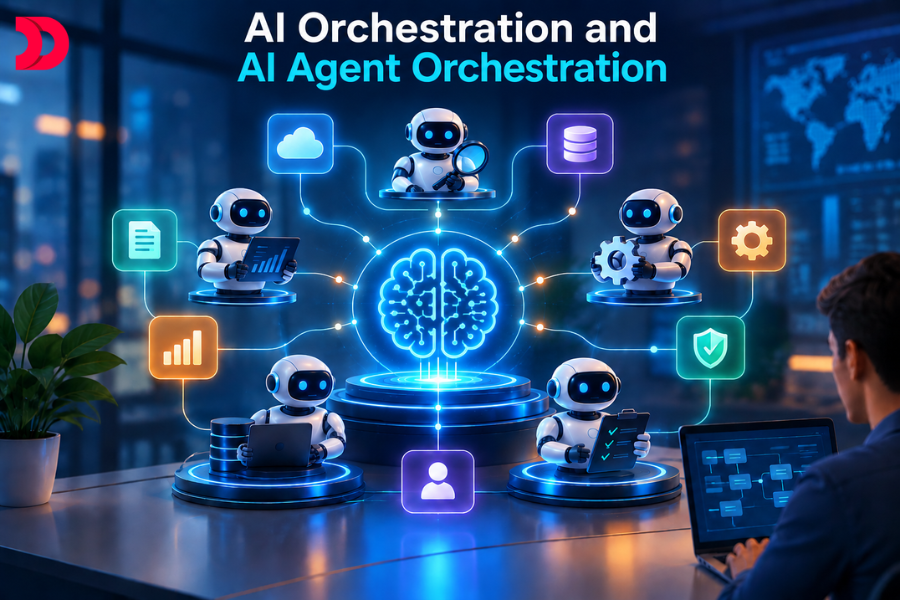
More complex applications may use multiple specialised agents. One agent could manage customer support, another could handle product recommendations and another could work with orders or internal operations.
6. Connect Business Data and APIs
An agent needs reliable information to provide useful responses.
Depending on the project, it may connect with CRM systems, ERP platforms, databases, inventory systems, payment services, calendars or other business applications.
For internal company knowledge, retrieval augmented generation can allow the system to retrieve relevant information from approved documents and knowledge sources before generating a response.
Data quality is important here. Even a capable AI model can produce poor results if the information it receives is incomplete, outdated or incorrect.
7. Implement Security and Permissions
Security should be considered from the beginning rather than added after development.
An AI agent may have access to customer information and business systems, so the application needs appropriate authentication, authorisation and access controls.
Sensitive actions can also require additional verification or human approval.
The goal is to ensure that the agent can perform useful tasks without receiving unnecessary access to business systems or customer data.
8. Test Real User Scenarios
AI applications need extensive scenario testing because users do not always communicate in predictable ways.
The development team should test clear requests, incomplete instructions, ambiguous questions, unexpected inputs, incorrect information, failed API connections and situations where the agent should transfer the task to a person.
Testing should measure not only whether the application responds but also whether it performs the correct action.
9. Launch and Improve
Launching the application is the beginning of the improvement process.
After release, businesses can analyse how users interact with the agent, which requests fail, where users need human support and which tasks take longer than expected.
These insights can then be used to improve prompts, workflows, knowledge sources, integrations and the overall mobile experience.
What Technology Stack Is Used for AI Agent Mobile App Development?
There is no single technology stack that fits every AI mobile application. The choice depends on the product requirements, existing systems, performance expectations and development strategy.
| Layer |
Common Technology Options |
| Mobile application |
React Native, Flutter, Swift, Kotlin |
| Backend |
Python, Node.js, Java, .NET |
| Database |
PostgreSQL, MySQL, MongoDB |
| AI layer |
Large Language Models, Machine Learning Models, AI APIs |
| Knowledge layer |
RAG, Vector Databases, Knowledge Bases |
| Cloud |
AWS, Google Cloud, Microsoft Azure |
| Integration |
REST APIs, GraphQL, Third Party APIs |
Businesses that want one application for both iOS and Android may consider cross platform development with React Native or Flutter. Native development can also be suitable when the product requires platform specific capabilities or highly specialised performance.
The technology should be selected based on the application’s requirements rather than following a particular trend.
What Is an AI Agent Architecture?
An AI agent architecture determines how the mobile application communicates with the AI model, backend services, business data and external tools.
A typical architecture can include the mobile interface, authentication layer, application backend, AI orchestration layer, model provider, knowledge or retrieval system, business APIs and monitoring services.
When a user sends a request, the mobile application passes it to the backend. The agent then interprets the request and determines whether it needs information from a database, a business API or another approved tool.
The result is returned to the application after the required processing and validation.
For complex applications, the architecture may also include memory, workflow management, multiple agents and additional evaluation systems.
The architecture should be designed around the actual workflow rather than making the system unnecessarily complex from the beginning.
How Much Does It Cost to Build an AI Agent Mobile App?
The cost of AI app development depends on the scope and technical complexity of the product.
A basic application with one AI workflow and limited integrations will have very different development requirements from an enterprise application with multiple agents, complex business systems and advanced security.
The mobile platforms also affect the scope. Building for both iOS and Android can require a different approach depending on whether cross platform or native development is selected.
AI related operating costs should also be considered. Depending on the application, businesses may have ongoing expenses for AI model usage, cloud infrastructure, storage, third party APIs and monitoring.
The best way to estimate the project is to define the MVP first. Once the features, workflows, integrations and user requirements are clear, a development team can prepare a more realistic estimate.
How Long Does It Take to Build an AI Agent Mobile App?
The development timeline depends on the same factors that affect cost.
A focused MVP with one primary workflow can be developed faster than a large platform with multiple AI agents, several integrations and advanced administrative capabilities.
The planning stage should cover product design, AI architecture, mobile development, backend development, integration, testing and deployment.
It is also important to allow time for AI evaluation. An application may function technically while still requiring improvements to the agent’s responses and decision making.
For this reason, businesses should treat AI agent development as a product development process rather than simply an integration project.
AI Agent Mobile App vs Traditional Mobile App
AI agents do not mean that traditional mobile interfaces are no longer useful. In many cases, the strongest products combine both approaches.
| Traditional Mobile App |
AI Agent Mobile App |
| Users follow predefined navigation |
Users can describe their goals |
| Tasks generally follow fixed flows |
Agent can handle flexible requests |
| Interaction mainly uses screens and forms |
Interaction can include natural language |
| Automation is mostly rule based |
AI can reason within defined boundaries |
| Users perform many steps themselves |
Agent can perform authorised actions |
| Personalisation often follows predefined rules |
AI can use approved context |
The right choice depends on the product. A financial application may still need traditional screens for account management while using an AI agent to help customers understand their transactions.
Should You Build an AI Agent In House or Hire an AI App Development Company?
An internal team may be suitable if your business already has experienced mobile developers, backend engineers, AI specialists and cloud professionals.
However, building an AI agent mobile app can require several areas of expertise at the same time. The project may involve product design, mobile development, backend engineering, AI integration, data architecture, cloud infrastructure, security and quality assurance.
An experienced AI app development company can bring these capabilities together and help manage the development process from product planning to deployment.
When evaluating a development partner, look at its experience with mobile applications, AI systems, business integrations and cloud architecture. It is also useful to ask how the company approaches security, testing, scalability and post launch improvements.
When Should You Hire AI Automation Specialists?
AI agents and AI automation often work together.
If your primary requirement is to automate repetitive business processes across several systems, you may want to hire AI automation specialists who understand workflow design, integrations and intelligent automation.
For example, a business could automate a lead workflow where a new enquiry is analysed, relevant customer information is retrieved, the CRM is updated and a response is prepared for a sales representative.
The exact level of automation should depend on the process and the amount of human involvement required.
When Should You Hire Mobile App Developers?
If you already have the AI architecture or backend and need someone to build the mobile experience, you may choose to hire mobile app developers with experience in React Native, Flutter, iOS or Android.
Mobile developers can create the user interface, integrate APIs, implement authentication and connect the application with your AI services.
For a complete AI product, mobile developers will usually need to work alongside backend and AI specialists so that the user experience and agent workflows function as one system.
How to Choose the Right Mobile App Development Company
Selecting a mobile app development company for an AI project requires looking beyond basic mobile development experience.
The company should understand how mobile applications communicate with backend services and how AI systems interact with business data and external tools.
It is also worth reviewing previous work, technical capabilities, development methodology, security practices, testing processes and post launch support.
Ask potential partners how they would approach your specific use case. A technical discussion should cover the user journey, AI capabilities, data requirements, integrations, permissions, scalability and expected outcomes.
The development partner should be able to explain the architecture clearly instead of simply recommending AI because it is currently popular.
Why Choose DevsTree for AI Agent Mobile App Development?
DevsTree brings together mobile application development, AI engineering, backend development, cloud solutions and business automation.
This allows businesses to approach an AI mobile product as a complete solution rather than treating the mobile application, AI system and backend infrastructure as separate projects.
DevsTree can support AI powered mobile applications involving agentic AI, generative AI, RAG, AI automation, React Native, iOS, Android, backend engineering, APIs, cloud infrastructure and data solutions.
The development process can begin with understanding the business problem and defining the most valuable workflow. From there, the team can plan the product architecture, build the mobile experience, integrate AI capabilities and prepare the application for production.
Whether you are starting a new AI product or adding intelligent functionality to an existing mobile application, the technology should support a clear business objective.
Final Thoughts
An AI agent mobile app can give your customers and employees a simpler way to interact with your business. Instead of building another application that requires users to navigate through complicated workflows, you can create an experience where they describe what they need and the application helps handle the next steps.
The right solution will depend on your business process, users, existing technology and long term product goals. A clear use case should come before choosing an AI model or development framework.
If you already have an AI app idea, an existing mobile application or a business process you want to automate, DevsTree can help you evaluate the opportunity and plan the right technical approach.
Talk to DevsTree about your AI agent mobile app and explore how to turn your idea into a practical, scalable product.










 Sep 14, 2026