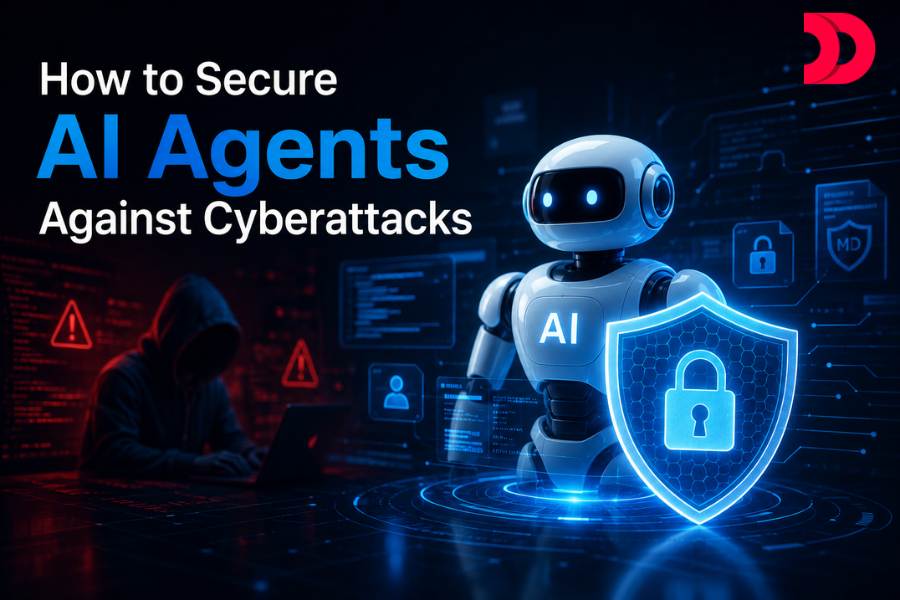
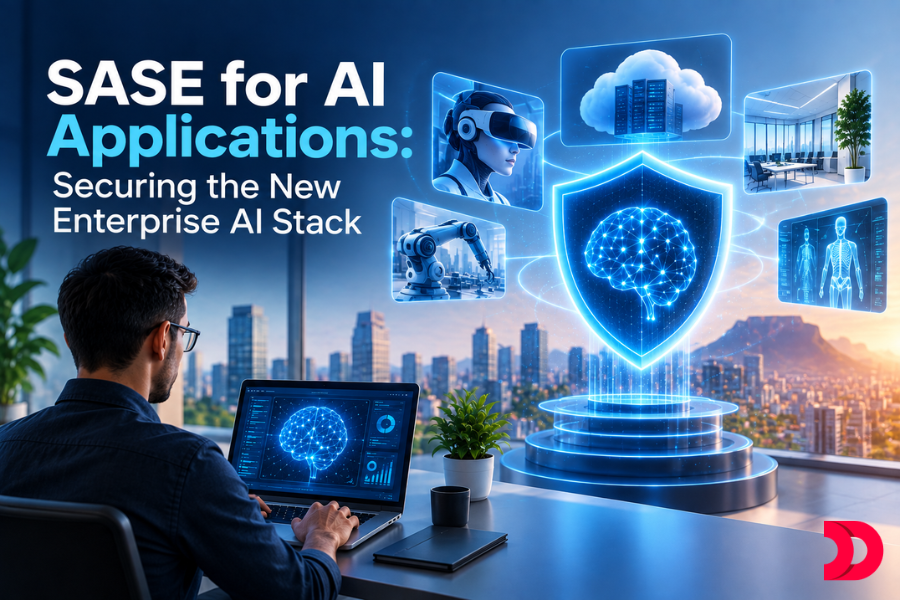
Artificial intelligence (AI) has become prevalent in modern enterprises. As this technology reaches a mature operational level, the corporate sector witnesses the integration of various stacks into the system. Intelligent agents, LLMs, inference pipelines, and autonomous data retrieval agents have become a part of core enterprise workflows. This proliferation has, however, introduced severe operational and surface vulnerabilities. AI cybersecurity services must address this challenge.
Legacy network boundaries cannot defend against cyberattacks on AI-powered systems. Enterprise infrastructure teams may find it difficult as well due to their other priorities. In such a scenario, companies need to opt for LLM security services and AI cybersecurity services. Secure Access Service Edge (SASE) can provide the necessary security for artificial intelligence workloads.
Let’s take a closer look at SASE’s role in the enterprise AI stack. We will start with the evaluation of security gaps.
Evaluation of Security Gaps in Enterprise AI
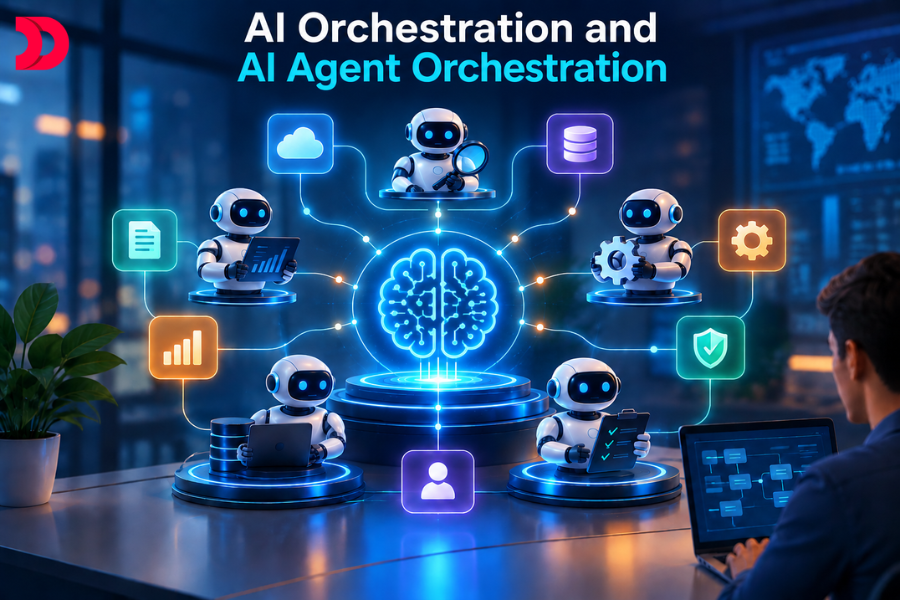
A standard enterprise AI architecture comprises multiple independent and highly complex layers. These layers include distributed data repositories, specialized vector databases (like Pinecone), agentic orchestration frameworks (like LangChain), etc. This AI stack also includes various custom model endpoints and conversational client interfaces.
Businesses can architect sophisticated and multi-tiered AI solutions by partnering with a reputable AI software development company. These intelligent solutions drive automation across various sections or departments. It is, however, necessary to keep in mind that every single interface between these internal layers introduces a distinct threat vector. It may act as a potential point for a security breach.
Legacy firewalls, static perimeter switches, and VPNs (Virtual Private Networks) do not track applications in much detail. This is a reason why they cannot inspect structured JSON payloads, vector query embeddings, or streaming SSE responses from LLMs. Enterprise infrastructure remains blind to operational threats and vulnerabilities without proper payload inspection.
Some of the key vulnerabilities in unsecured AI workloads include:
- Data Exfiltration via Prompts
Employees intentionally or unintentionally upload sensitive information into public LLMs. This can be anything from IP, Personally Identifiable Information, to internal source code. Management has no idea about it until it becomes a bigger problem.
- Indirect Prompt Injection
External data sources, web pages, or integrated documentation feed malicious hidden instructions into background AI retrieval agents. It causes autonomous system hijacking.
- Data Poisoning & Vector Manipulation
Unauthorized access or malicious tampering with document embedding stores and RAG (Retrieval-Augmented Generation) vector databases can hamper model reasoning. It causes issues with vectors.
Rogue internal development or when business teams leverage unvetted third-party APIs without enterprise access governance or security approval, it may increase vulnerabilities.
- Model Inversion & Weight Theft
Exploiting exposed API endpoints to reverse-engineer proprietary fine-tuned weights makes the system vulnerable. Model inversion is another major issue. , In this, targeted prompt sequences extract the underlying training data.
Here, SASE (Secure Access Service Edge) comes into play.
Role of SASE in Securing AI Applications
SASE unifies Software-Defined Wide Area Networking (SD-WAN) with identity-centric, cloud-native security functions. Some major functions of SASE are Zero Trust Network Access (ZTNA), Secure Web Gateway (SWG), and Firewall-as-a-Service (FWaaS). Cloud Access Security Broker, or CASB, is also one of its major features.
SASE acts as an intelligent, high-speed inline proxy in enterprise AI stacks. It governs every interaction between end users, internal data vectors, autonomous software agents, and backend microservices. SASE applies granular security policies directly to individual data flows instead of securing physical perimeters. These data flows can be based on real-time user context, device posture, geographic location, and payload content.
AI-aware ZTNA is a core pillar of SASE. It operates on the principle of “never trust, always verify”. It makes sure that authorized microservices, along with identities, can reach the API endpoints for models. It also covers read and write actions inside enterprise AI applications.
Even if an attacker gains access to a part of an internal network, ZTNA policies stop any querying of those corporate knowledge bases.
SASE also eliminates the traditional trade-off between security and network performance. It minimizes network latency for real-time model inference while enforcing compliance guardrails on every transaction. SASE deploys AI-inspection policies at edge point-of-presence (PoP) locations across global cloud networks. Organizations can integrate AI cybersecurity services into SASE architecture to safeguard their applications.
Key Security Components within AI-Optimized SASE Pipelines
Comprehensive AI cybersecurity services are necessary for deploying SASE for intelligent applications. These services are designed to parse and inspect contextual AI telemetry in real time. Standard Web Application Firewalls (WAFs) can inspect traffic for legacy vulnerabilities like SQL injection, XSS, or buffer overflows. Specialized AI security goes deeper by inspecting conversational context and semantic intent with vector representations.
Here are the major security components of a SASE pipeline:
- Data Loss Prevention (DLP)
Advanced inline DLP engines use specialized NLP (Natural Language Processing) models to detect PII, financial metrics, and proprietary source code within prompt payloads. This can prevent semantic data loss effectively.
Real-time behavioral monitoring and circuit breakers can prevent service denial attacks and model abuse. Such attacks or runaway compute expenditure result from recursive sub-agent loops or malfunctioning agentic workflows.
Automatic sanitization and filtering of LLM outputs in real-time to prevent accidental disclosure of system prompts, backend connection strings, and confidential metadata. These egress guardrails also prevent hallucinated malicious code links.
- Context-Aware API Gateways
Dynamic authentication layers in SASE can bind AI interactions to user identities. It is necessary to ensure that vector searches only return documents the user is explicitly authorized to view in underlying systems like SharePoint.
The AI model also needs dedicated LLM security services to ensure safety across the lifecycle. These services can combine with SASE networking to create a resilient, multi-layered defense model.
Specialized LLM Security Services Across AI Model Lifecycle
LLM security services are capable to mitigate vulnerabiltieis identified in the OWASP TOP 10 for Large Language Model Applications. Here is a quick table comparing the combined security of LLM defense with SASE and traditional network defense.
| Threat Vector |
Traditional Network Defense |
SASE + Dedicated LLM Security Defense |
| Direct Prompt Injection |
Blocked and cannot parse semantic internet or natural language structure within payloads |
Inline Guardrails scan and neutralize adversarial jailbreakers, system overrides, and prompt manipulation |
| Data Leakage via RAG |
Blocks and inspects network packets without document permission awareness |
Context-aware ZTNA validates user identity and document-level permissions dynamically before vector index querying.
|
| Unsecured API Integrations |
Blocks and allows open HTTPS connections once the transport authentication passes. |
CASB and FWaaS enforce strict policy controls, API payload validation, and token billing thresholds over calls. |
| Model Inversion & Extraction |
Blocks and sees standard traffic without observing query repetition or response patterns. |
Behavioral anomaly engines monitor query volume and distribution to detect systematic reverse-engineering attempts. |
Enterprise security teams can isolate model execution environments effectively by enforcing zero-trust execution contexts at the SASE edge. They can prevent the compromised autonomous LLM agent from making unauthorized lateral calls to underlying corporate databases using SASE boundary rules.
Why Partner with AI Security Consulting Company
The convergence of enterprise cybersecurity and cloud network architecture is difficult and complex. An established AI security consulting company empowers modern enterprises to assess their current risk posture systematically.
It also performs thorough threat modeling on existing data pipelines and prepares a future-proof SASE deployment strategy. A strategic and multi-purpose SASE deployment roadmap includes AI asset discovery, data flow mapping, zero trust policy definition, and SASE guardrail integration.
A reputable AI software development company also offers continuous monitoring and red teaming as needed. It helps your company establish auditing and automated logging frameworks to demonstrate compliance with international regulatory frameworks.
Concluding Remarks
An architectural evolution is necessary to secure the modern enterprise AI stack effectively. Companies should consider advanced security aspects, including embedding intelligent AI security guardrails directly within a unified, cloud-native SASE edge. Partner with a reliable AI consulting company that helps you adopt AI while maintaining complete command over data integrity, brand safety, and operational resilience.









 Sep 14, 2026