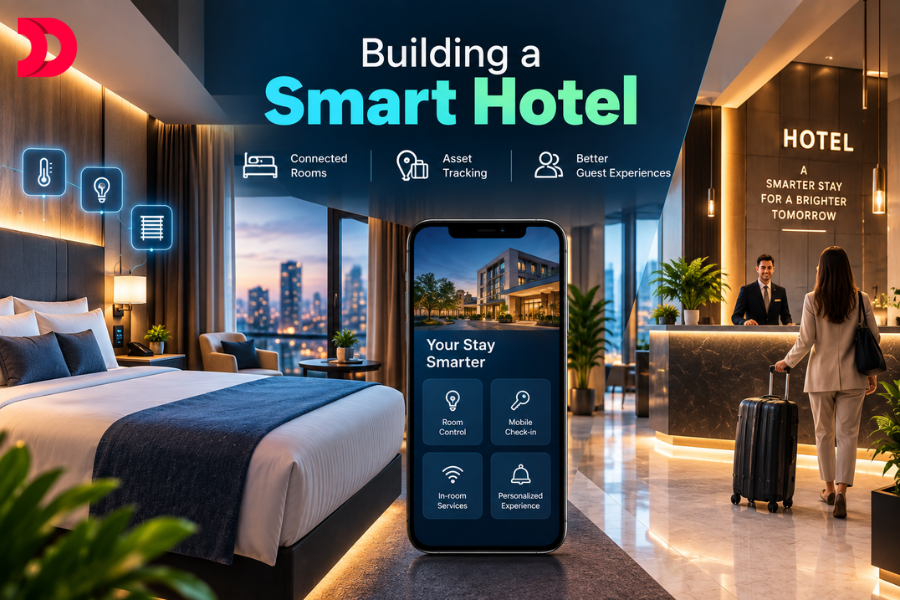
The hospitality sector witnesses a massive shift in terms of customer expectations, bookings, and occupancies. Yesterday’s luxury was defined by plush carpets, and today’s luxury is defined by seamless experiences. Modern travelers cannot wait in a queue at the front desk. They do not prefer to spend a few minutes finding the switch that turns off the bedside lamp as well.
Enter the IoT (Internet of Things). Whether it is physical hardware or intelligent cloud networks, an IoT app development company can maintain a subtle balance. It enables hoteliers to transform the travel experience and asset tracking operation fundamentally. This blog talks about the ‘Smart Hotel’ concept with the help of IoT. We will dig deep into the IoT app development benefits in terms of connected rooms, asset monitoring, and guest experience.
Pillars of Smart Hotel
Modern hotel strategy rests on three interconnected pillars- room control, asset visibility, and personalized service delivery. Hotels or resorts can hire IoT app developers who can take care of these pillars.
The guest room has significant importance in any hotel. IoT converts this room to an adaptive environment which is tailored to the individual choices. Bluetooth Low Energy (BLE) and Near Field Communication (NFC) enable guests to bypass the front desk entirely. They can unlock their doors using smartphones. Connected HVAC systems and smart switches allow guests to set room temperature and ambience through a dedicated mobile app.
Automated energy management consists of smart motion sensors and door contacts that can save energy. An experienced mobile app development company ensures that these backend IoT hardware protocols communicate with a robust, advanced app solution.
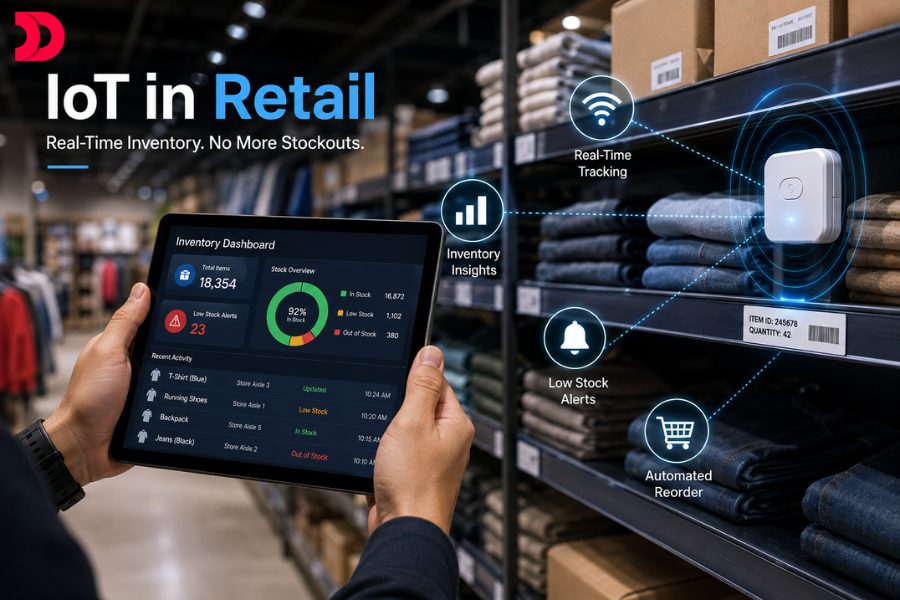
Backend asset tracking is also essential for hotels to measure the ROI properly. Managing a large property requires real-time monitoring of various moving parts from luggage carts to kitchen equipment. Real-time location systems (RTLS) enable the hotel staff to pinpoint equipment immediately through an interactive dashboard. These systems work on BLE and RFID tags. Staff safety and panic buttons are necessary for ensuring security of housekeepers.
IoT vibration and temperature sensors are attached to critical infrastructure like commercial boilers and HVAC chillers. These sensors can monitor equipment health in real time. Hoteliers can hire IoT app developers with understanding of hardware protocols like MQTT to build monitoring tools.
Taking care of the guest’s needs is a primary task of a hotel or resort. Core IoT app development benefits in the hospitality sector focus on eliminating friction points along the guest journey. Here is a quick table containing the relationship between various stages of the guest journey and related smart experiences.
| Guest Journey Stage |
Traditional Experience |
Smart Hotel Experience |
| Arrival |
Wait in line at the desk; receive physical plastic keycards. |
Mobile check-in on the taxi ride; digital key delivered to phone. |
| Entry in the Room |
Dark room, hot/cold air, hunting for switches. |
The room detects arrival; lights activate soft ambient mode; climate pre-set. |
| Service Requests |
Call the front desk; wait for a staff member to pick up. |
One-tap app request for extra towels or room service. |
| Check-Out |
Review printed bill at desk; return keycards. |
In-app review and one click check-out. |
A mobile app development company can integrate technology into the hotel’s IoT network.
Technical Architecture of Smart Hotel Application
Building an IoT application for hotels required a multi-layered architecture. Devices broadcast signals securely to local gateways, which push data to cloud servers. These servers are useful for handling guest-facing mobile applications and staff management dashboards. When you work on a smart hotel project, it is better to partner with an experienced IoT app development company. It helps you ensure this multi-tiered architecture remains stable and scalable.
Key Implementation Challenges of IoT-Based Apps
IoT-enabled smart hotel solutions offer many benefits. However, their implementation may pose some practical hurdles. Following are some of the major implementation challenges of IoT-based apps for hotels.
- Interoperability and Legacy Systems
Usually, hotels run legacy Property Management System (PMS), Point of Sale (POS) tools, and older HVAC hardware. These systems create issues and difficulty in integrating new smart sensors. This requires specialized middleware and custom APIs with expertise of a team of dedicated developers. It will reduce challenges related to interoperability and legacy systems.
- Cybersecurity & Data Privacy
A connected hotel has many points and a vast surface for cyber attacks. This is dangerous for the customer’s valuable and sensitive information’s safety. Smart locks, guest payment credentials, and personal preferences are inevitable for ensuring data privacy. Hotels must comply with encryption protocols (such as AES-256) and privacy-related standards.
- Network Infrastructure & Reliability
What if guests are locked out of their rooms when the Wi-Fi or mesh network goes down? This can damage the reputation of a hotel significantly. Smart hotel architectures, therefore, must include edge computing capabilities, enabling room controls, and digital keys to function locally.
These capabilities and local digital news can work well even if the internet temporarily drops.
All these hurdles are based on both software and hardware. It is, therefore, necessary to choose the right mobile app development company with proven hardware-integration experience. Such a development company can help you avoid costly project delays and other issues.
Concluding Remarks
A smart hotel app development process consists of auditing existing infrastructure, defining high-value use cases, choosing the right development team, and running a pilot program. Transformation of your hotel through a custom IoT solution is a strategic move in this digital era. It assists you to leverage the IoT app development benefits. You can also protect operating margins while building real brand loyalty with a smart hotel solution.
DevsTree IT Services is a trusted IoT app development company. Our in-house team of experienced IoT developers can build a smart hotel solution for a modern digital traveler. Contact us to discuss your hotel’s requirements and the scope of advancing technology to gain a technical edge.











 Oct 22, 2026