Millions of apps are available on app stores today, but only a small percentage generate meaningful revenue. Many app creators spend months developing an app only to realize they have no clear monetization strategy. Others believe they need millions of downloads before earning money.
The truth is different.
You can make money from an app even with a relatively small user base if you choose the right monetization model. Whether you are planning to build your own app or looking for ways to earn through existing money making apps, there are multiple proven methods available.
In this guide, you’ll learn exactly how to make money from app development, which revenue models work best in 2026, and how successful developers combine different monetization strategies to maximize profits.
Expert Insight
Having worked with startups and enterprises on mobile app development projects, we’ve seen that app success depends less on download volume and more on choosing the right monetization strategy. Many profitable apps generate consistent revenue with a relatively small but highly engaged user base.
Industry Insight
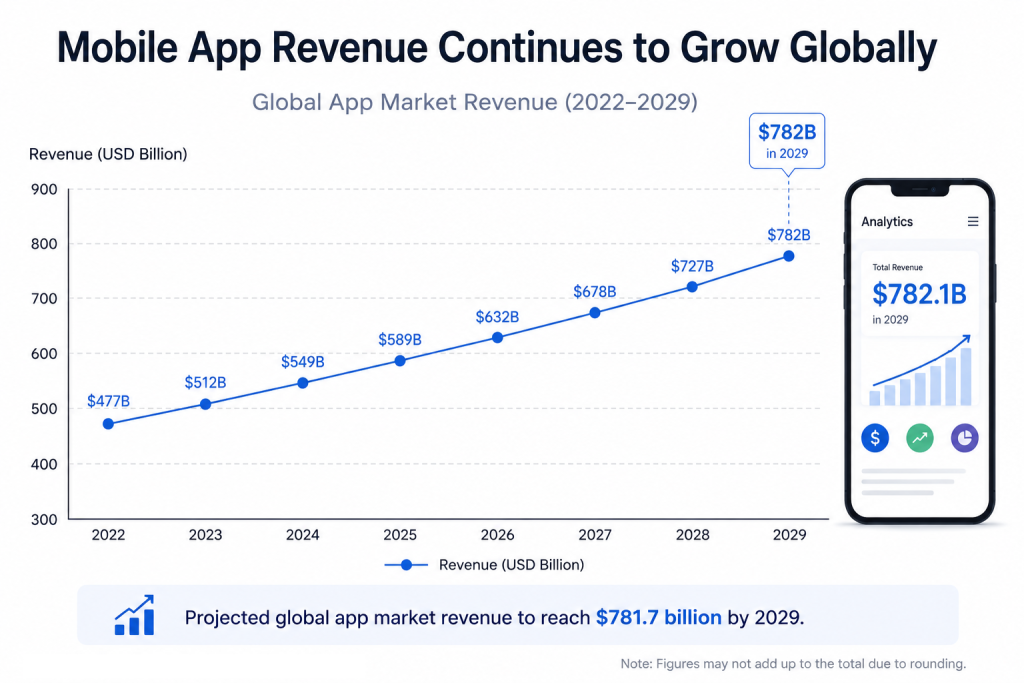
According to Statista, mobile app revenue continues to grow globally, with subscription-based apps becoming a major contributor across productivity, fitness, and entertainment categories.
How Does an App Make Money?
Apps make money through subscriptions, in app purchases, advertising, affiliate marketing, sponsorships, and premium upgrades. Most successful apps combine multiple revenue streams instead of relying on a single monetization method, creating a stable and scalable business model.
App monetization is the process of generating revenue from mobile app users. Different app categories use different approaches.
For example:
- Fitness apps often use subscriptions.
- Mobile games rely on in-app purchases.
- News apps use premium memberships.
- Utility apps combine ads and premium upgrades.
Popular app revenue models include:
Subscription Model
Users pay monthly or yearly fees.
Examples:
- Fitness apps
- Language learning apps
- AI productivity tools
- Meditation apps
Benefits:
- Predictable recurring revenue
- Higher customer lifetime value
- Stable business growth
In App Purchases
Users buy digital products inside the app.
Examples:
- Extra game lives
- Virtual currencies
- Premium stickers
- Additional storage
Advertising Revenue
Developers display advertisements through networks like Google AdMob.
Common ad formats:
- Banner ads
- Interstitial ads
- Rewarded video ads
- Native ads
Affiliate Marketing
Apps recommend products or services and earn commissions from purchases.
Based on our experience developing mobile applications across fitness, healthcare, education, and eCommerce industries, subscription and freemium models continue to be among the most sustainable monetization approaches. They allow businesses to balance user acquisition with long-term revenue growth.
How Much Money Can an App Make?
An app’s earning potential varies widely. Small niche apps may earn a few hundred dollars monthly, while successful subscription apps can generate thousands or even millions of dollars per year. Revenue depends on downloads, user engagement, retention, and monetization strategy.
Several factors influence app earnings:
User Base
More active users generally create more revenue opportunities.
For example:
- 1,000 active users
- 10,000 active users
- 100,000 active users
Each growth stage increases monetization potential.
Industry Insight
According to Statista, global mobile app revenues are expected to exceed hundreds of billions of dollars annually, driven largely by subscriptions, in-app purchases, and mobile gaming. This growth demonstrates the increasing opportunities available for app founders and businesses.
Revenue Per User
Revenue per user often matters more than downloads.
Example:
- 1,000 paying subscribers at $10/month = $10,000 monthly revenue
- 100,000 free users with poor monetization = less income
App Category
Certain niches typically generate higher revenue:
- Finance apps
- Productivity apps
- Health and fitness apps
- Education apps
- AI powered applications
Retention Rate
Users who stay longer generate significantly more revenue through subscriptions, purchases, and referrals.
The highest earning apps focus heavily on retention before scaling user acquisition.
How To Earn Money From Apps?
The best ways to make money from an app include subscriptions, freemium upgrades, in-app purchases, affiliate marketing, advertising, sponsorships, and selling digital products. The ideal method depends on your app category and audience behavior.
Here are the most effective app monetization methods:
1. Subscription Revenue
Subscriptions are currently among the most profitable app business models.
Best for:
- SaaS apps
- Fitness apps
- AI apps
- Educational platforms
Benefits:
- Recurring income
- Predictable growth
- Higher business valuation
Real-World Example
Popular apps such as Headspace, Calm, and Duolingo have successfully built subscription-based business models by offering premium content, advanced features, and personalized experiences. Their success demonstrates how recurring revenue can support long-term growth while delivering ongoing value to users.
2. Freemium Model
Users access basic features for free while advanced functionality requires payment.
Examples:
- Premium templates
- Advanced analytics
- AI features
- Unlimited usage
Real-World Example
Many leading productivity and collaboration apps use the freemium model, allowing users to experience core functionality before upgrading to premium plans. This approach reduces adoption barriers while increasing conversion opportunities.
3. In App Purchases
Especially effective for gaming apps.
Popular purchases include:
- Coins
- Skins
- Characters
- Power ups
4. Advertising
Advertising remains one of the easiest monetization methods.
Common ad types:
- Banner ads
- Video ads
- Rewarded ads
Industry Example
Many free mobile games rely on rewarded video ads, where users voluntarily watch advertisements in exchange for in-game rewards. This model helps generate revenue while maintaining a positive user experience.
Must Read : AI App Development Process: From Idea to Launch
5. Affiliate Marketing
Promote relevant products within the app.
Examples:
- Finance apps promoting credit cards
- Travel apps recommending hotels
- Fitness apps recommending equipment
6. Sponsorship Deals
Brands pay to reach your audience.
This works especially well when your app serves a targeted niche market.
What We Recommend
When advising clients on app monetization, we typically recommend validating user engagement before aggressively monetizing. Apps with strong retention rates often generate significantly higher lifetime revenue than apps focused solely on acquiring new users.
How Do Free Apps Make Money?
Free apps primarily make money through advertisements, in app purchases, subscriptions, affiliate marketing, sponsorships, and premium feature upgrades. Offering free access helps attract users while monetization occurs through additional services or user actions.
Many of the world’s most profitable apps are free to download.
Examples include:
- Social media apps
- Gaming apps
- Streaming platforms
The reason is simple.
Removing upfront payment barriers increases downloads significantly.
Common free app monetization models include:
Advertising Revenue
Users view ads while using the app.
Developers earn money through:
- Impressions
- Clicks
- Video views
Freemium Upgrades
Basic features remain free.
Premium features require payment.
Examples:
- Extra cloud storage
- Advanced editing tools
- AI powered features
Subscription Access
Free users experience limited functionality.
Premium subscribers unlock:
- Full content access
- Unlimited usage
- Advanced capabilities
This model creates a larger user base while still generating recurring revenue.
How Can Beginners Create a Profitable App?
Beginners can create profitable apps by solving a specific problem, validating market demand, building a minimum viable product, choosing the right monetization strategy, and continuously improving user experience based on feedback and analytics.
Building a profitable app does not require a huge budget.
Follow these steps:
Step 1: Identify a Problem
Successful apps solve real user problems.
Examples:
- Budget tracking
- Habit building
- Study planning
- Fitness coaching
Step 2: Validate Demand
Research:
- App Store reviews
- Google trends
- Online communities
- Competitor apps
Look for recurring complaints.
Those complaints become opportunities.
Step 3: Build an MVP
An MVP includes only essential features.
Benefits:
- Faster launch
- Lower costs
- Real user feedback
Step 4: Choose Monetization Early
Do not wait until launch.
Plan revenue generation from the beginning.
Options include:
- Subscription model
- Freemium model
- Advertising
- Affiliate marketing
Step 5: Optimize User Retention
Retaining users is cheaper than acquiring new ones.
Focus on:
- User onboarding
- App performance
- Push notifications
- Customer support
Case Study
Want to see a real-world example? Read our case study on how a mobile application achieved 1M+ downloads through strategic product development, user engagement, and app store optimization.
Can You Make Money Without Creating Your Own App?
Yes. You can earn money using existing money making apps that reward users for surveys, gaming, product testing, shopping, and market research participation. While earnings are typically lower than owning an app, they can provide extra income.
Several platforms allow users to earn rewards directly from their smartphones.
Popular examples include:
Users earn points by:
- Watching videos
- Shopping online
- Taking surveys
- Completing offers
A market research platform that rewards users for participating in consumer surveys.
Users earn cash for:
- Reading emails
- Surveys
- Gaming
- Online activities
Designed for mobile gamers.
Users earn rewards by:
- Discovering new games
- Reaching milestones
- Staying active
Although these apps won’t replace a full time income for most users, they can provide supplemental earnings.
Advanced App Monetization Strategies
Once your app gains traction, consider combining multiple revenue streams.
Hybrid Monetization
Combine:
- Subscriptions
- Advertising
- Affiliate marketing
This reduces dependence on one revenue source.
Personalized Offers
Use user behavior data to present relevant premium features.
Benefits:
- Higher conversions
- Better user experience
Referral Programs
Reward users for inviting friends.
Advantages:
- Lower acquisition costs
- Faster organic growth
Premium Content
Offer exclusive:
- Courses
- Templates
- Tools
- Resources
Digital products often generate high profit margins.
Common App Monetization Mistakes to Avoid
Many developers lose revenue because of avoidable mistakes.
Too Many Ads
Excessive advertising damages user experience.
Weak Retention
Acquiring users is expensive.
Keeping them engaged is critical.
Ignoring Analytics
Track:
- User behavior
- Conversion rates
- Churn rate
- Revenue per user
Delayed Monetization Planning
Monetization should be integrated during product planning.
Not after launch.
Copying Competitors Blindly
Every audience behaves differently.
Test multiple monetization models before scaling.
Expert Recommendation
Before selecting a monetization model, analyze your audience behavior, retention metrics, and competitive landscape. The most successful apps rarely depend on a single revenue stream. Instead, they combine subscriptions, premium upgrades, advertising, and partnerships to create a more stable business model.
Conclusion
Learning how to make money from app development is no longer limited to large technology companies. Independent developers, startups, and even solo creators are building profitable mobile businesses every day.
The most successful apps usually combine subscriptions, freemium upgrades, in app purchases, affiliate marketing, and advertising to create multiple revenue streams. The key is solving a real problem, retaining users, and continuously optimizing monetization.
If you’re planning to launch an app, start with a clear business model from day one. Focus on delivering value first, then scale your revenue through the monetization methods that fit your audience best.
The sooner you start testing and learning, the faster you’ll discover what works for your app.
Frequently Asked Questions
FAQ's
Simple apps can cost a few thousand dollars, while advanced apps may require tens of thousands depending on features and development complexity.
Subscriptions are generally considered the most profitable because they generate recurring monthly revenue.
Yes. Free apps commonly earn through ads, subscriptions, affiliate marketing, and in app purchases.
There is no fixed number. A small audience with high paying subscribers can earn more than a large audience with poor monetization.
Finance, productivity, health, education, AI, and business apps typically generate strong revenue.











 Oct 22, 2026