Sales pipelines expand, and hiring cycles accelerate- all these indicators highlight a hyper-growth phase of your enterprise. It is, however, necessary to consider that every operational element stretches to its limit in this phase. One such aspect is information technology infrastructure. IT system evaluation at regular intervals is therefore essential for expanding businesses.
Software systems, communication tools, and security measures, sufficient for a team of 30 people, can cause a lot of trouble for a team of 150 people or more. It may result in fragmented tools and unoptimized database architectures that slowly erode efficiency and productivity. A systematic IT system evaluation can help companies address these issues effectively. A reliable IT consulting services provider does a thorough audit and assessment to get a clear picture.
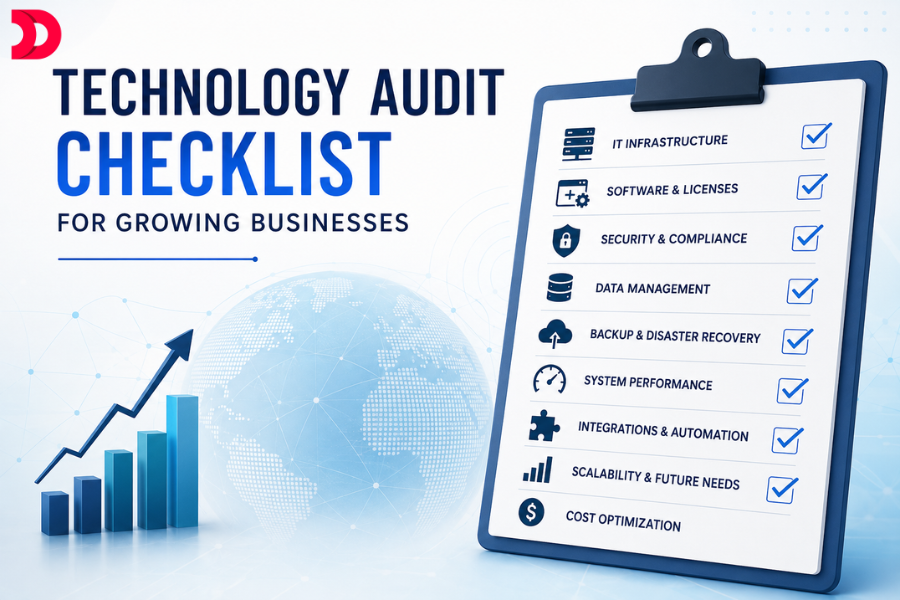
Here is a comprehensive and useful audit checklist for growing businesses. It will help entrepreneurs navigate scale seamlessly and maximize return on investment (ROI).
Strategic Technology Audit Checklist
We can strategize a technology audit in four aspects. These major factors are-
- Cyber Security Defense and Compliance
A growing business is usually a soft target for sophisticated cyber attacks. When a business expands to new regions, it is necessary to comply with a complex web of respective standards and regulations.
You should verify that every device connected to your network has centralized EDR (Endpoint Detection and Response) software. This includes remote employee laptops and tablets.
- IAM (Identity Access Management)
Businesses should implement both Role-Based Access Control (RBAC) and Multi-Factor Authentication (MFA) across every login layer.
- Data Encryption Pipelines
Companies should confirm that sensitive records, financial ledgers, and proprietary source codes have two-way encryption at both the ends.
Enterprises can review their compliance status regularly against global data privacy frameworks. Some examples of frameworks are GDPR, HIPAA, or local data protection standards.
Apart from these steps, it is essential to ensure that the infrastructure is capable to withstand cyberattacks, technical failures, and a rise in traffic.
- Infrastructure Resilience and Cloud Scalability
Prolonged downtime is dangerous for growing businesses. It is, therefore, necessary to ensure that network infrastructure is resilient enough to sustain spikes in traffic. It should be capable of recovering instantly from unexpected technical glitches. Companies can audit their cloud computing instances, like AWS or Google Cloud. This can help them identify unused servers or expensive data egress pathways and save on monthly operational expenditures.
Disaster Recovery (DR) and backup testing are also important for growing businesses. You can schedule quarterly failover drills. Such drills can verify that all disaster recovery protocols are ready to restore business operations within minutes of a failure. Finally, companies can run diagnostic checks on localized networking hardware, switches, and firewalls. This can ensure the capability of the network to manage increased device volumes.
- Application Portfolio and System Integration
The growth phase leads companies to a phenomenon where different departments purchase solutions independently. It results in isolated data silos and companies need to pay redundant software licensing fees. Companies can map out every active software subscription and identify their overlapping or redundant features. This is necessary to make a consolidated enterprise agreements.
Another aspect is evaluating the stability of connections between core software suits, including CRM, ERP, and financial monitoring systems. Finally, companies can locate their legacy tools that rely on outdated frameworks. It is essential to make a clear roadmap to replace or containerize these systems before they cause any threat to the system.
- Data Engineering and Analytics Maturity
Data is the most valuable and strategic asset for any enterprise. Rapid and proper analysis of data can produce actionable insights, and the audit of your primary databases is the first step for it. Data auditing identifies slow-running queries or structural issues that delay loading speed for the application.
The next step should be establishing centralized definitions for core business metrics. You need to clean fragmented data stores to get a single, undisputed version of truth. This can help the company management to make insightful decisions. Both these steps bring maturity in the data analysis process.
Apart from this technology audit checklist, you should consider infrastructure assessment metrics.
Operational Infrastructure Assessment Matrix
It is essential to categorize your findings into an operational matrix on the basis of business impact and system urgency. Here is a quick table showing each pillar of infrastructures and high-risk indicators.
| Infrastructure Pillar |
Diagnostic Target |
High-Risk Indicator |
| Cyber Security |
Identity Access & Logs |
Shared passwords, lack of MFA (Multi Factor Authentication), unmonitored employee access |
| Cloud Systems |
Compute Resource Waste |
Unused virtual machines, unpredictable monthly bills |
| Integrations |
Cross-Platform Workflows |
Manual copy-pasting of data between ERP and CRM |
| Business Continuity |
Disaster Recovery |
Backups exist but have never been tested for restoration |
A reputable data engineering company can help you assess these metrics and address the execution gap.
How to Address the Execution Gap
The execution of a comprehensive infrastructure audit inside a live, fast-moving business is a complex task. If your organization’s IT team is managing daily help desk tickets and deploying software updates, it is more cumbersome to review a high-level system. Internal evaluations can occasionally suffer from tunnel vision as well. Teams that have spent years building manual workarounds to bypass rigid software constraints may develop blind spots gradually.
A global IT consulting services provider can address this execution gap efficiently. An external consulting company blends deep industry expertise and standardized assessment frameworks. It brings completely objective perspectives to the technology stack. This firm can make a prioritized, risk-mitigated technical roadmap in line with your budget and long-term business goals. You can hire technology consultants to address challenges of execution effectively.
Roadmap for Strategic Audit You Need to Know
A structured, phased approach can achieve a sustainable, scalable IT ecosystem. Here is a roadmap for effective technology audit.
- Discovery and Asset Mapping
You should document every piece of physical hardware, cloud-hosted platform, and software subscription across your company.
- Risk and Vulnerability Analysis
It is essential to evaluate digital assets against modern performance, cost, and security standards. You should also classify vulnerabilities based on their impact.
This step involves the remediation rollout with priority for the highest-risk items such as porous security access boundaries and database vulnerabilities.
- Establish Oversight Protocols
You can turn your technology audit from a one-off panic response into a regular, automated corporate routine by establishing continuous monitoring tools and scheduling.
It is better to consult a leading IT consultant to make a proper roadmap of technology audit.
Concluding Remarks
We cannot treat technology infrastructure as an isolated and backend department in today’s hyper-competitive digital landscape. Your digital stack can act as an engine that empowers your company’s growth and offers it competitive edge. Conducting a systematic IT system evaluation is therefore essential. It ensures that your company can stay firm against vulnerabilities. Premium IT consulting services can build scalable system architectures to protect your margins.
DevsTree IT Services offers you a clear pathway to effective technology audit. You can hire technology consultants who can transform your technical stack into valuable assets through an effective roadmap for corporate success. Contact us to learn more about the scope and benefits of regular technology audits for your company.









 Oct 01, 2026