Top Reasons Companies Are Moving to Hybrid Cloud Solutions
On-premise or private cloud and public cloud approaches have made the entrepreneur’s life easy. In this competitive business scenario, however, it is not enough to implement a single concept. The world’s most successful enterprises have realized the importance of hybrid cloud infrastructure. Hybrid cloud solutions are essential for modern businesses in multiple ways. Some of them include the management of data compliance and legacy dependencies while addressing scaling requirements. .
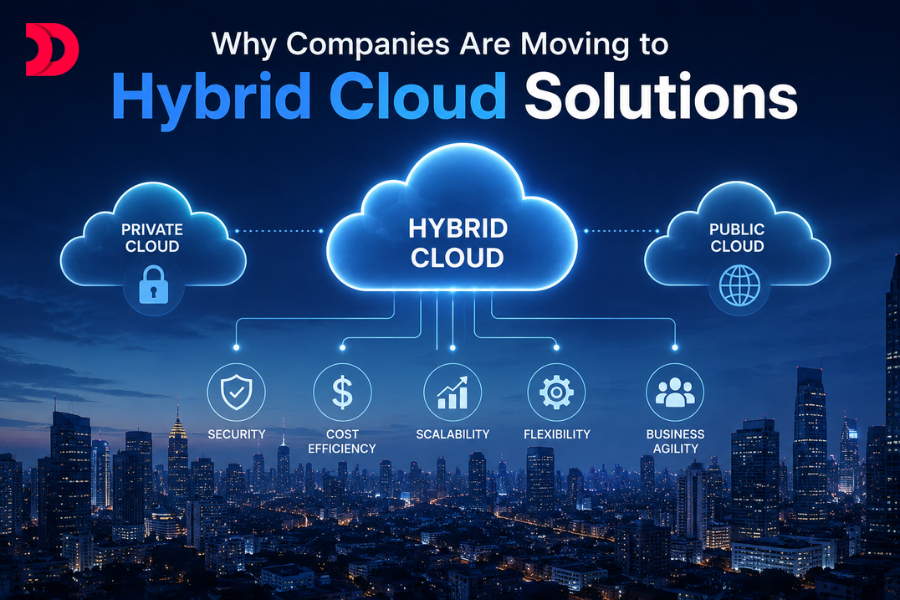
A hybrid cloud approach involves private infrastructure with public cloud platforms like AWS, GCP, or Microsoft Azure. Businesses can get the best of both worlds by enabling their data and applications to move seamlessly between these environments. It gives absolute security and control of private systems with the flexibility and scalability of the public cloud. Partnering with an experienced hybrid cloud development company helps businesses implement this model.
Here is a detailed analysis of why the global companies should opt for hybrid cloud architecture. We will start with the importance of hybrid cloud solutions.
Hybrid Cloud Movement- Gain Flexibility without Compromise
A standard public cloud environment offers shared computing resources across a multi-tenance architecture. It is highly scalable for consumer-centric apps or testing environments. But, it creates friction for core enterprise applications that need ultra-low latency or isolated database processing. Hybrid cloud solutions can help companies get rid of this challenge through their specific operational characteristics.
When it comes to handling eCommerce platforms, analytical tools, and customer portals, auto-scaling is important. This can help you handle massive spikes in seasonal traffic on the public cloud.
Whether you want to keep proprietary source codes or historical records securely inside a private cloud, core or static workloads are essential . It can help you avoid volatility and data processing fees.
One-size-fits-all model is not suitable in meeting complex and diverse business requirements. A reliable cloud migration company can help you gain the advantage of hybrid solutions.
5 Reasons Global Companies Opt for Hybrid Cloud
Cloud computing technology is highly cost-efficient and scalable. Here are the top five reasons why companies prefer hybrid cloud infrastructure these days.
- Cost Optimization and Financial Predictability
Many companies get massive monthly bills for hosting data-heavy production workloads in the public cloud continuously. Egress fees (the cost of moving data out of a cloud environment) and unstructured storage costs can erode corporate margins quickly. A hybrid model can fix this issue by enabling you to keep baseline transactional data on internal infrastructure. You can leverage the public cloud for bruising computing power during peak season.
This financial predictability enables your company to use capital toward product innovation.
- Adherence to Global Data Compliance
When your company operates globally, it needs to meet regional data privacy regulations, such as GDPR in Europe. These laws make it mandatory for companies to store and process specific citizen data within national physical borders. A robust hybrid cloud infrastructure makes it possible by enabling companies to act as a localized entity in every market. You can rout sensitive personal identifiable information (PII) to run within local private storage centers.
This setup is useful for ensuring seamless compliance without compromising on expansion.
- Business Continuity and Disaster Recovery
It is risky to rely completely on a single public cloud vendor. If that provider experiences a regional outage, your entire business operations will get affected. On the other hand, it is highly expensive to maintain a duplicate physical data centre for backup purposes. Hybrid cloud frameworks can give an elegant solution to this issue and maintain business continuity.
Organizations can utilize their private cloud for daily products tasks and maintain an automated, real-time pipeline to a public cloud environment. This can help in DR (Disaster Recovery) and ensure zero operational downtime.
- Leveraging DevOps for Modernization
Established enterprises may find it difficult to discard legacy core systems completely. These legacy applications have fundamental business logic that keeps companies operational. A reputable cloud migration company can help such enterprises bridge the gap between legacy systems and new approaches. It builds advanced, containerized microservices on the public cloud to keep legacy data elements secure through APIs.
This approach assists global enterprises to leverage modern mobile applications without disruption.
- AI and Machine Learning Benefits
This is one of the key reasons for moving to hybrid cloud. Companies can maintain complete ownership of their training data inside a secure private infrastructure. They can push anonymized subsets of that data security into public cloud ML pipelines to train models. The lightweight operational model can be deployed back to private infrastructure after getting trained. This can maximize data privacy while utilizing AI processing power at a global level.
Hybrid cloud consulting services can assist companies understand the benefits of this approach and give a proper migration strategy.
How to Mitigate the Complexity while Moving to Hybrid Cloud
Managing a hybrid environment introduces real operational complexity. Specialized technical knowledge with deep insights of current trends is essential to manage security policies across both environments. Companies can hire cloud engineers who have expertise in advanced tools like Kubernetes and network security protocols. Managed cloud consulting services can help companies with a professional diagnostic assessment and an optimization roadmap.
Cloud Migration Framework for Global Enterprises
A systematic and phased execution plan is essential to ensure zero data loss while transitioning to a hybrid state. Here is a standard cloud migration framework in the form of a quick table.
| Phase |
Core Objective |
Key Activities |
| Assessment |
Infrastructure Audit |
Measure dependencies, evaluate legacy systems, and analyze data compliance |
| Architecture |
Hybrid Environment Design |
Establish secure VPNs, build identity access management (IAM) |
| Pilot Migration |
Low-Risk Validation |
Migrate non-critical microservices or test environments |
| Integration |
Macro-Scale Rollout |
Move production databases, connect API layers, initiate automated MLOps |
A reputable cloud migration company can manage all these phases with an end-to-end data transfer pipeline. This will keep daily operations completely unaffected throughout the transition.
Concluding Remarks
A robust hybrid cloud infrastructure gives global businesses the computational agility without forcing them to compromise on data security and expenses. Companies can either choose to hire cloud engineers or consult a reliable migration firm to sustain long-term growth through hybrid cloud concept. This approach can optimize operational parameters and give your enterprise a competitive edge across the world.
DevsTree IT Services is a renowned hybrid cloud consulting services provider. Our experienced business consultants assist you at every stage from ideation to implementation of hybrid cloud solutions. Contact us to learn more about the scope and benefits of hybrid cloud for your company.











 Oct 01, 2026