Small businesses are operating in a completely different environment today.
Customers expect instant replies. Teams are expected to deliver faster results. Marketing changes every week, competition keeps increasing, and even small operational delays can affect sales.
A few years ago, automation was mostly something large companies invested in.
That is no longer true.
In 2026, even small businesses are using AI tools to handle customer support, organize workflows, manage leads, create content, automate communication, and reduce daily operational pressure.
And honestly, many business owners do not even realize how much time gets wasted on repetitive tasks until they finally automate them.
Replying to the same customer questions every day.
- Updating spreadsheets manually.
- Sending follow up emails repeatedly.
- Managing invoices.
- Posting social media content constantly.
Individually these tasks look small.
Together they quietly consume hours every single week.
That is exactly why AI automation has become one of the biggest growth advantages for modern businesses.
The companies adopting automation early are usually able to move faster, stay more organized, and compete more effectively without building massive teams.
In this blog, we will look at the AI automation tools that are genuinely helping small businesses improve operations in 2026.
Not theoretical tools.
Practical ones businesses are already using daily.
Why AI Automation Is Becoming Essential for Small Businesses
One of the biggest misconceptions about AI is that it only helps with speed.
It does much more than that.
Good automation systems reduce operational chaos.
That matters because most growing businesses eventually reach a stage where the workload increases faster than the team can manage it. Communication becomes inconsistent. Follow ups get delayed. Internal processes become disorganized.
That is usually when productivity starts slowing down.
AI automation helps solve these operational gaps.
For example, a business receiving customer inquiries from Instagram, WhatsApp, website forms, email, and Facebook ads can easily lose leads if responses are delayed. Automation tools reduce that friction by organizing communication and improving response time.
The biggest benefit is not replacing people.
It is reducing repetitive manual work so teams can focus on higher value tasks.
Businesses using AI automation properly often experience:
- Better workflow efficiency
- Faster customer communication
- Reduced operational workload
- Improved lead management
- More organized internal systems
- Better productivity across teams
- Lower chances of repetitive human errors
And in highly competitive industries, even small efficiency improvements create long term advantages.
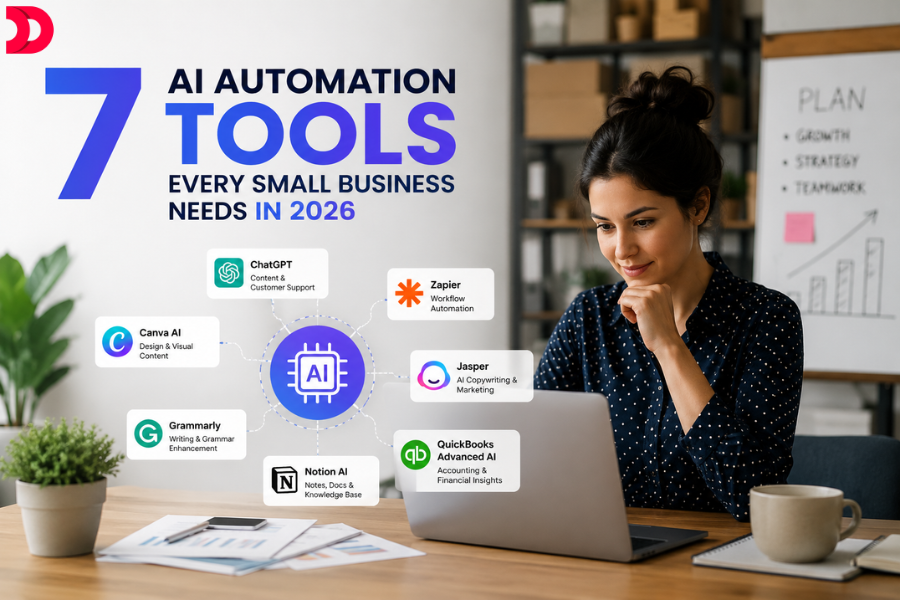
1. ChatGPT for Customer Communication and Content Work
OpenAI developed ChatGPT, and it has quickly become one of the most practical AI tools businesses use daily.
Most companies are not using ChatGPT for complicated futuristic tasks.
They are using it for simple operational work that consumes time every day.
- Writing customer replies.
- Creating content drafts.
- Handling repetitive support questions.
- Preparing emails.
- Generating product descriptions.
- Drafting proposals.
A small ecommerce brand, for example, may receive hundreds of repetitive questions every week about delivery timelines, returns, pricing, or stock availability.
Earlier, businesses needed someone manually handling all those conversations.
Now many companies automate large portions of that communication while still maintaining fast response times.
Marketing agencies also use ChatGPT heavily for blog outlines, ad copy ideas, caption drafts, and client communication support.
The biggest reason businesses adopt tools like ChatGPT is simple.
Smaller teams can suddenly handle larger workloads without constantly increasing operational pressure.
That flexibility matters a lot for startups and growing companies.
2. Zapier for Workflow Automation
Zapier is one of those tools businesses usually start appreciating only after using it.
Before automation, many companies waste hours moving information between apps manually.
A lead arrives from a website form. Someone copies it into a CRM. Another person updates a spreadsheet. Then someone sends a follow up email separately.
It sounds manageable in the beginning.
But once lead volume increases, these small repetitive tasks become operational bottlenecks.
Zapier solves this by connecting business applications together and automating workflows in the background.
For example, a real estate business running Facebook ads can automatically transfer new leads into their CRM, notify the sales team instantly, and trigger follow up communication without manual work.
The process happens automatically.
That operational efficiency becomes extremely valuable over time.
Businesses often underestimate how much productivity disappears inside repetitive admin work until automation removes it.
Agencies, service businesses, and sales teams benefit heavily from workflow automation because they deal with repetitive operational tasks every single day.
3. HubSpot AI for Sales and CRM Management
HubSpot combines customer management, sales tracking, and marketing automation into one ecosystem.
And for growing businesses, that organization becomes important very quickly.
Many companies lose potential customers for surprisingly simple reasons.
- Someone forgot to follow up.
- Leads were scattered across different tools.
- Customer conversations were not tracked properly.
- Teams responded too late.
These are common operational problems.
HubSpot helps businesses organize communication and automate sales workflows more efficiently.
A consulting company handling multiple inquiries every week, for example, can automatically track lead stages, schedule follow ups, manage customer interactions, and monitor conversion activity from one platform.
That level of visibility helps businesses stay more organized as operations grow.
The reality is that most businesses do not struggle because they lack leads.
They struggle because they fail to manage leads consistently.
That is where CRM automation becomes valuable.
4. Grammarly for Professional Communication
Grammarly is often underestimated because people still think it is only a grammar correction tool.
Businesses actually use it much more broadly now.
Professional communication affects trust more than many companies realize.
Poorly written emails, unclear proposals, weak website copy, or inconsistent messaging can slowly damage business credibility.
This becomes even more important for startups, agencies, consultants, and service based businesses where communication directly influences sales and client relationships.
Businesses use Grammarly while preparing proposals, client emails, reports, presentations, website content, and internal communication.
A startup founder pitching investors, for example, may use Grammarly to improve tone and clarity before sending important communication.
That small improvement matters.
Because customers and clients often judge professionalism through communication quality long before they experience the actual service.
5. Notion AI for Team Productivity and Organization
Notion has become extremely popular among startups, remote teams, and creative businesses.
The reason is simple.
Growing companies become disorganized very easily.
- Meeting notes get lost.
- Tasks are scattered across tools.
- Deadlines become unclear.
- Documentation disappears somewhere inside folders.
Eventually teams spend more time searching for information than actually working.
Notion AI helps businesses centralize workflows, planning, task management, documentation, and collaboration inside one structured workspace.
Content agencies often use it to manage editorial calendars, approvals, campaign planning, client feedback, and project tracking together.
Instead of switching between five different applications, teams can manage operations from one place.
That simplicity improves productivity more than people expect.
Sometimes operational clarity itself becomes a competitive advantage.
6. QuickBooks AI for Financial Automation
Intuit integrates AI inside QuickBooks to simplify business finance management.
And honestly, financial organization is one area where small mistakes quietly create long term problems.
Many business owners focus heavily on sales and growth while financial management remains inconsistent in the background.
- Invoices get delayed.
- Expenses are not tracked properly.
- Cash flow visibility becomes unclear.
- Payment follow ups are missed.
Over time these issues start affecting operations.
QuickBooks helps businesses automate invoicing, expense tracking, payment reminders, reporting, and financial organization.
For small teams especially, automation removes a large amount of repetitive accounting work.
A service company handling recurring monthly clients, for example, can automate invoices and maintain cleaner financial records without spending hours on manual tracking.
The biggest advantage is not only saving time.
It is reducing operational stress around finances.
7. Canva AI for Marketing and Content Design
Canva has changed how small businesses approach marketing design.
Earlier, creating professional visuals usually required either hiring designers or learning complicated software.
Now businesses create social media posts, promotional graphics, ad creatives, presentations, and marketing content much faster.
A local restaurant promoting festival offers can design Instagram campaigns within minutes.
An ecommerce brand launching a product can quickly create banners, promotions, and ad creatives without depending entirely on external designers.
That speed matters because online marketing now depends heavily on consistency.
Businesses that publish content regularly usually stay more visible and competitive.
Canva helps smaller brands maintain that consistency without large creative teams.
And for many small businesses, that accessibility has made digital marketing significantly easier.
Which AI Tool Should Small Businesses Start With?
Many businesses make one mistake while adopting AI.
They try automating everything immediately.
That usually creates confusion.
The better approach is much simpler.
Start with the biggest operational problem first.
If customer communication consumes too much time, start with ChatGPT.
If repetitive admin work slows operations, use Zapier.
If sales follow ups are inconsistent, focus on CRM automation.
Businesses get better results when automation solves real workflow problems instead of becoming another complicated system.
Common AI Automation Mistakes Businesses Still Make
Even good automation tools can create problems if businesses implement them poorly.
One common mistake is depending too heavily on AI generated output without review.
Another problem is automating broken workflows instead of fixing them first.
Some businesses also overload teams with too many tools together, which actually reduces productivity instead of improving it.
AI works best when it supports business operations naturally.
Not when it completely replaces strategic thinking or human decision making.
The companies benefiting most from AI automation are usually the ones combining automation with strong operational systems.
The Future of AI Automation for Small Businesses
AI automation will continue becoming more advanced over the next few years.
Businesses are already moving toward predictive marketing, smarter customer personalization, AI assisted operations, automated sales systems, and intelligent workflow management.
And honestly, the gap between businesses using AI efficiently and businesses ignoring automation is becoming more visible every year.
The advantage is no longer theoretical.
It is operational.
Companies that automate repetitive work early usually scale faster because teams spend less time managing small tasks manually.
That efficiency compounds over time.
Final Thoughts
AI automation is no longer something only large enterprises invest in.
Small businesses are now using automation tools daily to improve communication, organize workflows, manage operations, reduce repetitive work, and improve customer experience.
The biggest advantage is not simply working faster.
It is operating more efficiently with fewer operational gaps.
Businesses do not need to automate everything immediately.
In most cases, starting with one useful workflow is enough.
Over time, those small improvements create stronger systems, better productivity, and more scalable operations.
And in 2026, businesses that combine smart automation with strong execution are usually the ones growing faster than everyone else.
Ready to Automate Your Business with AI?
Stop wasting time on repetitive tasks. Let our AI automation experts build smart workflows that save time, reduce costs, and grow your business faster.
Hire AI Automation Experts Today and transform the way you work.











 Sep 21, 2026