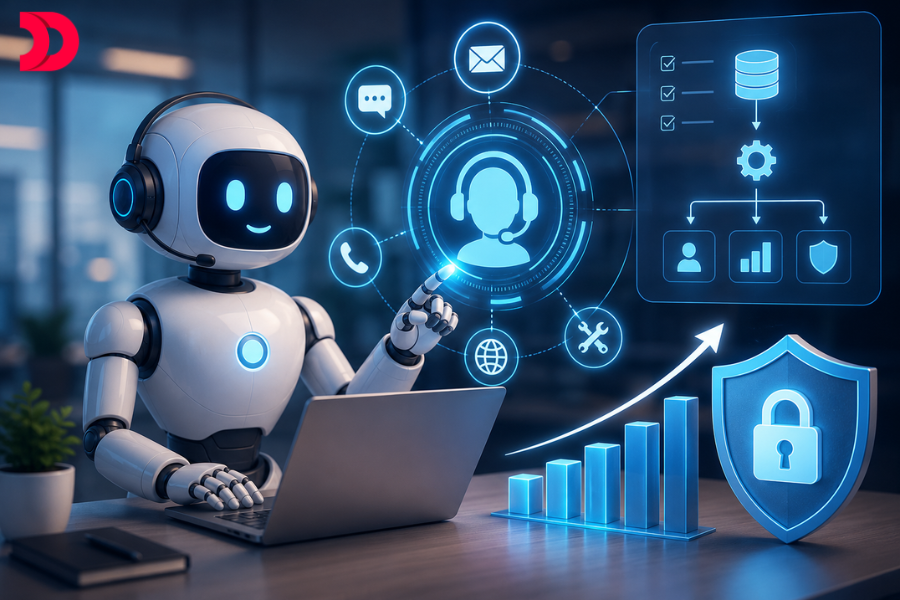
How can modern enterprises thrive without having an excellent customer support system? Whether you want to scale your business or strengthen your reach, customer support plays a vital role in this competitive edge. Recently, we have witnessed the end of static, rule-based, chatbots that answered according to predefined FAQs. Today, global enterprises rely on autonomous AI agents. As an intelligent and context-aware system, these agents give reasons, executing complex workflows across legacy systems. Whether you are an entrepreneur or CTO, you may have a question about how much it will cost to build a solution that resolves customer issues without human intervention. This blog delves into the financial realities, architectural cost drivers, and strategic considerations to calculate the cost of customer support agent development.
AI Agent Development- Estimated Costs and Scop
There is no one-size-fits-all figure when calculating the cost of an enterprise-grade AI agent for customer services. Your investment entirely depends on the agent’s autonomy and security requirements as per your company’s ecosystem. Here is a quick table based on cost range and scope of development for your reference.
Development Type
Estimated Range (in USD)
Primary Use Case with Capabilities
Customized Platform-Based Agents
25k to 60k
Built using enterprise low-code platforms like Microsoft Copilot Studio
Highly sophisticated networks of specialized agents and domain-specific fine-tuning of features
The initial capital expenditure for developing a custom AI agent is significant, but it results in long-term operational savings. This can convert the development cost into a high-yield strategic investment by reducing cost-per-ticket by 60 to 80 percent.
Key Drivers of the Development Cost for Custom AI Agents
AI application development is a complex process that involves several steps and factors. Here are the major drivers that determine the development cost of AI agents for customer support.
Complexity of Architecture (USD 15,000 to USD 50,000)
An AI agent uses a Large Language Model (LLM) as a reasoning engine. It breaks down user intent into sub-tasks and plans execution steps. An advanced AI agent can self correct if an action fails. Development of this cognitive layer needs advanced prompt engineering with robust memory design. Developers use advanced guardrails to prevent AI hallucinations.
Data Engineering and RAG Integration (USD 20,000 to USD 75,000)
An AI agent needs data access continuously. When it comes to customer support, these agents should answer user queries accurately without hallucinating. This is a reason why developers build Retrieval-Augmented Generation (RAG) pipelines. These pipelines convert your company’s internal knowledge bases, APIs, and product manuals into mathematical vectors. Here, the cost scales on the basis of volume, format, and cleanliness of your enterprise data.
System Integration and API Orchestration (USD 15,000 to USD 65,000)
An informational agent answers questions and an agentic AI solution takes action. The AI agent, therefore, must connect with your existing tech stack. CRM systems, ERP, inventory databases, and payment gateways are some of the existing business solutions with which AI agents should be connected. Each custom API integration, webhook setup, and authentication protocol adds hours in AI agent development. This increase can ultimately multiply the agent’s business value.
Security, Privacy, and Compliance (USD 10,000 to USD 40,000)
Global enterprises give priority to data security. A powerful AI agent can handle Personally Identifiable Information (PII) or financial data effectively. The development process follows stringent compliance protocols like HIPAA, GDPR, and PCI-DSS. End-to-end data encryption, dynamic PII masking pipelines, and comprehensive audit logging are also essential to integrate into the agent. All these factors contribute to the agent development cost. An AI ML development company takes a phased approach in developing AI support agents.
Breakdown of AI Agent Development Phases
You can partner with a reputable AI-ML development company. Here is a breakdown of a typical custom AI agent development process.
Phase 1. Discovery and Design
This is a primary phase that involves the making of technical blueprint, LLM selection matrix, data compliance strategy, and UI/UX wireframes. This phase is essential to prevent scope creep and ensure alignment of technical capabilities with defined business KPIs for the agent.
Phase 2. Data Engineering and Integration
This is a crucial phase before developing actual AI agents. It involves the development of RAG pipelines and setting up vector databases. Developers implement semantic search optimization and chunking strategies. This phase directly impacts the accuracy and relevance of the agent.
Phase 3. Core Agent Development and Integration
This is a development phase in which AI engineers implement cognitive loops and integrate APIs with internal software. This phase triggers human-in-the-loop (HITL) handoff. It turns the conversational interface into an action-oriented operational AI agent for customer support.
Phase 4. Testing and Adversarial Alignment
This phase involves red-teaming, latency optimization, conversational flow refinement, and guardrail deployment in the agent. This can protect your brand reputation by keeping the AI agent polite, safe, on-brand, and accurate under any circumstances.
Phase 5. Deployment and Feedback Loops
This is the last phase in which an AI ML development company deployed cloud infrastructure like AWS or Azure. The company also builds real-time monitoring dashboards and analytics setup with reinforcement learning pipelines according to human feedback. All these five stages ensure that the AI support agent can work flawlessly and in a way your business requires.
Ongoing Costs of AI Support Agents
Deployment of an AI agent is not sufficient for the company. CTOs must consider operational expenditure to ensure the system remains sustainable and cost-effective for a long time. Here, the most important costs are token consumption, API infrastructure, and maintenance charges. A high-volume enterprise managing around 50,000 support tickets needs to spend around USD 1500 to USD 8000 every month in pure LLM API costs. Update of internal APIs, change in product catalog, and shift in user behavior further attract charges. These AI models can experience ‘model drift’ where their performance parameters degrade subtly over time. It is, therefore, essential to allocate around 15 to 20 percent of the initial development cost every year for maintenance. This ensures your AI support agent stays synchronized with your enterprise.
How to Drive Maximum ROI for Your Company
Investing in a custom AI agent is an ongoing project to scale operational capacity without increasing headcount. A customer support agent can automate up to 70 percent of routine and transactional inquiries for your company. Your human support team can focus exclusively on high-value customer interactions. You must partner with an established AI-ML development company to ensure your investment delivers maximum returns. The ideal AI agent development partner brings more than raw coding capabilities. You can leverage the benefits of their deep expertise in production-grade RAG pipelines, data security compliance, and cost-optimized model orchestration. Want to learn more about an autonomous customer support agent? Contact us to get a customized architectural blueprint with an exact cost estimation for your AI support agent.
Artificial intelligence (AI) has become prevalent in modern enterprises. As this technology reaches a mature operational level, the corporate sector witnesses the integration of various stacks into the system. Intelligent agents, LLMs, inference pipelines, and autonomous data retrieval agents have...
AI orchestration is the coordination layer that connects AI models, AI agents, tools, APIs, data, workflows, memory, and enterprise systems so they can work together toward a defined business outcome. AI agent orchestration is a more specific concept that focuses...
The software industry is now building AI-Native software from the ground up rather than using AI as an add-on feature. Before, software companies required a team of developers, designers, testers, and engineers to handle the entire software development lifecycle (SDLC)....
Today, almost every business operates on AI agents, and why wouldn’t they? Artificial Intelligence (AI) has helped businesses simplify day-to-day tasks like handling large amounts of information and supporting complex tasks, making decisions, and automating workflows. AI agents can perform...
What if your mobile app could understand what customers need and take the next step for them? That is the idea behind an AI agent mobile app. Instead of making users move through multiple screens, search for information and complete...
If using an AI-powered app can make everyday tasks easier, imagine how an AI-Native app can make your life easier. Well, today’s technology has gone beyond imagination, and we are here to turn your imagination into reality by helping you...








 Sep 21, 2026