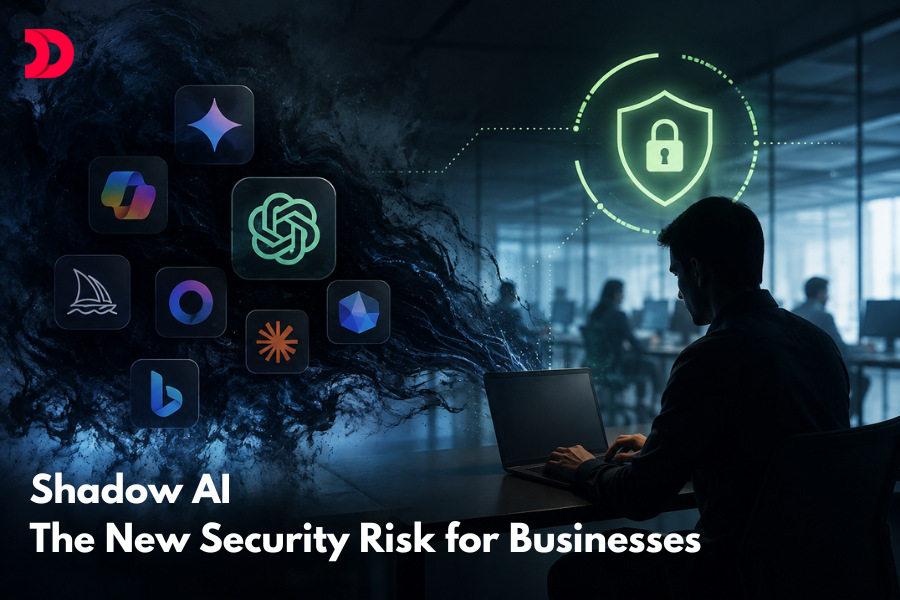
I am sure you heard about AI and generative AI, but have you ever heard of Shadow AI? Since the growing popularity of ChatGPT and other AI tools, more people are becoming aware of Shadow AI. So what exactly is Shadow AI? Employees choose shortcuts and use AI tools to make their work faster, easier, and smarter. Now don’t get me wrong: while AI can help enhance your day-to-day work, using AI tools without informing or obtaining approval from the company is known as Shadow AI.
For example, putting your company’s confidential data into AI tools without their knowledge or approval is what Shadow AI means. This process can put the company’s sensitive data at serious risk. If you run a company, understanding the cons of Shadow AI and its security risks can help you prevent them from affecting your business.
What is Shadow AI?
Shadow AI means an employee uses Artificial Intelligence (AI) tools without informing or taking approval from the business, including using public chatbots, AI writing assistants, AI image generators, AI coding tools, and AI browser extensions.
While all AI tools can help elevate your work, using them without approval can cause businesses to lose visibility and control over their sensitive data.
What’s the reason behind the Shadow AI Boom?
One study found that people mostly use AI tools to create reports & documents, draft emails and messages, write and edit content, for coding & finance-related tasks, and create presentations to make their work more efficient and faster. Also, the growing adoption of Generative AI Development makes it accessible for employees to use secure and trustworthy AI tools.
Now the question that comes to mind is, if AI tools are making work more efficient, then what’s the issue with using them? The issue is not that employees cannot use AI tools; the issue is that they should not use unapproved AI tools. Choosing to use unapproved AI tools can put the business’s sensitive data at security risks.
Then why do employees still use unapproved AI tools? There can be several reasons: 1) they know how to use AI tools and have been using them in their personal lives, so they use them for work too; 2) their employer didn’t provide an approved AI tool, so they were forced to use unapproved AI tools.
What Every Business Owner Needs to Know Now about Shadow AI
Learning the potential risks of Shadow AI can help businesses combat unauthorized use of AI.
Risks included:
- Company’s sensitive data shared without permission
- Business Ideas and confidential information being shared on an unknown AI tool
- Sharing sensitive information on an unapproved tool can put you at high cybersecurity risks.
- Put your creative ideas and confidential technologies at risk
- An AI tool may not provide correct information to the employee, leading to errors and affecting business performance.
How to Minimize the Risks of Shadow AI
The issue is not that employees are using AI tools; it’s that they might be using tools that could put your business data and its reputation at risk.
There is no denying that AI can help your employees enhance their daily tasks. However, forcing employees to completely stop using AI tools is also not a proper solution either. Rather, businesses should focus on the following steps to help them control the risk of Shadow AI.
- Build clear rules for AI Use
Set clear boundaries for which AI tools they can use, which are not approved, security responsibilities, what information is allowed to be shared in it, and what information is not. This way, employees will be more cautious and only use approved AI tools.
- Offer staff approved AI tools
Instead of restricting staff from using AI tools, provide them with approved AI tools. Offer staff Enterprise AI tools that enable data protection, high-grade security, compliance features, and are accessible and easy to use.
For some, the matter of Shadow AI may not seem like a huge problem. In cases like this, businesses should teach their employees about the risk of using unauthorized AI tools. For example, putting the company’s sensitive data on an unauthorized tool may cause cybersecurity issues; failing to comply with regulatory requirements can lead to penalties. A data breach or use of incorrect information from AI can put the company’s important data and reputation at risk.
- Strengthen Your Security Controls
Tighten your security measures by deciding who should and who should not have access to AI tools. Use multi-factor authentication to prevent unauthorized access to AI tools, monitor the types of AI tools employees are using, and train employees about Shadow AI, data breaches, cybersecurity risks, and how the use of unauthorized AI tools can literally put the business’s confidential data at high risk.
AI is becoming a part of our day-to-day lives; rather than seeing it as a potential risk, using AI effectively can save time, improve productivity, and drive business growth. We recommend that businesses not fear AI and keep an eye on employee requirements, review approved tools, assess cybersecurity risks, and governance policies to ensure AI is safe, secure, and reliable to use.
Don’t Fear AI: Take Control of Shadow AI
When a data breach happens, companies usually start to think Oh! Our sensitive information might be hacked, but sometimes it’s just that an employee simply shared the company’s sensitive information on a third-party AI tool that should not have been shared. Shadow AI takes place when an employer does not provide authorized AI tools.
So, What’s the Verdict?
Nowadays, AI is booming; every day, new apps, new features, and updates are being introduced, making it irresistible for employees not to use AI. That’s why working with DevsTree, a trusted AI Agent Development company, can help businesses build safer AI solutions.
Instead of making AI an opponent, providing employees with approved AI tools, setting clear boundaries for their use, and teaching them the consequences of using unapproved tools can help your business avoid a data breach while helping employees be more productive in their work.











 Oct 01, 2026