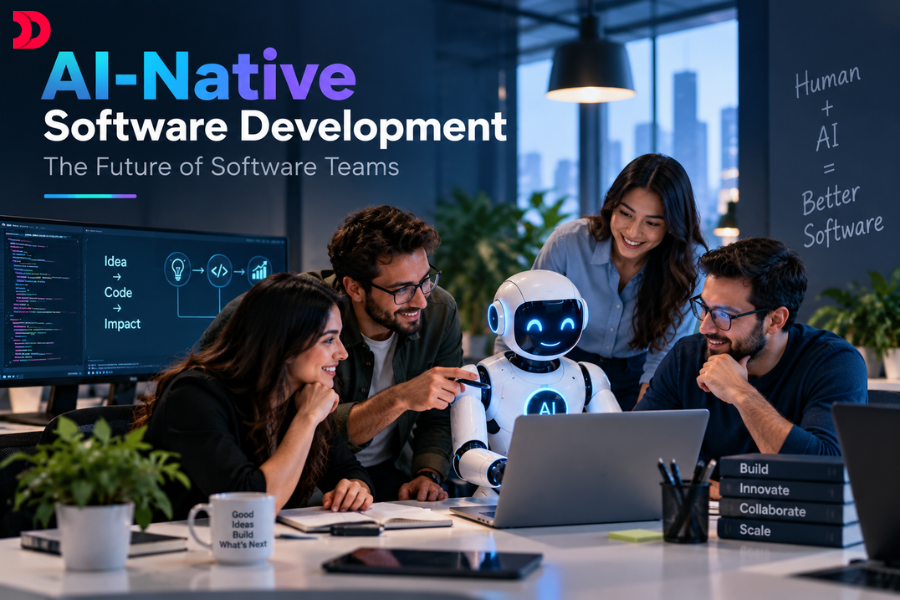
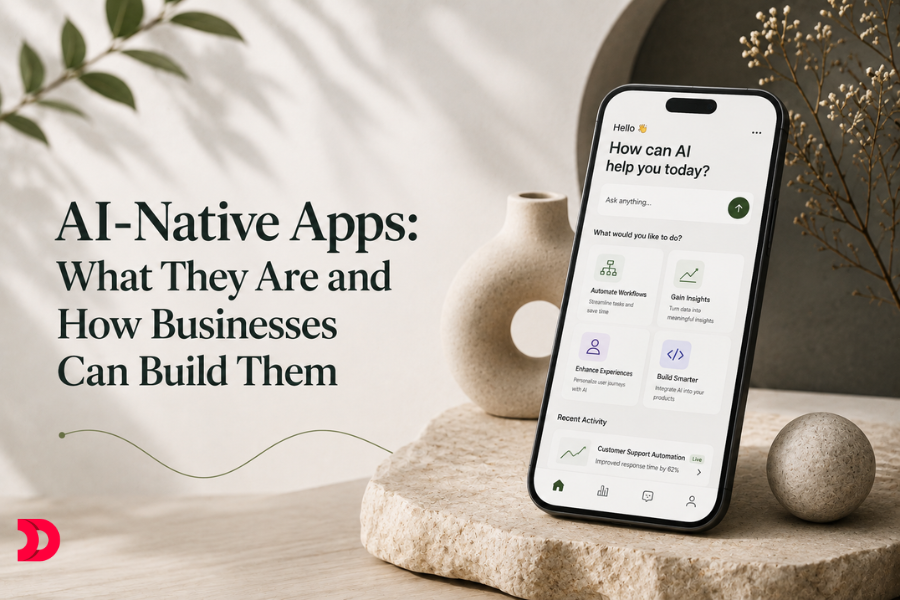
If using an AI-powered app can make everyday tasks easier, imagine how an AI-Native app can make your life easier. Well, today’s technology has gone beyond imagination, and we are here to turn your imagination into reality by helping you build an AI-Native app. An app that is built on Artificial Intelligence (AI) technology from the ground up helps businesses perform tasks just like the human brain. Rather than writing prompts for AI to do things for us, AI-Native apps collect data, understand user behavior, and provide custom solutions accordingly.
What are AI-Native Apps
AI-Native app is an application built with Artificial Intelligence (AI) that is integrated as a core component rather than an add-on AI feature.
For example, the Google Docs + AI app, on which users can write, summarize, and proofread, was built first as a traditional app, and afterwards, AI features were added, making it an AI-powered app.
On the other hand, an AI-native app is built with AI from the very start, understands, analyzes, decides, automates tasks, and provides personalized solutions to users.
Difference between Traditional AI Platform vs Native-AI Platform
| Traditional AI platform |
Native-AI platform |
| AI features are added afterwards |
Developed with AI capabilities from the very beginning |
| At first, it was built traditionally and integrated with AI capabilities |
From the start, it builds on AI as a core component |
| Only executes pre-fixed tasks |
It has decision-making capabilities |
| Supports human decision |
It recommends, analyzes, and automatically completes tasks |
| Requires high human involvement |
Requires little to no human involvement |
| Built on fixed, rule-based logic and relational databases. AI feature is added afterwards |
Built around real-time data, vector layers, and Autonomous agents that make decisions and automate the workflow. |
| Examples of Traditional AI apps: Traditional CRM, ERP |
Examples of AI-Native apps: GitHub Copilot, Cursor AI, Perplexity AI, Deel, Abridge |
Let’s understand the difference with a simple example:
For example, an online travel booking app with an add-on AI feature includes chatbots, personal assistants, and recommendations. An AI-powered traditional app gives what users ask for with traditional search and booking workflows.
Now, the travel booking app is built with AI as a core from day one: Simply write a 7-day family trip to Bali with your preferred budget, food, and location. The AI analyzes and understands your budget and goals, and provides you with a personalized 7-day travel plan featuring recommended flights, hotels, and activities to enjoy during your trip.
7 steps to follow to build an AI-native application
- Identify the right use case.
Do not build an AI app just cause its trending. Identify if your business has any specific problems that AI can help to overcome. If your business requirements include handling a large volume of unstructured data, repetitive work, real-time prediction, and natural language understanding, then building an AI-native app can help run your business more effectively than traditional software ever can.
- Design an AI-Native app from day one.
Simply adding an AI feature to an already existing app can make your user interface complicated to maintain. Instead, design an AI-Native app from the very start with all the qualities you want AI to accomplish. Rather than updating data manually, create your own AI app that can collect and process new data, make decisions, predict, update, test, and launch data.
- Build a good data foundation.
To let AI work best at its core, accurate, up-to-date data is required. Before building an AI app, building a good, high-quality data foundation is essential. A good, secure, and organized data foundation includes collecting relevant users’ data, cleaning it, categorizing it, storing important information, tracking different versions of the data, and making it accessible to AI so it can perform at its best.
- Select the correct AI models
A correct AI model is the one that can work with your business requirements, use case, data goals, and fit within your AI app development cost. Figure out what tasks you want your Model to accomplish and choose the correct model accordingly. Types of AI models include: Foundation models, Small Language Models (SLMs), and expert/task specific models.
- Develop and train your AI Models
People often make the mistake of building an AI app successfully but forget to test it in real-world situations. Using tools like PyTorch or TensorFlow can help train your AI models to use your own data and work according to your business needs. During the training phase, check whether the AI gives correct answers, its response time, whether it gives fair answers to each user, and whether it gives proper output even when the input is not proper.
- Human involvement & accountability
Building an AI app is one thing, but making sure it runs fast, predicts, and gives proper answers even when audiences are large is what makes it reliable. Even though AI can analyze, understand, and make decisions on its own, it still requires human involvement. For example, AI can suggest an employee, but it’s up to the recruiter whether to hire them or not. This mechanism helps AI to work efficiently, combined with human accountability.
- Monitor and Improve Continuously
Work never stops! After launching your AI-native app, it should be continuously monitored and updated with the newest features and trends. Make sure to take your users’ feedback and improve the AI model with the newest requirements. Use a different AI model and train it with the newest data if the current one gets outdated. All of these precautions can help your AI app be effective, scalable, and reliable.
Conclusion – Why choose DevsTree AI-Native app development
If AI-Native app development is what you need for your business to grow, then you are at the right place. DevsTree, a trusted AI app development company, can help you build a secure, reliable, and scalable AI app. Rather than adding AI features as an add-on, we build an AI app from scratch, making it cost-effective.
We will ensure we use the right platform and technologies to build your AI app that can be suitable even for large companies. From designing the user interface, training the AI model, connecting it to work with APIs, launching it, to monitoring, DevsTree will stay together at each part of the process.










 Sep 28, 2026