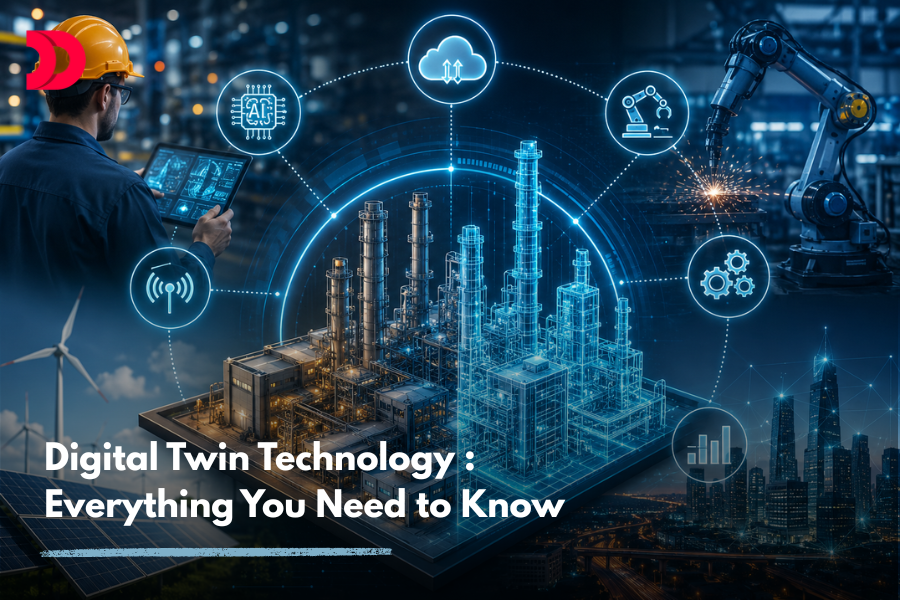
Digital Twin Technology is a digital representation of a physical object, process, system, or environment that continuously receives real time data from sensors, IoT devices, software, and connected systems. Unlike a static 3D model or simulation, a digital twin evolves alongside its real world counterpart, allowing businesses to monitor performance, predict failures, optimize operations, test changes virtually, and make data driven decisions without disrupting physical assets. From manufacturing equipment and smart buildings to hospitals, bridges, and entire cities, digital twins help organizations improve efficiency, reduce costs, and extend the lifecycle of valuable assets.
Digital Twin Technology: The Foundation of Smarter, Connected Businesses
Businesses today generate massive amounts of operational data, but collecting data alone is no longer enough. Organizations need a way to understand what that data means, predict what will happen next, and take action before problems occur. This is where Digital Twin Technology is transforming industries.
Instead of waiting for equipment to fail or relying on manual inspections, companies can create a virtual version of their physical assets that reflects real world conditions in real time. This digital replica continuously updates using data collected from IoT sensors, connected devices, enterprise applications, and cloud platforms. As conditions change in the physical environment, the digital twin changes as well.
The result is better visibility into operations, faster decision making, improved maintenance planning, and the ability to test scenarios before implementing them in the real world. Whether it is a manufacturing plant monitoring production lines, a hospital tracking medical equipment, or a construction company managing a large infrastructure project, digital twins are becoming an essential part of modern digital transformation.
As artificial intelligence, cloud computing, edge computing, and industrial IoT continue to evolve, digital twins are no longer limited to large enterprises. Organizations of all sizes are beginning to adopt this technology to improve productivity, reduce operational costs, and build smarter products and services.
In this guide, you’ll learn what Digital Twin Technology is, how it works, its core components, architecture, technology stack, business benefits, industry applications, implementation process, software options, and the future of this rapidly growing technology.
What Is Digital Twin Technology?
A Digital Twin is a virtual representation of a physical object, process, system, or environment that mirrors its real world counterpart using live operational data. The digital model stays synchronized with the physical asset through continuous data exchange, allowing organizations to observe, analyze, simulate, and optimize performance throughout the asset’s lifecycle.
Unlike traditional computer models that remain static once created, a digital twin is dynamic. It constantly receives updated information from connected devices and reflects the current state of the physical asset.
Imagine a wind turbine installed in a remote location. Hundreds of sensors continuously measure temperature, vibration, pressure, rotation speed, energy output, and weather conditions. This information is transmitted to the cloud, where a digital twin recreates the turbine’s behavior in real time. Engineers can monitor performance, detect abnormalities, predict component failures, and recommend maintenance before expensive breakdowns occur.
The same concept applies across many industries.
A hospital can create digital twins of medical equipment to monitor usage and maintenance schedules. A construction company can build a digital twin of an ongoing project to track structural progress and resource utilization. Manufacturers can optimize production lines without interrupting operations.
The value of Digital Twin Technology lies in its ability to combine physical systems with digital intelligence, creating an environment where decisions are based on real time insights rather than assumptions.
Why Digital Twin Technology Matters Today
The demand for Digital Twin Technology has increased significantly as businesses embrace Industry 4.0, smart manufacturing, connected infrastructure, and data driven operations.
Modern organizations manage thousands of connected devices, machines, vehicles, and assets. Monitoring these systems manually is time consuming and often reactive. Problems are typically identified only after they affect production, customer experience, or operational efficiency.
Digital twins shift this approach from reactive to proactive.
Instead of asking:
“What went wrong?”
Businesses can ask:
“What is happening right now?”
“What is likely to happen tomorrow?”
“How can we prevent future failures?”
This ability to predict outcomes before they occur creates measurable business value.
Some of the biggest reasons organizations invest in Digital Twin Technology include:
- Reducing unexpected equipment failures
- Improving operational efficiency
- Optimizing asset performance
- Lowering maintenance costs
- Increasing workplace safety
- Accelerating product innovation
- Supporting sustainability initiatives
- Making faster business decisions
- Improving customer experiences
- Extending equipment lifespan
Digital twins also play an important role in digital transformation strategies because they connect operational technology (OT) with information technology (IT), creating a unified view of business operations.
How Does Digital Twin Technology Work?
Digital Twin Technology works by creating a continuous connection between a physical asset and its virtual representation. This connection enables real time monitoring, predictive analysis, and ongoing optimization throughout the asset’s lifecycle.
Although implementations differ across industries, the overall workflow follows a similar pattern.
Step 1: Create the Physical Asset
Everything begins with a physical object, process, or system.
Examples include:
- Manufacturing machines
- Buildings
- Medical devices
- Vehicles
- Bridges
- Industrial robots
- Wind turbines
- Oil pipelines
- Smart city infrastructure
These assets become the foundation of the digital twin.
Step 2: Collect Real Time Data Through Sensors
IoT sensors are installed on the physical asset to capture operational information.
These sensors monitor various parameters such as:
- Temperature
- Pressure
- Humidity
- Vibration
- Energy consumption
- Speed
- Location
- Structural movement
- Air quality
- Equipment health
The more relevant data collected, the more accurate the digital twin becomes.
Step 3: Transfer Data Securely
Collected data is transmitted through communication networks using technologies such as:
- WiFi
- Ethernet
- Bluetooth
- 5G
- LoRaWAN
- MQTT
- OPC UA
Reliable connectivity ensures the virtual model stays synchronized with real world conditions.
Step 4: Process Data at the Edge or in the Cloud
Raw sensor data often requires processing before analysis.
Edge computing handles immediate processing close to the physical asset, reducing latency and enabling faster decision making.
Cloud platforms store large volumes of historical data, support advanced analytics, and make information accessible across multiple locations.
Combining edge and cloud computing provides both speed and scalability.
Step 5: Update the Digital Twin
The processed information continuously updates the virtual model.
Unlike traditional simulations, which represent only a single scenario, a digital twin evolves continuously based on live operational data.
This allows engineers, operators, and decision makers to monitor the current condition of physical assets from anywhere.
Step 6: Analyze Data Using Artificial Intelligence
Artificial intelligence and machine learning transform raw data into actionable insights.
AI models can:
- Detect unusual operating conditions
- Predict equipment failures
- Identify inefficiencies
- Forecast maintenance schedules
- Optimize energy usage
- Recommend operational improvements
Instead of relying on manual inspections, organizations receive intelligent recommendations based on real time analytics.
Step 7: Visualize and Take Action
The final stage is presenting information through dashboards, reports, 3D visualizations, or interactive digital environments.
Decision makers can:
- Monitor equipment health
- Compare current performance with historical trends
- Test operational scenarios
- Schedule preventive maintenance
- Improve production efficiency
- Reduce operational risks
Because the digital twin reflects the current state of the physical asset, organizations can make faster and more informed decisions.
Core Components of a Digital Twin
Every successful digital twin consists of several interconnected components that work together to provide accurate, real time insights.
Physical Asset
The physical asset is the real world object or system being monitored. It can range from a single machine to an entire manufacturing facility, hospital, transportation network, or smart city.
Without a physical asset, there is no digital twin.
Sensors and IoT Devices
Sensors serve as the primary source of information by continuously collecting operational data.
Depending on the use case, organizations may deploy:
- Temperature sensors
- Pressure sensors
- Motion sensors
- GPS trackers
- Cameras
- RFID tags
- Environmental sensors
- Vibration sensors
- Smart meters
These devices ensure the digital twin accurately reflects changing conditions.
Connectivity Layer
Reliable communication infrastructure transfers data between physical assets and digital systems.
This layer supports secure, real time communication using industrial communication protocols and modern networking technologies.
Without strong connectivity, a digital twin cannot remain synchronized with the real world.
Data Platform
The data platform collects, stores, organizes, and manages information received from connected devices.
It typically includes:
- Cloud databases
- Data lakes
- Time series databases
- Streaming platforms
- Data integration tools
A well designed data platform ensures historical and real time information remains accessible for analytics.
Digital Model
The digital model is the virtual representation of the physical asset.
It combines engineering models, operational data, maintenance records, and environmental information into a unified digital environment.
As new information arrives, the model automatically updates to match the physical asset.
Artificial Intelligence and Analytics
Artificial intelligence transforms collected data into meaningful business insights.
Advanced analytics can identify trends, detect anomalies, predict future events, and recommend actions that improve operational performance.
Machine learning models become increasingly accurate as more historical data becomes available.
Visualization and User Interface
Users interact with digital twins through dashboards, 3D models, mobile applications, augmented reality interfaces, or business intelligence platforms.
These visualization tools make complex operational data easier to understand and help teams collaborate more effectively.
Whether an engineer is monitoring a production line or a facility manager is overseeing a smart building, intuitive visualization enables faster and more confident decision making.
Digital Twin Architecture
A digital twin is only as effective as the architecture that powers it. A well designed architecture ensures that data flows seamlessly from the physical asset to its digital counterpart, enabling real time monitoring, predictive analytics, and informed decision making.
Although the architecture may vary depending on the industry and business requirements, most digital twin solutions follow a layered approach. Each layer has a specific role in collecting, processing, analyzing, and visualizing data.
1. Physical Layer
The Physical Layer consists of the real world assets that the digital twin represents. These assets generate operational data throughout their lifecycle.
Examples include:
- Manufacturing equipment
- Industrial robots
- Buildings
- Bridges
- Wind turbines
- Medical devices
- Vehicles
- Production lines
- Pipelines
- Smart city infrastructure
The performance and condition of these assets directly influence the accuracy of the digital twin.
Key Functions
- Performs real world operations
- Generates operational data
- Interacts with the surrounding environment
- Acts as the source of information for the digital twin
2. Data Acquisition Layer
The Data Acquisition Layer captures information from the physical asset using connected devices and industrial equipment.
This layer is responsible for converting physical conditions into digital data that can be analyzed by software platforms.
Common data sources include:
- IoT sensors
- PLCs (Programmable Logic Controllers)
- RFID tags
- GPS devices
- Smart cameras
- Environmental sensors
- SCADA systems
- Industrial controllers
The quality of the collected data directly impacts the reliability of the digital twin.
Data Collected
- Temperature
- Pressure
- Speed
- Energy consumption
- Vibration
- Humidity
- Position
- Structural movement
- Equipment health
- Machine utilization
3. Connectivity Layer
Once data is collected, it must be transmitted securely and efficiently.
The Connectivity Layer manages communication between physical devices and digital platforms.
Depending on the environment, organizations may use wired or wireless communication technologies.
Common communication protocols include:
- MQTT
- OPC UA
- HTTP
- HTTPS
- AMQP
- Ethernet
- WiFi
- Bluetooth
- LoRaWAN
- 5G
A reliable connectivity layer minimizes latency and ensures that the digital twin always reflects current conditions.
4. Data Processing Layer
Raw sensor data often contains duplicate records, missing values, or unnecessary information. Before it becomes useful, the data must be cleaned, organized, and processed.
This is the responsibility of the Data Processing Layer.
Processing can occur in two locations:
Edge Computing
Edge devices process data close to the physical asset.
Benefits include:
- Lower latency
- Faster response times
- Reduced bandwidth usage
- Real time automation
Cloud Computing
Cloud platforms provide large scale storage and advanced computing capabilities.
Benefits include:
- Massive data storage
- Historical analysis
- AI model training
- Collaboration across locations
- Enterprise integration
Many organizations combine edge and cloud computing to achieve both speed and scalability.
5. Digital Twin Model Layer
This is the core of the entire architecture.
The Digital Twin Model Layer creates and maintains the virtual representation of the physical asset.
The model combines multiple sources of information, including:
- Engineering designs
- CAD models
- Historical maintenance records
- Sensor data
- Operational parameters
- Environmental conditions
Unlike traditional models, the digital twin continuously updates itself whenever new data becomes available.
This synchronization enables organizations to understand exactly how an asset is performing at any moment.
6. AI and Analytics Layer
Collecting data is only valuable if businesses can extract meaningful insights from it.
The AI and Analytics Layer uses machine learning algorithms, predictive analytics, statistical models, and business intelligence techniques to analyze incoming data.
This layer can:
- Predict equipment failures
- Detect unusual operating conditions
- Estimate remaining useful life
- Recommend maintenance schedules
- Optimize production
- Improve energy efficiency
- Forecast future performance
As more historical data becomes available, machine learning models become increasingly accurate.
7. Visualization Layer
The Visualization Layer transforms complex technical data into information that people can easily understand.
Users interact with the digital twin through:
- Interactive dashboards
- 3D visualizations
- Mobile applications
- Web portals
- AR and VR interfaces
- Business intelligence reports
Visualization enables engineers, operators, managers, and executives to monitor assets without being physically present.
8. Business Application Layer
The final layer integrates digital twin insights into enterprise applications that support daily business operations.
Common integrations include:
- ERP systems
- CRM software
- Asset Management Systems
- Maintenance Management Systems
- Manufacturing Execution Systems (MES)
- Supply Chain Platforms
- Enterprise Analytics Tools
This integration allows organizations to automate workflows and make better business decisions based on real time operational data.
Must Read : Enterprise IoT App Development: Key Features You Must Include
How the Digital Twin Architecture Works Together
The architecture follows a continuous cycle:
Physical Asset → Sensors → Connectivity → Data Processing → Digital Twin Model → AI Analytics → Visualization → Business Applications
As this cycle repeats, the digital twin continuously learns, updates, and improves its accuracy, helping organizations make proactive rather than reactive decisions.
Digital Twin Technology Stack
While the architecture explains how different layers interact, the technology stack focuses on the technologies used to build and operate a digital twin. A complete stack combines hardware, networking, software, cloud services, analytics, and visualization tools to create a scalable solution.
Hardware Layer
The hardware layer forms the foundation of a digital twin by collecting data from physical assets.
Common hardware includes:
- IoT sensors
- Smart meters
- RFID readers
- GPS trackers
- Cameras
- PLCs
- Drones
- Industrial robots
- Wearable devices
- Medical monitoring equipment
The choice of hardware depends on the industry and the type of asset being monitored.
Connectivity Layer
Reliable communication is essential for transferring real time data between physical assets and digital systems.
Common technologies include:
- MQTT
- OPC UA
- HTTP
- HTTPS
- Ethernet
- WiFi
- Bluetooth
- Zigbee
- LoRaWAN
- 5G
Secure communication protocols protect sensitive operational data while ensuring continuous synchronization.
Edge Computing Layer
Edge computing processes data near the source instead of sending everything to the cloud.
This reduces latency and enables immediate responses in time sensitive environments.
Popular edge computing platforms include:
- Azure IoT Edge
- AWS IoT Greengrass
- Siemens Industrial Edge
Edge computing is particularly valuable for manufacturing plants, autonomous vehicles, healthcare systems, and industrial automation.
Cloud Infrastructure Layer
Cloud platforms provide the storage, computing power, and scalability needed to manage millions of connected devices and billions of data points.
Popular cloud platforms include:
- Microsoft Azure
- Amazon Web Services (AWS)
- Google Cloud Platform
- IBM Cloud
Cloud services make it easier to manage global digital twin deployments from a centralized platform.
Data Storage Layer
Digital twins generate enormous amounts of structured and unstructured data.
Organizations use different storage solutions depending on their requirements.
Common options include:
- SQL databases
- NoSQL databases
- Time series databases
- Data lakes
- Data warehouses
Efficient storage ensures quick access to both historical and real time information.
Artificial Intelligence and Machine Learning Layer
Artificial intelligence transforms raw operational data into valuable business insights.
Machine learning models can:
- Predict failures
- Detect anomalies
- Optimize production
- Improve quality control
- Forecast maintenance needs
- Analyze equipment behavior
Popular AI frameworks include:
- TensorFlow
- PyTorch
- Scikit-learn
- Azure AI
- Amazon SageMaker
AI makes digital twins increasingly intelligent as they learn from historical and real time data.
Analytics Layer
Analytics platforms convert processed data into actionable insights.
Organizations use analytics to measure:
- Equipment efficiency
- Asset utilization
- Production output
- Energy consumption
- Operational risks
- Maintenance performance
Business intelligence tools also help visualize long term trends and identify opportunities for improvement.
Visualization Layer
A digital twin should be easy to understand, even when dealing with complex industrial systems.
Visualization technologies include:
- Power BI
- Tableau
- Grafana
- Unity
- Unreal Engine
- NVIDIA Omniverse
These tools present data through interactive dashboards, 3D environments, charts, and digital workspaces.
Enterprise Integration Layer
Most businesses already use enterprise software to manage operations.
A digital twin becomes even more valuable when integrated with existing business systems.
Common integrations include:
- SAP
- Oracle ERP
- Salesforce
- Microsoft Dynamics
- IBM Maximo
- Manufacturing Execution Systems
- Maintenance Management Systems
Integration ensures that insights generated by the digital twin automatically support business workflows.
Benefits of Digital Twin Technology
Digital Twin Technology provides far more than real time monitoring. It enables organizations to make informed decisions, improve operational efficiency, reduce risks, and maximize the value of physical assets throughout their lifecycle.
Real Time Monitoring
Digital twins provide a live view of equipment, systems, and infrastructure, allowing organizations to monitor performance continuously without being physically present.
Predictive Maintenance
By analyzing sensor data and historical trends, digital twins can predict potential failures before they occur. This helps reduce unplanned downtime and lowers maintenance costs.
Better Decision Making
With access to real time insights and predictive analytics, business leaders can make faster and more informed decisions based on accurate operational data rather than assumptions.
Improved Operational Efficiency
Digital twins help identify bottlenecks, optimize workflows, reduce waste, and improve resource utilization across business operations.
Lower Operational Costs
Early issue detection, optimized maintenance schedules, and efficient resource management contribute to significant cost savings over time.
Faster Product Development
Engineers can test designs, simulate performance, and evaluate changes in a virtual environment before implementing them in the real world. This reduces development time and minimizes costly design errors.
Enhanced Product Quality
Continuous monitoring helps detect quality issues early in the production process, enabling manufacturers to improve consistency and reduce defects.
Increased Asset Lifespan
By monitoring equipment health and performing maintenance at the right time, organizations can extend the useful life of valuable assets.
Improved Workplace Safety
Digital twins help identify hazardous conditions, monitor structural integrity, and reduce the need for workers to inspect dangerous environments manually.
Sustainability and Energy Efficiency
Organizations can analyze energy usage, optimize resource consumption, and reduce emissions by using digital twins to identify inefficiencies and improve operational performance.
Digital Twin vs. Simulation
Although the terms are often used interchangeably, a digital twin and a simulation serve different purposes.
| Feature |
Digital Twin |
Traditional Simulation |
| Data Source |
Uses live, real time data |
Uses predefined data and assumptions |
| Connection to Physical Asset |
Continuously connected |
Usually disconnected |
| Updates |
Dynamic and continuously updated |
Static unless manually rerun |
| Primary Purpose |
Monitor, predict, and optimize real world assets |
Test scenarios under predefined conditions |
| AI Integration |
Frequently includes AI and machine learning |
Optional and often limited |
| Lifecycle Support |
Covers the entire asset lifecycle |
Focuses on specific scenarios or stages |
| Decision Making |
Supports real time operational decisions |
Supports design and planning decisions |
A simulation helps answer “What could happen?”, while a digital twin answers “What is happening now, why is it happening, and what is likely to happen next?”
Product Lifecycle Optimization
One of the biggest advantages of Digital Twin Technology is its ability to optimize every stage of a product’s lifecycle. Instead of using separate systems for design, manufacturing, maintenance, and retirement, a digital twin provides a continuous flow of data throughout the asset’s journey.
Design and Development
Engineers can test product concepts, validate designs, and identify potential issues before physical prototypes are built, reducing development time and costs.
Manufacturing
During production, digital twins monitor equipment performance, improve quality control, and optimize manufacturing processes to increase efficiency.
Deployment
Once the product is delivered, the digital twin continues to track its performance in real world conditions, providing valuable insights into usage patterns and operational behavior.
Operations and Maintenance
Real time monitoring and predictive analytics enable organizations to perform maintenance before failures occur, minimizing downtime and extending asset lifespan.
Upgrades and Improvements
Data collected from the digital twin helps manufacturers identify opportunities for product enhancements, software updates, and design improvements for future versions.
End of Life
When an asset reaches the end of its lifecycle, historical data from the digital twin supports recycling, replacement planning, and compliance with sustainability goals.
Common Use Cases of Digital Twin Technology
Digital Twin Technology is no longer limited to manufacturing or large industrial facilities. Today, businesses across multiple industries use digital twins to improve efficiency, reduce costs, monitor assets, and make better decisions based on real time data. Whether the goal is to optimize a single machine or manage an entire city, digital twins provide continuous visibility into operations and help organizations respond quickly to changing conditions.
Below are some of the most common applications of Digital Twin Technology.
Predictive Maintenance
Predictive maintenance is one of the most valuable use cases of Digital Twin Technology. Instead of following a fixed maintenance schedule or waiting for equipment to fail, organizations can monitor the actual condition of machines in real time.
Sensors continuously collect data such as temperature, vibration, pressure, and operating speed. The digital twin analyzes this information using AI and machine learning to identify early signs of wear or failure.
This allows maintenance teams to:
- Detect issues before breakdowns occur
- Reduce unexpected downtime
- Extend equipment lifespan
- Lower maintenance costs
- Improve operational reliability
Industries such as manufacturing, energy, transportation, and healthcare rely heavily on predictive maintenance to keep critical assets running efficiently.
Smart Manufacturing
Manufacturers use digital twins to monitor production lines, machines, and factory operations in real time.
Instead of relying solely on historical reports, production managers can view live performance data, identify bottlenecks, and improve production efficiency.
Digital twins help manufacturers:
- Optimize production schedules
- Improve product quality
- Monitor machine performance
- Reduce material waste
- Increase production output
- Minimize downtime
This level of visibility enables manufacturers to improve operational performance while reducing overall production costs.
Product Design and Testing
Traditional product development often requires multiple physical prototypes, which increases both time and cost.
With Digital Twin Technology, engineers can create virtual prototypes that accurately represent physical products. They can test different designs, operating conditions, and environmental scenarios before manufacturing begins.
Benefits include:
- Faster product development
- Reduced prototype costs
- Improved product quality
- Better design validation
- Shorter time to market
Industries such as automotive, aerospace, and consumer electronics use digital twins extensively during product development.
Remote Asset Monitoring
Organizations often manage equipment across multiple locations, making regular inspections difficult and expensive.
Digital twins allow operators to monitor assets remotely through centralized dashboards.
Examples include:
- Wind farms
- Oil and gas pipelines
- Solar power plants
- Railway systems
- Industrial equipment
- Water treatment facilities
Remote monitoring improves operational visibility while reducing travel costs and manual inspections.
Supply Chain Optimization
Supply chains involve numerous moving parts, including warehouses, transportation vehicles, inventory systems, and distribution centers.
Digital twins provide a real time view of the entire supply chain, helping organizations identify delays, optimize inventory levels, and improve logistics planning.
Businesses can use digital twins to:
- Track shipments
- Predict delivery delays
- Optimize warehouse operations
- Improve inventory management
- Reduce transportation costs
Smart Buildings and Facility Management
Commercial buildings generate large amounts of operational data through HVAC systems, lighting, elevators, security systems, and energy meters.
A digital twin helps facility managers monitor building performance, optimize energy consumption, and improve occupant comfort.
Applications include:
- Energy management
- HVAC optimization
- Occupancy monitoring
- Security management
- Maintenance planning
- Space utilization
Infrastructure Monitoring
Bridges, tunnels, highways, airports, and railways require continuous monitoring to ensure public safety.
Digital twins enable engineers to monitor structural health by collecting data from sensors installed throughout the infrastructure.
Benefits include:
- Early detection of structural damage
- Better maintenance planning
- Improved public safety
- Extended infrastructure lifespan
- Reduced repair costs
Digital Twin Technology in Healthcare
Healthcare organizations generate enormous amounts of clinical, operational, and equipment data every day. Digital Twin Technology helps transform this data into actionable insights by creating virtual representations of patients, medical devices, hospital infrastructure, and healthcare processes.
As hospitals continue adopting connected medical devices and smart healthcare systems, digital twins are becoming an important tool for improving patient care and operational efficiency.
Personalized Patient Care
One of the most promising applications of Digital Twin Technology in healthcare is creating digital models of individual patients.
These virtual models combine information such as:
- Medical history
- Diagnostic reports
- Laboratory results
- Vital signs
- Imaging data
- Lifestyle information
Doctors can use this information to better understand disease progression, evaluate treatment options, and personalize patient care.
Medical Device Monitoring
Hospitals depend on medical equipment such as MRI scanners, ventilators, infusion pumps, and patient monitoring systems.
Digital twins continuously monitor the performance of these devices to ensure they remain reliable and safe.
Healthcare providers can:
- Detect equipment failures early
- Schedule preventive maintenance
- Reduce equipment downtime
- Improve patient safety
- Increase equipment availability
Hospital Operations
Managing hospital resources efficiently is a constant challenge.
Digital twins help administrators monitor:
- Bed occupancy
- Staff allocation
- Equipment utilization
- Patient movement
- Emergency response
- Facility performance
Real time visibility allows hospitals to improve operational efficiency while delivering better patient experiences.
Drug Research and Clinical Trials
Pharmaceutical companies can use digital twins to simulate how drugs interact with biological systems before conducting large scale clinical trials.
This approach helps researchers:
- Reduce development costs
- Improve testing accuracy
- Accelerate drug discovery
- Identify potential risks earlier
Although digital twins do not replace clinical trials, they support faster and more informed research decisions.
Digital Twin Technology in Construction
Construction projects involve multiple teams, heavy equipment, changing site conditions, and strict deadlines. Managing all these moving parts efficiently can be difficult without accurate real time information.
Digital Twin Technology gives project managers a dynamic digital representation of construction sites, enabling better planning, monitoring, and collaboration throughout the project lifecycle.
Construction Planning
Before construction begins, engineers and architects can create digital twins to visualize the entire project.
This helps identify:
- Design conflicts
- Space utilization
- Material requirements
- Construction sequences
- Potential project risks
Resolving issues during planning reduces delays and minimizes expensive modifications during construction.
Real Time Project Monitoring
Construction sites change every day.
By connecting IoT sensors, drones, cameras, and monitoring equipment, project managers can compare actual site conditions with planned progress.
Digital twins provide visibility into:
- Construction progress
- Equipment utilization
- Workforce productivity
- Material availability
- Site safety
This allows project teams to respond quickly whenever delays or issues arise.
Building Performance Management
Once construction is complete, the digital twin continues providing value throughout the building’s operational life.
Facility managers can monitor:
- HVAC systems
- Electrical systems
- Water consumption
- Energy efficiency
- Security systems
- Occupancy levels
Continuous monitoring helps reduce operating costs while improving building performance.
BIM Integration
Building Information Modeling (BIM) provides a detailed digital design of a building during planning and construction.
When BIM is integrated with Digital Twin Technology, the static design evolves into a live model connected to real time operational data.
This combination enables organizations to:
- Monitor completed buildings
- Improve maintenance planning
- Track asset performance
- Optimize facility operations
Digital Twin Technology in Civil Engineering
Civil engineering projects often remain operational for decades, making long term monitoring essential for safety and maintenance.
Digital Twin Technology allows engineers to monitor infrastructure continuously, helping them identify problems before they become critical.
Bridge Monitoring
Bridges experience constant stress from traffic, weather, and environmental conditions.
Sensors installed throughout the structure monitor:
- Vibration
- Load distribution
- Structural movement
- Crack development
- Temperature changes
The digital twin analyzes this information and alerts engineers when maintenance is required.
Highway and Road Infrastructure
Road networks require continuous maintenance to ensure safety and reduce repair costs.
Digital twins help transportation authorities monitor:
- Road conditions
- Traffic flow
- Pavement quality
- Weather impacts
- Maintenance schedules
This information supports more efficient infrastructure management.
Water Infrastructure
Water treatment plants, reservoirs, pipelines, and drainage systems can all benefit from digital twins.
Engineers can monitor:
- Water pressure
- Flow rates
- Leakage
- Pump performance
- Water quality
Continuous monitoring improves operational efficiency while reducing water loss.
Smart City Development
Many modern cities use digital twins to manage public infrastructure.
City planners can combine data from transportation systems, utilities, environmental sensors, and public services into a single digital environment.
Applications include:
- Traffic management
- Waste management
- Energy optimization
- Public safety
- Urban planning
- Environmental monitoring
This helps governments make better decisions while improving quality of life for citizens.
Industries Using Digital Twin Technology
Digital Twin Technology is transforming businesses across a wide range of industries. As connected devices, artificial intelligence, and cloud computing continue to evolve, more organizations are adopting digital twins to improve operational efficiency and reduce costs.
Some of the major industries using digital twins include:
Manufacturing
Manufacturers use digital twins to optimize production, improve quality control, monitor equipment, and support predictive maintenance.
Healthcare
Hospitals and healthcare providers use digital twins to monitor medical equipment, improve patient care, optimize hospital operations, and support medical research.
Construction
Construction companies use digital twins for project planning, progress monitoring, building management, and collaboration between stakeholders.
Civil Engineering
Engineers monitor bridges, roads, tunnels, dams, and public infrastructure to improve maintenance planning and enhance structural safety.
Automotive
Vehicle manufacturers use digital twins to design, test, manufacture, and monitor connected vehicles throughout their lifecycle.
Aerospace
Aircraft manufacturers use digital twins to simulate aircraft performance, optimize maintenance schedules, and improve operational safety.
Energy and Utilities
Power plants, wind farms, solar facilities, and utility providers use digital twins to monitor equipment, optimize energy production, and reduce downtime.
Oil and Gas
Digital twins help monitor drilling equipment, pipelines, offshore platforms, and refinery operations while improving safety and operational efficiency.
Logistics and Supply Chain
Organizations optimize transportation, warehouse management, inventory control, and delivery operations using real time digital models.
Smart Cities
Governments use digital twins to improve transportation systems, public infrastructure, utilities, emergency response, and environmental sustainability.
Step by Step Implementation Guide
Implementing Digital Twin Technology requires careful planning, the right technology stack, and a clear understanding of business objectives. Rather than focusing only on software, organizations should build an ecosystem where physical assets, connected devices, and digital systems work together seamlessly.
Step 1: Define Business Objectives
Start by identifying the problem you want the digital twin to solve.
Common objectives include:
- Reducing equipment downtime
- Improving operational efficiency
- Optimizing maintenance
- Increasing product quality
- Lowering operational costs
- Monitoring infrastructure
Clear goals help determine the scope and success metrics of the project.
Step 2: Identify the Physical Assets
Select the equipment, machines, buildings, or infrastructure that will be represented by the digital twin.
Many organizations begin with a single critical asset before expanding to larger systems.
Step 3: Install IoT Sensors and Data Collection Devices
Deploy sensors capable of collecting the operational data needed for your use case.
Depending on the application, this may include sensors for temperature, vibration, pressure, humidity, energy consumption, location, or structural movement.
Reliable data collection is essential for creating an accurate and useful digital twin.
Step 4: Build a Secure Connectivity Network
Connect all devices using appropriate communication technologies such as WiFi, Ethernet, MQTT, OPC UA, or 5G to ensure continuous and secure data transmission between physical assets and digital platforms.
Step 5: Develop the Digital Twin Model
Create the virtual representation of the physical asset by combining engineering designs, operational data, maintenance records, and real time sensor information.
The model should update automatically as new data is received.
Step 6: Integrate AI and Analytics
Use machine learning and predictive analytics to analyze operational data, detect anomalies, forecast failures, and generate recommendations that support better decision making.
Step 7: Connect Business Applications
Integrate the digital twin with enterprise systems such as ERP, asset management software, maintenance platforms, or business intelligence tools to automate workflows and improve collaboration across departments.
Step 8: Monitor, Improve, and Scale
Once deployed, continuously evaluate the digital twin’s performance, refine AI models, and expand the solution to additional assets, facilities, or business processes as organizational needs grow.
Cost of Building a Digital Twin
The cost of building a digital twin varies widely because every implementation has different technical and business requirements. A simple digital twin for monitoring a single machine requires far less investment than a large scale solution covering multiple factories, hospitals, or smart city infrastructure.
Several factors influence the overall cost of implementation.
Number and Complexity of Assets
The more assets included in the digital twin, the greater the investment in sensors, connectivity, data processing, and infrastructure.
Sensor Deployment
High quality IoT sensors, gateways, and monitoring devices represent a significant portion of the project budget. The type and number of sensors depend on the level of detail required.
Cloud Infrastructure
Cloud services are needed to store data, process information, and support analytics. Costs increase with higher data volumes, storage requirements, and computing resources.
AI and Analytics
Developing machine learning models, predictive maintenance algorithms, and advanced analytics capabilities requires specialized expertise and additional investment.
System Integration
Connecting the digital twin with ERP platforms, maintenance systems, CRM software, and existing enterprise applications adds to implementation complexity and cost.
Custom Development
Organizations with unique operational requirements often require custom software development, specialized dashboards, and tailored workflows, which can significantly increase project costs.
Maintenance and Scaling
A digital twin is not a one time project. Ongoing expenses include software updates, cloud services, cybersecurity, sensor maintenance, AI model improvements, and expansion to additional assets or locations.
Businesses should view Digital Twin Technology as a long term investment that delivers value through improved efficiency, reduced downtime, better decision making, and optimized asset performance over time.
Read Also : IoT App Development Cost: Complete Guide with Calculator
Digital Twin Technology is changing how businesses design, monitor, and manage physical assets by connecting the real and digital worlds. With the help of IoT sensors, AI, cloud computing, and real time data, organizations can improve operational efficiency, reduce downtime, optimize maintenance, and make faster, data driven decisions. From healthcare and construction to civil engineering, manufacturing, and smart cities, digital twins are helping industries work smarter and deliver better outcomes. As digital transformation continues to evolve, investing in Digital Twin Technology can give businesses a competitive advantage by improving performance, reducing costs, and supporting innovation throughout the entire asset lifecycle.









 Oct 01, 2026