2025 has been a remarkable year for LLM-powered agents. As this concept matures, developers have multiple options to build robust agents. It ranges from open-source toolkits for fast experimentation to enterprise-level frameworks for more observability. In such a scenario, it is essential for developers to choose the right AI agent framework.
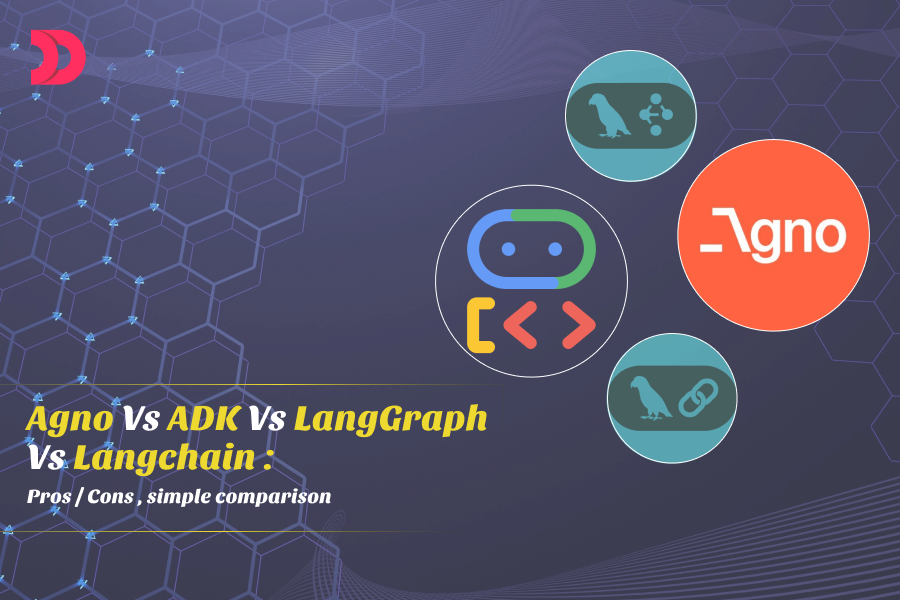
This definitive guide focuses on the leading AI agent frameworks Agno, ADK, LangGraph, and LangChain, with side-by-side comparison and their pros and cons. This post also includes the best-fit, real-life scenarios for more clarity. Let’s start with a quick overview of these AI agent frameworks.
Overview of AI Agent Frameworks- ADK, Agno, LangGraph, and LangChain
AI agents have become ubiquitous as all the core sectors have started adopting them. Somewhere, they handle customer services, and somewhere, they run financial models. Moreover, some companies use these agents to make real-time decisions. This leads to the increasing popularity of these agents across the world.
As per the Grand View Research report, the AI agents market is expected to reach approximately USD 50 billion by 2030 with a CAGR of over 45 percent. This estimate seems achievable as companies invest heavily in AI to improve their efficiency and reduce operational costs. The following graph shows the market size of AI agents between 2020 to 2030.
These AI agents need advanced frameworks that act as their foundation. Out of several options available, we will consider four major AI agent frameworks in this post.
Agno
This framework aims to solve the hard problems of deployment by focusing on reliability, structured outputs, and built-in observability. Agno is helpful for developers to transform a prototype into a secure, scalable service.
ADK
This is Google’s Agent Development Kit designed for enterprise scenarios. Its primary objective is to establish deep and seamless integration with the Google Cloud ecosystem, including Gemini models.
LangGraph
It empowers LangChain by handling complex and cyclical reasoning. It forces developers to model their agent flow as a State Machine or graph, providing precise control over state and multi-step decision-making.
LangChain
It is an original framework that focuses on rapid prototyping and module components. It provides a huge library of tools and integrations to enable developers to string everything in a sequential manner.
Let’s compare these four frameworks as per different parameters.
Head-to-Head Comparison- ADK vs Agno vs LangGraph vs LangChain
We will have a quick table to see the differences between the four top frameworks- ADK, Agno, LangGraph, and LangChain.
Features
Google ADK
Agno
LangGraph
LangChain
Core Focus
Enterprise-level Integration with Google Ecosystem
Reliability, Observability, and Structured I/O
Complex agentic workflows
Prototyping, Component Library
Agent Paradigm
Production Components, APIs
Structured Agents, Reliable Output
State Machine and Cyclical Graphs (DAGs)
Sequential Chains
Observability
Integrated with Google Cloud
Built-in monitoring
Improved using graph visualization
Basic
Learning Curve
Moderate
Moderate to Low
High
Moderate
Community
Large (Google-backed)
Small but growing
Large with LangChain extension
Largest
State Management
Handled by underlying GCP services
Built-in, State-based Transitions
Internal, Explicit
Internal, Explicit
Let’s check the pros and cons of these frameworks individually.
Pros and Cons of AI Agent Frameworks
Developers need to consider several factors when choosing the right agent framework. Here, we mention the pros and cons of the four top frameworks that play a vital role in the selection-
LangChain
Both LangChain and LangGraph belong to the same community. LangChain has the largest open-source community that offers numerous tutorials and immediate support. Moreover, it has an unparalleled range of integrations for models and databases.
Talking about the cons, LangChain brings unnecessary complexity and deep abstraction layers even for simple tasks. Furthermore, quick development speed often leads to frequent breaking changes and unstable APIs, with difficulty in the debugging process.
LangGraph
This framework is capable of solving complex, cyclical, and multi-step reasoning effectively. It also provides precise control over the agent state and decision-making flow. LangGraph is an advanced version that addresses complexities and challenges that LangChain cannot resolve.
It requires a deep understanding of State Machines, nodes, and edges. It adds overhead to simple linear tasks like LangChain. Though this is a robust framework, it can make developers stuck in a complicated ecosystem and increase the development time.
Google ADK
Agent Development Kit (ADK) from Google offers a seamless and scalable alignment with the entire Gemini ecosystem and GCP (Google Cloud Platform). It offers simplified and managed deployment pipelines within GCP. This open-source ADK supports other frameworks through the A2A protocol.
However, it is necessary to mention that Google ADK is optimized for GCP, which makes migration of AI agents to other cloud providers difficult. Additionally, developers may feel this framework is less flexible as compared to other available community-driven alternatives.
Agno
It has a production-oriented architecture with a lightweight design. It offers quicker instantiation time with reduced memory usage than competitors. It focuses on reliability and robust support for type-safe outputs. Moreover, built-in tracing, logging, and integrated UI dashboards are highly useful.
This is a relatively new framework with a smaller community and less adoption compared to LangChain. Furthermore, it has a less mature ecosystem with a growing integration library. This framework has a less mature component set than LangChain.
When to Use Which Framework- Your Useful Tips
It is essential to consider several aspects while deciding on a framework for making AI agents. One of these factors is the project’s goal. For example, LangChain is preferable if the primary requirement is rapid iteration with broad integration. Developers can choose LangGraph when the AI agents are complex and iterative that requiring advanced logic.
Agno is useful when the AI agent is used for measuring KPIs in production. Systems like a financial reporting agent require the Agno framework. On the other hand, Google ADK is beneficial when the team extensively uses the Google Cloud ecosystem for developing AI agents. This framework offers seamless security with unmatched scalability and streamlined integration.
It is better to consult a reputable AI development company to build an agent with the necessary features based on the most suitable framework.
Concluding Remarks
LangChain, LangGraph, Agno, and ADK are advanced frameworks to make enterprise-grade AI agents. However, it is essential to select the right framework based on the project’s requirements and other relevant factors. An AI app development company with a proven track record of making sophisticated agents can help you choose the most suitable framework.
DevsTree is a renowned AI app development company. We build high-end AI agents with customized features for various industry sectors. Contact us to learn more about our cost-effective development services.
I am sure you heard about AI and generative AI, but have you ever heard of Shadow AI? Since the growing popularity of ChatGPT and other AI tools, more people are becoming aware of Shadow AI. So what exactly is...
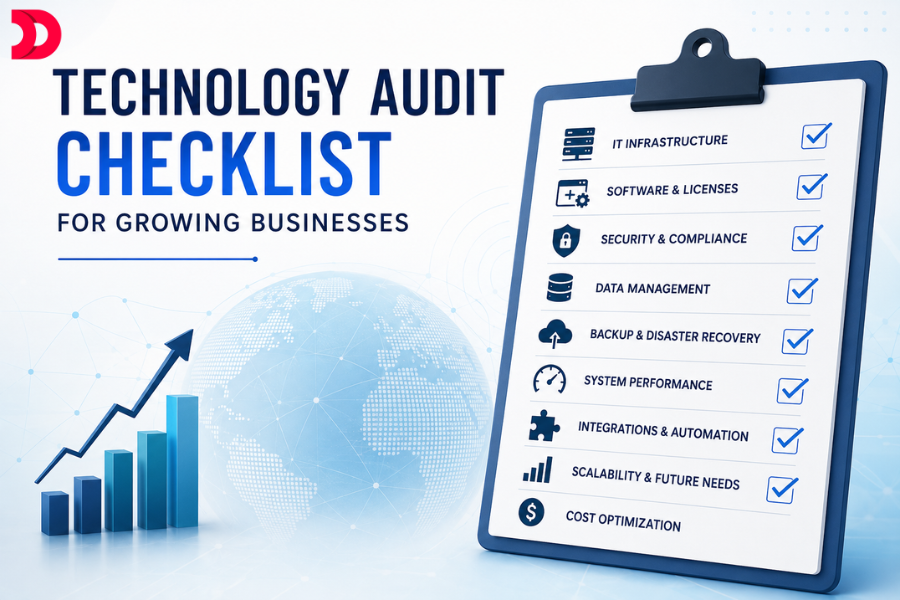
Sales pipelines expand, and hiring cycles accelerate- all these indicators highlight a hyper-growth phase of your enterprise. It is, however, necessary to consider that every operational element stretches to its limit in this phase. One such aspect is information technology...
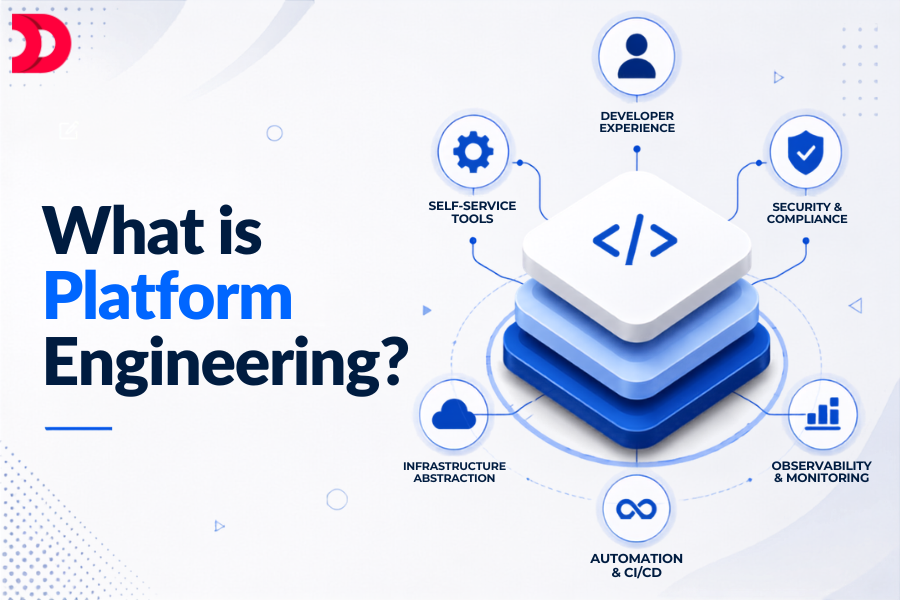
Platform engineering is an emerging discipline in software development. It can make the developer experience (DevEx) better and help them deliver products quickly. The platform engineering’s focus stays on building automated, self-service internal developer platforms (IDPs). Platform engineering teams build...
Digital Twin Technology is a digital representation of a physical object, process, system, or environment that continuously receives real time data from sensors, IoT devices, software, and connected systems. Unlike a static 3D model or simulation, a digital twin evolves...
Top Reasons Companies Are Moving to Hybrid Cloud Solutions On-premise or private cloud and public cloud approaches have made the entrepreneur’s life easy. In this competitive business scenario, however, it is not enough to implement a single concept. The world’s...
Every developer has lived this nightmare: it's 2 AM, your phone buzzes, someone on Slack says "the app is broken," and you have zero idea why. You open the logs thousands of lines scroll past but nothing tells you what...









 Aug 17, 2026