Algorithm is everything when it comes to measuring the effectiveness of AI models and the success of AI-based startups. Large Language Models (LLMs) and specialized edge AI are gaining fame quickly as enterprises want scalable solutions for handling multiple tasks. In such a scenario, algorithms in AI models play a crucial role. Entrepreneurs and techies must measure the capability and scalability of models to expand business and drive growth.
Here, MLOps Benchmarking comes into play. It can measure the scalability of AI models in terms of latency, throughput, and cost. This post talks about the importance of benchmarking to measure the performance vs cost trade-off of AI models. We will also dig deep into the way benchmarking improves the bottom line of modern business. Let’s start by discussing the role of MLOps Benchmarking for scaling AI.
Role of MLOps Benchmarking in Scaling AI
Most AI projects begin their journeys in a controlled setting where a data scientist trains a model on a high-end workstation. Here, experts measure the performance of AI models either by accuracy or through F1 scores. However, when this model comes out of the lab environment to serve a global user base, the aspects for measuring success change. Here, MLOps Benchmarking is essential.
When modern organizations treat AI model deployment as a ‘set it and forget it’ type of task and do not measure benchmarking, it may lead to the following issues-
A sudden increase in users could result in an exponential increase in cloud compute bills.
If an AI-powered bot takes more than 10 seconds to respond, users will abandon it.
There is no guarantee of 99.9% uptime without knowing the breaking point of GPU clusters.
Benchmarking provides the models with the necessary ‘stress test’ to move from a Proof of Concept (POC) to a robust enterprise-grade service. It enables corporate users to simulate real-world traffic and identify bottlenecks in the data pipeline. It also helps in selecting the right hardware for the company’s specific workload.
Key Metrics of MLOps Benchmarking
It is essential to define metrics to measure the benchmarks of models. Here are four predefined metrics of this benchmarking-
- Latency
It is the time taken for a single request to travel from the user to the model and back as a completed response. The current Generative AI-based era measures Time to First Token (TTFT) and Total Request Frequency.
Latency is a safety or usability requirement for real-time applications such as high-frequency trading or voice assistants. Technies focus on P99 Latency, which is the time within which 99 percent of requests are completed, to identify tail latency due to network congestion.
- Throughput
It measures how many inferences the infrastructure can handle at once. It is usually expressed in Queries Per Second (QPS) or Tokens Per Second (TPS) in the case of LLMs. Throughput defines the infrastructure’s ceiling for growth. High latency but low throughput indicates that your company cannot serve more than a few users simultaneously.
Throughput is directly related to market penetration. For example, if you want to support 100,000 concurrent users, throughput benchmarking can suggest the necessary hardware exactly.
- Cost per Inference
This is economy-related and the most critical metric for the C-Suite. It considers the total cost of infrastructure (compute, storage, etc.) and divides it by the number of successful inferences. Let’s understand the value of this benchmarking through an example.
If your Cost per Inference is USD 0.05 but your customer pays only USD 0.02 per interaction, you end up breaking the business model. Here, this benchmarking can help you find the necessary AI solution for this situation.
- Model Performance Drift
Let’s face it. AI models’ accuracy drops with the change in real-world data. This is known as Model Drift. For example, an AI model that was 95 percent accurate in January might be 70 percent accurate by June due to changes in data.
This metric includes a continuous evaluation of the model’s output quality against the given dataset. This evaluation can ensure that the model is still capable of meeting business requirements effectively.
How to Balance High Performance with Costs
Zero latency and infinite throughput with zero cost is an ideal situation. However, it is not possible in the real world. MLOps can assist companies in managing such situations-
- High Performance vs High Cost
It is essential to keep GPUs ‘warm’ 24/7 to achieve near-zero latency. However, this is incredibly expensive. Moreover, using ‘serverless’ AI functions can save money by only charging when the model is in use. But it introduces another latency that can damage the user experience.
- Model Optimization Techniques
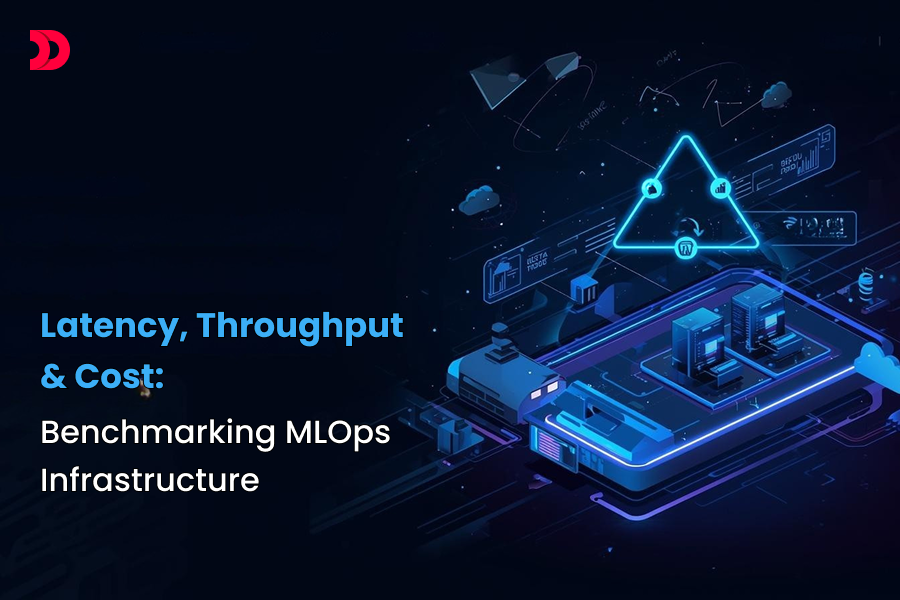
Techies use several optimization strategies, including quantization and pruning, to balance the triangle of cost, latency, and throughput. Benchmarking can reveal these strategies, and users can utilize them to optimize the model.
AI development companies can assist your enterprise in implementing these strategies into the models based on benchmarking. Let’s understand how benchmarking can improve the bottom line of a business.
Key Ways MLOps Benchmarking Improves Bottom Line
It is fair to say that benchmarking is not just a technical exercise. It can mitigate the risk of a model that directly impacts the ROI of your investment in AI.
Benchmarking enables teams to identify the ‘breaking point’ of their clusters and implement auto-scaling groups. This implementation can add more computing power to ensure that the users get a consistent experience globally.
- Accelerated Deployment Speed
A standardized benchmarking suite facilitates you to automate the ‘Go/No-Go’ decision for new models. If a data scientist develops a new version of a model, the MLOps pipeline can run it through the benchmark automatically. It can maintain the user experience effectively.
Benchmarking allows entrepreneurs to get the right size of GPU as per their requirements. It can tell the exact instances that provide your company with the best performance for the specific model infrastructure.
Apart from these aspects, companies can decide whether to go with the public cloud, like AWS/Azure, or move to the private cloud. However, it is necessary to consult a reputable AI software development company to understand more about how benchmarking can improve the bottom line.
Concluding Remarks
Advanced algorithms and MLOps infrastructure will give a competitive edge to modern companies in this AI-powered era. Whether a techie or an entrepreneur, benchmarking can help everyone to balance the triangle between cost, latency, and throughput. This can result in more reliability and an increase in the ROI over the period.
DevsTree IT Services is a renowned AI solutions provider. Our in-house team of experienced professionals can make user-friendly and advanced AI models to meet diverse business needs. Contact us to learn more about our enterprise software development services.











 Oct 01, 2026