Quick Answer:
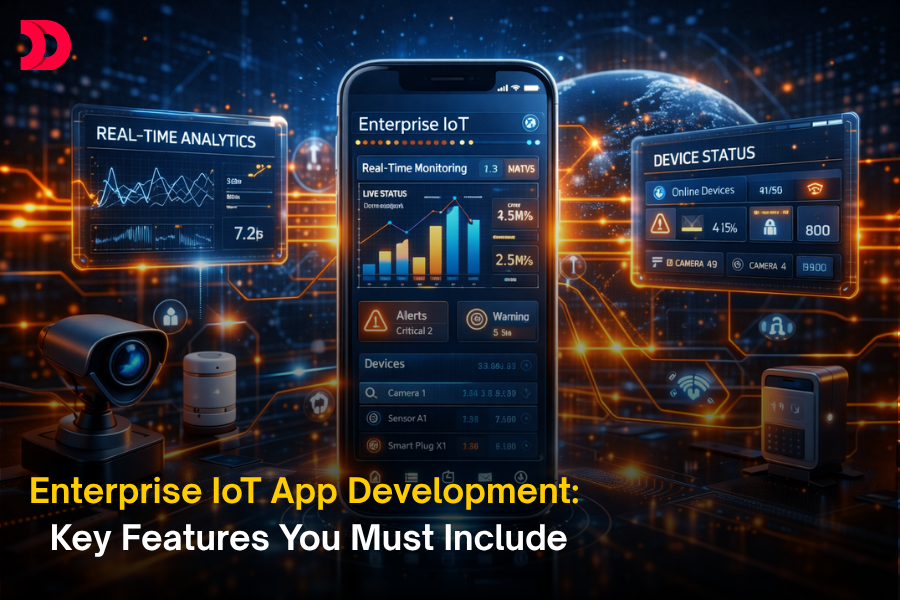
Enterprise IoT app development connects physical devices to business systems for real-time monitoring, analytics, and automation. Key features include scalable architecture, seamless ERP/CRM integration, end-to-end security, and cloud platform connectivity. Projects typically take 3–9 months and cost anywhere from $20K to $500K+ depending on complexity.
If you’ve been tasked with building an enterprise IoT application or evaluating whether your organization is ready for one you already know this isn’t a simple project. You’re not just writing an app. You’re connecting the physical world to your business systems, often at scale, across dozens or hundreds of devices.
The companies that get it right spend time upfront on architecture, security, and integration. The ones that skip those steps end up rebuilding everything six months in. This guide breaks down every key feature you need to include, the platforms worth considering, real-world use cases, and honest cost and timeline estimates.
What Is Enterprise IoT App Development?
Enterprise IoT app development is the process of building software that connects physical devices sensors, machines, vehicles, equipment to your core business systems. The app collects data from those devices in real time, processes it, and makes it actionable for your operations team.
Think of a manufacturing plant monitoring 500 machines simultaneously, a logistics company tracking every truck in its fleet, or a hospital system managing medical equipment across multiple buildings. That’s what enterprise IoT enables.
Important distinction: Consumer IoT (smart home devices, wearables) is very different from enterprise IoT. Enterprise deployments demand higher reliability, stricter security, deep system integration, and the ability to scale to millions of data points per day without breaking.
Factor
Consumer IoT
Enterprise IoT
Scale
Dozens of devices
Hundreds to millions of devices
Uptime requirement
Best effort
99.9%+ availability
Security standard
Basic encryption
End-to-end, compliance-grade
Integration
Standalone or app-based
ERP, CRM, data warehouses
Typical cost
$500–$5,000
$20K–$500K+
Key Features You Must Include
These aren’t optional add-ons. Every enterprise IoT application that holds up in production includes these features from day one. Skipping any of them creates technical debt that’s expensive to fix later.
Scalable architecture
Distributed, modular design that handles high loads without failure. Built to grow with your data volume.
System integration
Seamless connectivity with ERP, CRM, data warehouses, and legacy systems your business already runs on.
End-to-end security
Protection across the entire pipeline — from device to cloud. Covers authentication, encryption, and access control.
Real-time monitoring
Live dashboards and alerts that surface anomalies, threshold breaches, and operational events instantly.
Data analytics
Built-in processing layer that turns raw device data into structured insights your team can actually act on.
Automation engine
Rule-based and AI-driven triggers that automatically respond to device events without manual intervention.
Architecture: Get This Right First
Architecture is the most critical decision you’ll make, and it’s the hardest to change later. Enterprise IoT architecture needs to be distributed, modular, and designed to handle failure gracefully. A single monolithic system will buckle under real-world loads.
Your architecture should separate the device layer, the messaging layer, the processing layer, and the application layer. Each piece can then scale independently. Common messaging protocols include MQTT (lightweight, ideal for constrained devices) and Apache Kafka (high-throughput event streaming for large-scale deployments).
Common mistake: Teams design for current device counts and get blindsided when they scale from 50 devices to 5,000. Design for 10x your current volume from the start it’s far cheaper than retrofitting later.
Security: Non-Negotiable at Every Layer
IoT security breaches are catastrophic because compromised devices can affect physical infrastructure, not just data. You need protection at every layer device authentication, encrypted data transmission, secure API endpoints, and role-based access control for the application itself.
Compliance requirements add another layer. Healthcare deployments need HIPAA compliance. Financial applications require SOC 2. Industrial systems often need IEC 62443. Build compliance in from day one, not as an afterthought.
Integration with Existing Business Systems
Your IoT app doesn’t exist in isolation. It needs to communicate with the tools your business already uses ERP systems for operations, CRM platforms for customer data, and data warehouses for long-term analytics. Poorly planned integration is one of the top reasons enterprise IoT projects run over budget and timeline.
Best Platforms for Enterprise IoT Development
Platform choice depends on your existing cloud ecosystem, team expertise, and the scale of your deployment. Here’s a clear breakdown of the leading options.
Platform
Best For
Key Strength
Pricing Model
Microsoft Azure IoT Hub
Large-scale enterprise deployments
High-throughput cloud data ingestion, deep Microsoft ecosystem integration
Per-message / per-device
AWS IoT Core
Teams already on AWS
Tight integration with Lambda, S3, and Kinesis for event-driven workflows
Per-message / per-connection
IBM Watson IoT
AI-heavy analytics use cases
Strong built-in AI/ML capabilities for predictive insights
Subscription tiers
Mendix IoT
Low-code / visual app building
Visual modeling speeds up development; good for non-developer teams
Per-app subscription
Windows IoT Enterprise
Windows-based device environments
Familiar development ecosystem; Visual Studio toolchain support
OEM licensing
Our take: If your organization is already in the Microsoft ecosystem, Azure IoT Hub is the natural choice the integration with existing tools is hard to beat. If you’re greenfield, AWS IoT Core offers the most flexible event-driven architecture.
Common Enterprise IoT Use Cases
Understanding where IoT adds real business value helps you prioritize features and justify the investment. These are the four most common and most proven use cases in enterprise deployments today.
Predictive maintenance: Sensors on equipment detect early signs of failure vibration anomalies, temperature spikes, pressure drops and trigger maintenance alerts before breakdowns occur. Organizations using predictive maintenance report 25–30% reduction in unplanned downtime.
Asset tracking and management: Real-time GPS and RFID visibility of physical assets vehicles, equipment, inventory, containers across multiple locations. Eliminates manual tracking and reduces asset loss significantly.
Smart factory automation: IoT-connected production lines that auto-adjust parameters, flag quality issues, and optimize throughput in real time. Widely adopted in manufacturing and pharmaceutical production.
Process automation and data collection: Replacing manual data entry with automated sensor-driven collection across operations reducing errors and freeing staff for higher-value tasks.
Development Process: From PoC to Production
Successful enterprise IoT projects follow a structured process. Jumping straight to full-scale development without validation is the fastest way to waste budget.
Phase
Goal
Typical Duration
Output
Proof of Concept (PoC)
Validate technical feasibility with minimal investment
4–8 weeks
Working prototype on limited devices
MVP
Build core features for a real environment test
2–4 months
Deployable app with essential functionality
Iterative development
Expand features based on real feedback
Ongoing sprints
Stable, full-featured production app
Full deployment
Scale to full device fleet and user base
1–3 months
Live enterprise IoT application
Cost and Timeline: What to Realistically Expect
One of the most common questions teams ask is: “how much will this cost and how long will it take?” Here’s an honest breakdown based on project complexity.
Project Type
Estimated Cost
Timeline
Complexity
Basic IoT app
$20K – $50K
3–4 months
Low
Mid-tier enterprise app
$50K – $150K
4–7 months
Medium
Full enterprise solution
$150K – $500K+
6–9 months
High
PoC / MVP only
$10K – $30K
4–8 weeks
Validation
Budget tip:
The biggest cost drivers are custom integrations with legacy systems, compliance requirements, and device count. If you can start with a PoC to validate core assumptions, you’ll reduce risk and often cut total project cost by 20–40%.
Enterprise IoT app development is complex but it doesn’t have to be chaotic. The organizations that succeed treat it as a strategic infrastructure investment, not just a technology project. They start with a PoC, choose platforms that align with their existing ecosystem, build security in from day one, and design architecture that scales.
The key features covered in this guide scalable architecture, ERP/CRM integration, end-to-end security, real-time monitoring, and a strong data layer aren’t optional. They’re the difference between an IoT application that drives real business value and one that becomes a costly maintenance burden.
Start small, validate fast, and build toward scale. That’s the enterprise IoT playbook that actually works.
The hospitality sector witnesses a massive shift in terms of customer expectations, bookings, and occupancies. Yesterday’s luxury was defined by plush carpets, and today’s luxury is defined by seamless experiences. Modern travelers cannot wait in a queue at the front...
Stockouts or shortages of products can cause a lot of damage to the retail business. Retailers can miss revenue and lose customer trust in this omnichannel commerce landscape due to stockouts. IoT (Internet of Things) technology can help them avoid...
Globally, the agriculture sector witnesses a revolutionary change. It is largely because of the geopolitical situation, changing monsoon patterns, and even increasing temperature. The world’s population is expected to reach nearly 10 billion by 2050, which will cause a huge...
Whether it is Industry 4.0 revolution or smart factory, the Internet of Things (IoT) has remained a foundational pillar of modern tech concepts. Today, we have billions of connected devices from smart medical implants to industrial sensors. All these devices...
IoT is changing how businesses operate. From smart homes and wearable devices to industrial automation and connected healthcare systems, Internet of Things applications are everywhere. But before building an IoT solution, one big question comes up: how much does IoT...
We started with a BLE integration task.We ended up reverse-engineering an encrypted security protocol. Kerong’s BLE smart locks operate nothing like consumer Bluetooth devices. Why? Because beneath the BLE layer sits a multi-stage security architecture. It involves many security nuances...









 Sep 08, 2026