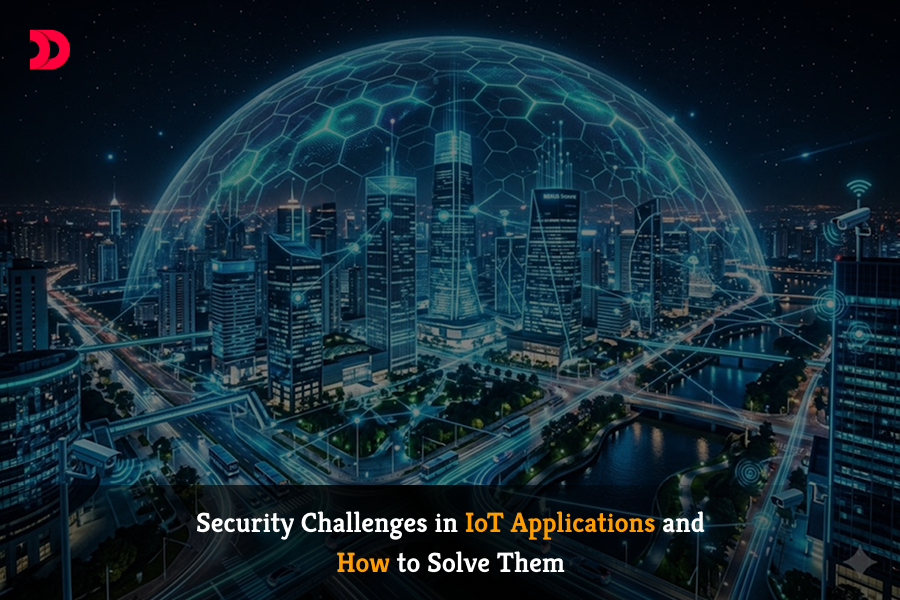
Whether it is Industry 4.0 revolution or smart factory, the Internet of Things (IoT) has remained a foundational pillar of modern tech concepts. Today, we have billions of connected devices from smart medical implants to industrial sensors. All these devices touch our lives through feature-rich applications. However, this hyperconnectivity brings the risk of cyberattacks. As companies tend to integrate this technology, they must address the challenges in IoT security.
This post talks about some of the major security challenges in IoT applications. These challenges range from simple password vulnerabilities to sophisticated AI-based threats. A reputable IoT app development company can assist you in solving these challenges by following the ‘Security by Design’ philosophy. Here we mention some key challenges related to IoT security. We will also dig deeper into the ways to address them effectively.
Major Challenges in IoT Security
Let’s face it. Mostly, connected devices are resource-constrained and geographically dispersed. This can lead to security gaps, and traditional IT frameworks may not address properly.
Device Constraints and Limited Power
Many IoT devices that are used in large-scale agriculture or environmental monitoring, require less power. However, these devices always lack the memory necessary to run advanced encryption algorithms or modern antivirus software. It makes them soft targets for hackers or cyberattackers who exploit these limitations.
Insecure Firmware and Patch Management
Mostly IoT devices work on the ‘Set and Forget’ approach. There are no regular updates in these connected devices. As a result, a vulnerability may remain undetected for years. When attackers use automated bots to scan devices with outdated firmware, they can easily find this vulnerability and target it.
Data Privacy and Communication Issues
IoT applications often handle sensitive telemetry data, including health metrics. They also contain confidential data like home layouts or industrial secrets. The lack of encryption of the communication channel between the device and the cloud may result in ‘man-in-the-middle’ attacks.This leads to massive data and privacy breaches for the company.
Companies can hire IoT developers to address these challenges. It is necessary because IoT security is more complex than traditional IT security.
Difference between Traditional IT vs IoT Security
The IoT ecosystem consisting of sensors and actuators is more complicated that traditional IT systems comprising servers. Here is a quick table of comparison between traditional IT and IoT with a focus on security.
Feature
Traditional IT
IoT Ecosystem
Hardware
High-performance, standardized
Resource-constrained, heterogeneous
Updates
Centralized and automated
Decentralized and manual
Physical Access
Secured in office or data centers
Often placed in public or remote areas
Lifespan
3-5 Years
10-20 Years
It is necessary for modern businesses to go beyond reactive measures to address the IoT challenges.
How to Secure the IoT Lifecycle
A startup or a global enterprise can leverage the following strategies to safeguard their IoT lifecycle.
Zero Trust Architecture
This model assumes that no device inside or outside the corporate network is trustworthy. Every device needs verification by default. Companies can ensure that the attacker cannot access the confidential database by implementing micro-segmentation.
Robust Identity Management
It is essential to stay away from universal passwords. Every device should have a unique and secure identity. Enterprises can utilize PKI (Public Key Infrastructure) and digital certificates. It helps them make sure that only authorized devices can communicate with their servers.
AI for Behavioral Analytics
Static security rules are not enough in the year 2026 and beyond. Modern security frameworks use AI to establish normal behavior. For example, if a smart meter starts sending gigabytes of data to an unknown IP address suddenly, the system separates this device.
It is essential to choose the right IoT application development company to implement these strategies and ensure secure rollout.
Importance of the Right Development Partner
Making of a secure and user-friendly IoT application requires deep expertise in embedded systems and cybersecurity protocols. When companies hire IoT developers, it is essential to confirm that they understand the nuances of secure boot and HSMs. Moreover, sufficient knowledge of encrypted data pipelines is also necessary.
A specialized IoT app development company brings a lot of experience in navigating regulatory frameworks including the EU’s Cyber Resilience Act. The right app development partner assists companies to get the secure code for their dedicated apps from day one. Organizations can leverage the benefits of this revolutionary technology with the help of the right partner.
Let’s have a glimpse on future trends that can contribute to addressing security challenges.
Future Trends for Addressing Challenges in IoT Security
Blockchain and cryptography are two futuristic technologies that redefine IoT security. Let’s dig deeper into them.
Blockchain
It eliminates ‘single points of failure’ by decentralizing device identity and logs. This technology offers tamper-proof ledgers that record every interaction of the device. This can make audit trails transparent and immutable.
Post-Quantum Cryptography
The rise of quantum computing has started replacing traditional encryption. Experienced app developers are experimenting with quantum-resistant algorithms to protect IoT assets. We can expect that quantum cryptography will become more popular in the years to come.
IoT app development companies and enterprises prioritize security, and therefore, we can expect that more trends will come to address related challenges.
Concluding Remarks
IoT has the potential to transform industries of different sizes. However, it is essential to ensure security of the IoT ecosystem and application. Companies should identify the unique challenges in IoT security ranging from hardware constraints to the lack of standardization. They can choose the right IoT app development company or hire IoT developers with a security-first mindset to address challenges.
DevsTree is a renowned IoT application development services provider. Our in-house team of dedicated app developers combine IoT, AI, and data engineering to build enterprise-grade solutions. Contact us to learn more about our services and the best practices we follow to address IoT security challenges.
The hospitality sector witnesses a massive shift in terms of customer expectations, bookings, and occupancies. Yesterday’s luxury was defined by plush carpets, and today’s luxury is defined by seamless experiences. Modern travelers cannot wait in a queue at the front...
Stockouts or shortages of products can cause a lot of damage to the retail business. Retailers can miss revenue and lose customer trust in this omnichannel commerce landscape due to stockouts. IoT (Internet of Things) technology can help them avoid...
Globally, the agriculture sector witnesses a revolutionary change. It is largely because of the geopolitical situation, changing monsoon patterns, and even increasing temperature. The world’s population is expected to reach nearly 10 billion by 2050, which will cause a huge...
Quick Answer: Enterprise IoT app development connects physical devices to business systems for real-time monitoring, analytics, and automation. Key features include scalable architecture, seamless ERP/CRM integration, end-to-end security, and cloud platform connectivity. Projects typically take 3–9 months and cost anywhere...
IoT is changing how businesses operate. From smart homes and wearable devices to industrial automation and connected healthcare systems, Internet of Things applications are everywhere. But before building an IoT solution, one big question comes up: how much does IoT...
We started with a BLE integration task.We ended up reverse-engineering an encrypted security protocol. Kerong’s BLE smart locks operate nothing like consumer Bluetooth devices. Why? Because beneath the BLE layer sits a multi-stage security architecture. It involves many security nuances...









 Sep 08, 2026