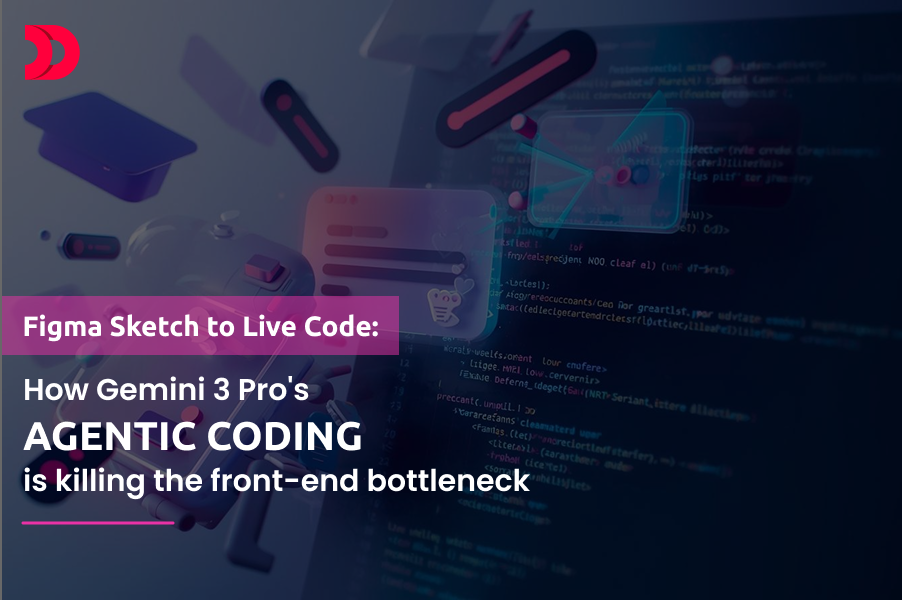
The front-end bottleneck has kept developers on their toes for years. It is the tedious and error-prone process of converting static and high-fidelity designs, created in Figma or Sketch, into dynamic, production-ready code manually. This challenge demands countless hours of repetitive effort, leading to frustrating pixel-perfect debates. It is also prone to discrepancies between the design mockups and the final product, which causes delays.
Gemini 3 Pro has given an agentic solution to this challenge by introducing Agentic Coding. This next-generation AI agent can interpret an entire visual artifact and understand its layout, hierarchy, and style. It plans and executes the code generation across multiple files and components autonomously. The Agentic Coding model has the ability to reason like a developer. This can eliminate the manual translation layer between design and development.
This post discusses the role of agentic coding in the front-end ecosystem and solving the challenge of converting designs into dynamic code. Let’s start by discussing the core features of Gemini 3 Pro and agentic coding.
Overview of Core Features of Gemini 3 Pro and Agentic Coding
Gemini 3 Pro has the capability for multimodal AI development. It means that the model can ‘see’ the design. It can ingest a wide variety of inputs together, including images like Figma screenshots and low-fidelity wireframes. Multimodality enables Gemini 3 Pro to understand the visual context deeply, even for hand-drawn sketches. It is crucial for design-to-code tasks because the model can perceive the visual hierarchy, layout, spacing, and typography.
The next feature of Gemini 3 Pro is the ability to translate vision into a detailed action plan. Also known as agentic coding, this concept goes beyond simple and single-prompt AI code generation. An agentic model of Gemini 3 Pro generates a block of code and operates through a sequence of steps to fulfill a complex task autonomously. It can generate relevant placeholder data for display as well.
In a way, this concept acts as a developer agent that executes a multi-step workflow to deliver a complete, functioning output in design. Next, we will examine the workflow steps.
Step-by-Step Guide to Gemini 3 Pro Workflow
Gemini 3 Pro can execute a seamless, three-step workflow for transforming static visual designs into functional code without human intervention. Here are the steps for the agentic workflow:
Step 1. Ingesting the Visuals
It starts as Gemini 3 Pro ingests a visual input. For example, a high-fidelity Figma screenshot or a conceptual image is ingested. Now, this model interprets the intent of the design with its multimodal capabilities. Here, the AI understands the visual hierarchy, aesthetic style, and user flow. At the same time, the human developer remains in the loop for providing crucial context using the prompt. This sets the stage for high-quality output.
Step 2. The Agentic Execution
The agentic coding workflow starts after receiving the input. Here, AI moves from interpretation to autonomy. The agent starts the first task, planning, by decomposing the complex visual design into smaller, functional components. Code generation is the next task in which the agent outputs structures and clean code. Then the agent enters a phase of refinement by using its advanced reasoning. It checks the visual rules and corrects the code.
Step 3. Deployment and Iteration
The generated and fully structured code is accessible to developers through the Gemini API for web apps. It enables them to integrate the robust AI code generation directly into development environments, CI/CD pipelines, or custom internal tools. Developers can pull the generated codebase into their IDE (Integrated Development Environment) for final review and manual refinements. As a result, the design file will be converted into a live app.
It is interesting to see how this workflow can solve the design shortcomings in the front-end environment.
Impact on Front-End Ecosystem and Solving Bottleneck
The emergence of agentic coding restructures the front-end development workflow from scratch. It automates the most tedious and repetitive steps to save the developer’s time and effort. It brings a paradigm shift in the developer’s role by making them a high-level architectural manager from a manual translator. Here is how it solves the bottleneck:
- Agentic Coding as a Solution
The immediate and most tangible impact of agentic coding is the elimination of the front-end bottleneck. Gemini Pro 3 facilitates a significant reduction in the time-to-market by handling the labor-intensive process of translating virtual assets into code. It enables developers to focus on high-value complex tasks by handling mundane translation work autonomously. In other words, developers can handle the integration of complex logic and other tasks.
- Designer-Developer Strategy
The rise of agentic AI technology has brought radical changes in the relationship between designers and developers. Its multimodal AI development capabilities enable designers to adhere to established system and component libraries. This is necessary to reduce ‘design drift,’ while enabling designers to gain the ability to prototype functional applications instantly. Developers can receive clean, standardized code to minimize the friction and confusion.
Role of Developers in the Future
The transformational impact of Agentic Code in the Gemini 3 Pro redefines the developer’s role. Developers have become AI architects instead of manual code writers or translators. They can manage and direct the code generation agents while focusing on quality assurance. This will enhance the value chain in the future and enable developers to focus on critical thinking to address complicated challenges.
Concluding Remarks
The age of manual design-to-code translation has come to an end with the advent of agentic coding. This capability of Gemini 3 Pro has transformed the front-end workflow to remove a bottleneck for developers. As AI makes and executes a plan based purely on visual and conceptual inputs, developers can focus on complexity and innovation. The future of accelerated app development will integrate AI code generation into the existing workflow.
DevsTree is a leading AI/ML development company that assists the global corporate clientele in leveraging the benefits of agentic AI technology. We utilize the technological enhancements in every step of software development, from design to development. Contact us to learn more about our services and their scope to drive growth for your business.






 Nov 28, 2025