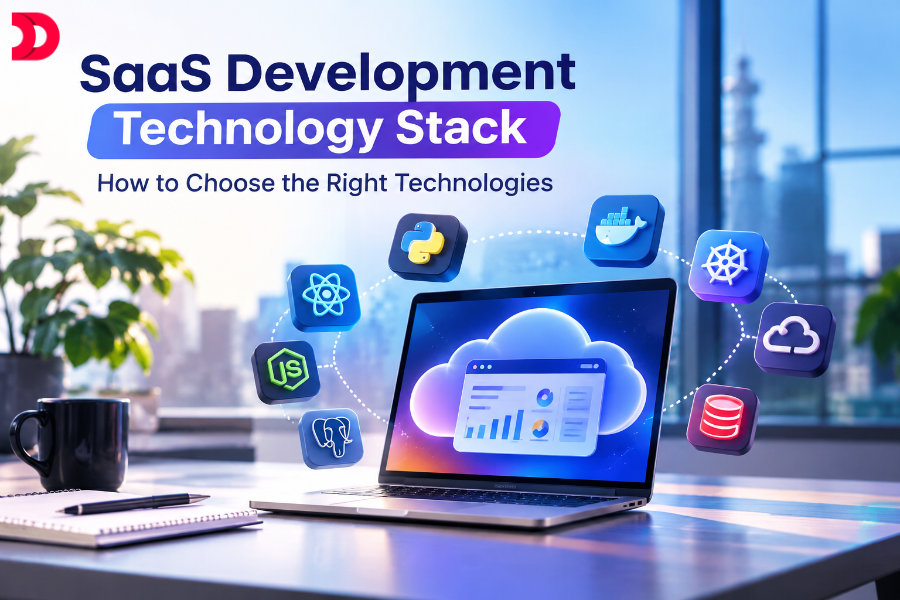
Looking to build a SaaS product but confused about how to choose the right technologies for your SaaS development technology stack? With so many people recommending different technology stacks, many brands are usually attracted to the one that is popular and that every other business is using. The right technology Stack isn’t the most popular; it’s the one that fits your development costs, saves you time, handles your application’s data efficiently, and that your developers are familiar with. But before moving forward, let’s first understand what a SaaS technology stack is and how to choose the right technologies for your SaaS software.
What is SaaS development?
SaaS application development is cloud-based software that users can access over the internet without actually installing it on the device. Unlike traditional apps, which must be installed on the device to access, SaaS applications can be used easily through the internet in a web browser on a subscription basis. Some of the well-known SaaS applications include Canva, Slack, Google Drive, and Dropbox.
Criteria for choosing the right tech Stack
Choosing the right tech Stack is one of the most crucial and hardest parts, especially for Startups looking to build SaaS software. Today, there are many third-party tools and libraries available to build a SaaS product, but finding the perfect combination is very crucial from day one. Otherwise, it can be very hard to change the tech stack later down the road. Before moving forward, businesses should consider a few criteria when choosing their SaaS architecture.
The first criterion is easy setup. Make sure to use technologies that are easy to set up. Avoid new, shiny, popular CSS frameworks that everyone is using, and choose a set of libraries that actually complete your business requirements and help you easily integrate with other libraries later in the future. Good DX (Developer Experience) is very important. Choose the right tech stack that your developers have expertise in. Lastly, look for third-party tools and technologies that have at least a free plan so that early-stage startups and MVPs can get started with the SaaS without having to pay upfront. And once you combine AI skills with this, the combination becomes more powerful.
What is a SaaS tech Stack?
A SaaS tech stack combines technologies, programming languages, frameworks, and tools used to build, run, and scale your SaaS (Software as a Service) application. The SaaS tech stack includes Frontend, Backend, Database development, cloud hosting, security, and maintenance. Let’s understand each component of the SaaS tech stack and its role in application development.
1. Frontend and Backend for SaaS
What is Frontend Development
Front-end development is the client-side of any application or website that users can see and access.
What is Backend Development
Back-end development is the server-side part of the application that works behind the scenes.
React (MERN stack development)
React is one of the best JavaScript libraries for building front ends and websites; combined with TypeScript, it helps reduce code errors. React is one of the most popular front-end libraries and offers a wide range of community packages like markdown editors, animation utilities, or UI libraries. AI is also good at writing React code because it has been trained extensively on React code.
MERN Stack development is a combination of 4 technologies: using the React framework for the frontend, MongoDB for the database, Express.js for the backend, and Node.js, a runtime environment to build a full-stack SaaS application.
Angular (MEAN Stack Development)
Angular is a full-fledged front-end framework for creating flexible, scalable, and interactive interfaces for your SaaS product. Angular allows developers to build dynamic single-page web applications. It also has a strong foundation in TypeScript. Angular provides a lot of components and features such as control flow syntax, Deferrable views, and Hydration strategies. It also offers ready-to-use tools for routing, HTTP communication, forms, and testing.
MEAN stack development is a combination of 4 technologies: using the Angular framework for the frontend, MongoDB for the database, Express.js for the backend, and Node.js, a runtime environment to build a full-stack SaaS application.
Next.js
When it comes to choosing a SaaS tech stack, there are 2 options: Either using separate codebases for Frontend and Backend development or using the same codebase for both through Next.js. If you ask me, my recommendation is to use a single codebase for both. Using different ones for both can be hard to manage in the future.
Along with MERN and MEAN stack development, Next.js is a React-based framework that is widely used in web application development and is best for creating high-quality web applications with some great features such as data fetching, client and server rendering, HTML streaming, and advanced routing. Next.js can be used for both front-end and back-end development, with no need for a separate codebase.
Features:
- Easy to set up
- Big companies like Netflix and Notion use Next.js
Other Languages and frameworks for Frontend and backend development are HTML, CSS, JavaScript, React Router, TypeScript, .NET, Node.js, Java, Python, and PHP
2. Database
A database is a collection of organized data. It stores and manages the data of your application, such as user data, product data, inventory data, and other important business data. Every SaaS app needs a way to save data. So, which database should we use?
PostgreSQL is the best choice because it has all the features you need to build your SaaS product. PostgreSQL is an open-source relational database. It can store and scale most complicated data workloads. It is loved for reliability, data integrity, a robust feature set, extensibility, and support for complex queries, transactions, JSON data, full-text search, and Geospatial data. Postgres scales well, supporting table partitioning, authentication, advanced indexing, and replication.
It plugs perfectly into almost any modern cloud architecture and system design pattern best for storing and scaling enterprise data. To build a modern AI application, simply add PG Vector extension. Postgres lets you store your complex AI embeddings directly.
3. Authentication
Authentication is a must, as it helps to identify who is trying to access the website
Better Auth is one of the easiest ways to set up authentication in a SaaS app, packed with features. It works perfectly with your other stacks, supports social sign-on (for Apple, Google, or GitHub), built-in credential auth, Auth for AI agents, security & observability, making your SaaS product enterprise-ready.
4. Cloud Hosting
Vercel is best when it comes to Cloud hosting. It is easy to set up and has a free-tier plan. The best thing about Vercel is that it can connect to GitHub. Simply push your code to GitHub, choose the repository, and Vercel deploys it. Then you will have your own URL and can set up your domain. It supports various frameworks such as Next.js.
Vercel also offers preview branches. So if you want to add any new feature to the SaaS product, you are going to have your own custom URL that you can check out before merging it back into the main branch and making it available for all to see.
Other popular cloud platforms include
- Amazon Web Services (AWS)
- Microsoft Azure
- Google Cloud Platform (GCP)
5.Email Delivery
Resend is the best platform to use to send welcome Emails, notifications, and password resets. It has a clean API, great deliverability, and is easily customizable with email templates. Companies of all sizes use Resend to send important Emails. Its simple, elegant interface makes it easy to start sending emails in minutes. Resend easily integrates with your favorite programming languages with ready-made tools (SDKs).
6. Cloud Security
Cloudflare R2 is best for storing files, images, and unstructured data. It is S3-compatible and has zero egress fees. So, you are not paying extra for bandwidth when you download files or load images. Its generous free tier allows you to start with R2 object storage.
7. AI Skills
Adding AI skills to your Tech stack can take your SaaS product to the next level. AI Skills are the reusable capabilities of AI agents that allow you to enhance your AI agents. For example, you can have a UI design skill when asking Claude to redesign the landing page. The skill will provide a relevant design that Claude can follow to implement the new landing page. Anyone can install AI skills in the project and add them to the codebase. Simply open Skills.sh to find and search all the AI skills. One can install any skill simply using a single command.
Best web development stack for different projects
| Project |
Best recommended stack |
| SaaS Application |
Next.js with Node.js and PostgreSQL, MERN, or Laravel with React |
| Startups and MVP |
Ruby on Rails, Laravel, Django, or a JavaScript-based stack such as Next.js or Node.js |
| Ecommerce |
Shopify, WooCommerce, or a custom stack of Laravel, React, and PostgreSQL |
| Enterprise Application |
.NET, Java, Angular, React, or Laravel |
| AI Application |
Python with Django or FastAPI, combined with React or Node.js backend development |
| High Traffic Applications |
Next.js, React, Node.js, Laravel, Django, or other mature frameworks |
What mistakes to avoid while choosing a Tech Stack for your SaaS development
- Do not choose a technology or framework because it is popular. Every business has its unique requirements. Conduct a technology stack evaluation and choose the one that fits your business needs, development costs, timeframe, and technical features.
- Just because it fits does not mean it’s right. You do not need to use every single technology or third-party tool in your SaaS application. Choose a simple stack that is easy to set up, scale, and maintain.
- Do not choose a stack that your developers aren’t familiar to work with. Choosing a technology or framework that your teams are not comfortable working with can become hectic to maintain in the future.
- Do not simply focus on the development speed. We understand developing and launching software quickly is important, especially for startups, but rushing the development without proper planning can cost you a high price.
- If your SaaS application is working great with few users, it doesn’t mean it will in the future as well when the traffic increases. Choose technologies and frameworks that can handle increasing users, data, and workload as your SaaS app grows.
- Do not rebuild your entire SaaS product when you find performance or maintenance issues. First, identify the problem and try to fix it; if not, then you can think about rebuilding the entire application.
- While choosing the newest and most trendiest technologies can help you build a modern application, choosing them without considering the business ecosystem, cost-efficiency, scalability, and developer resources can lead to mistakes.
Conclusion: Where DevsTree stands
Choosing the right SaaS stack is a very crucial step, and many organizations make mistakes at the first step. At DevsTree, we provide Saas Consulting and product strategy services where we analyze your business needs, project requirements, development cost, and project timeframes to help you choose the right SaaS tech stack that will enhance your business growth.
Not only that, but we can also help you build the custom SaaS stack using the right technology that is aligned with your current business requirements while keeping it simple, flexible, scalable, and easy to maintain.








 Nov 13, 2026