Modern businesses mean using trending, up-to-date technology, ideas, and methods while building software. But one of the major things that businesses usually neglect, but that severely impacts how your brand looks, feels, and operates, is software architecture style. There are 3 types of architecture: monolith vs. microservices vs. modular monolith.
Choosing the correct software architecture will determine your website’s scalability, performance, cost, security, and maintainability. On the other hand, choosing the wrong architecture can make your software slower, more expensive, and hard to maintain. If you are also stuck on which architecture will suit your modern business, then today is your lucky day. In this guide, we will help you understand the differences, pros, and cons between all 3 so that you can choose the right structure for your business.
What is Monolith Architecture?
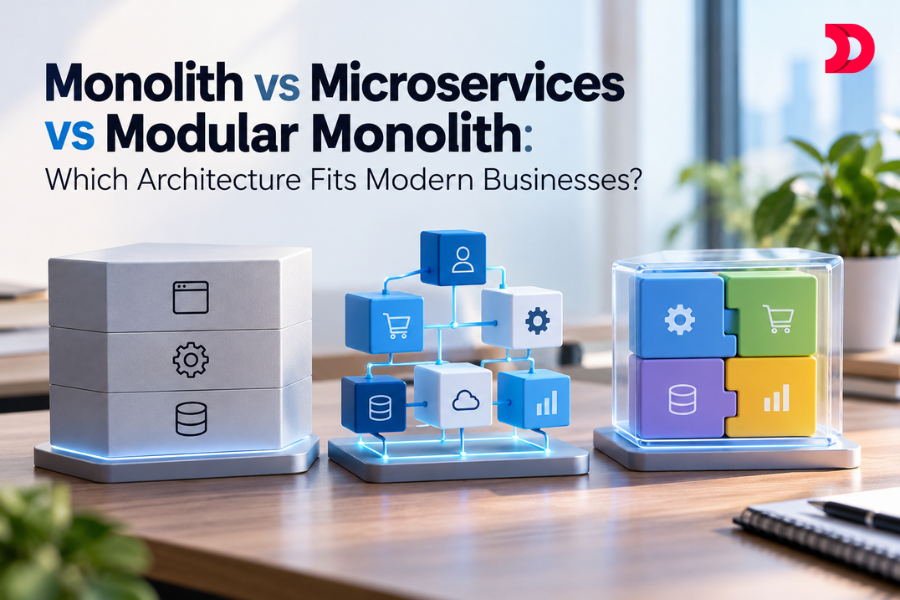
In Monolithic architecture, an application is developed as a single unit and deployed as a single unit, with a single CI/CD pipeline.
A typical web application has 3 components: Front-end, Back-end, and data storage. Monolithic architecture is a structure where the front-end, back-end, and data storage are written and deployed together in a single codebase. Monolithic architecture is a traditional structure that helps businesses build an application from scratch. It is the best architecture for small or early-stage applications.
Initially, every application built with monolithic architecture gradually migrates to a better architecture as the app’s requirements and scalability grow.
Example: Let’s say you run an online shopping app. In a monolithic architecture, all the major functionalities — user ID, products, orders, inventory, and payment – are developed and deployed together as a single application.
Pros
- It is easy to understand, develop, and manage.
- Since all code lives in a single application, it helps developers make changes very easily
- It can be built at a lower cost with minimal infrastructure.
- There is only one system, one database, and one deployment pipeline, making it less confusing.
- All code is written in one application, which makes it easy to secure the architecture.
- It also makes the integration testing easier
Cons
- If a bug occurs in a component, it can affect the performance of the entire application
- Every time you make a small change in any part of the application, the entire application gets redeveloped and redeployed.
- As the company grows, its codebase grows, which leads to slower development
- Even if you want to update just one module, you have to deploy the entire application.
What is Microservices Architecture
In a microservices architecture, each component of a web application is developed as a small, independent service. Each service is responsible for a specific business need and communicates through APIs. This means that with microservices, you can develop a service, deploy it, and even scale it independently, making it suitable for cloud-native architecture.
As businesses grew, scaling with monolithic architecture became difficult and costly. To overcome these disadvantages of Monolithic architecture, people turned to microservices architecture, where businesses can easily scale or update a required service without scaling the entire application.
Example: Let’s say you run an Airbnb Platform. In a microservices architecture, all the major functionalities like user authentication, property listings, and payments are developed, deployed, and scaled into small, independent services. Each service will have its own database and can communicate with other services through APIs. So if your payment service requires scaling, you can scale only the payment service without impacting the other services, which was not possible in a monolith.
Pros
- Each service can be scaled, updated, and managed independently.
- Issues in one service will not affect the performance of the entire application
- Developers can use different tools, programming languages, and different versions for each service.
Cons
- Managing hundreds and thousands of independent services can become complex.
- Communication with other services only happens through APIs, which increases processing time and delay.
- CI/CD pipeline, tools like Kubernetes, and proper monitoring are required for managing a microservices architecture.
What is Modular Monolith Architecture
A modular monolithic structure is basically one deployable unit, but its codebase is organized into separate, loosely coupled modules. This architecture makes development clean, deployment easy, and reduces infrastructure costs. It makes code organization and monitoring easy. Also, since the code is divided into independent modules, debugging is easier.
How is this different from Microservices? Imagine you have built a food delivery app using a microservices architecture, with login, orders, payments, and notification services. The more services you have, the more deployment and infrastructure resources you require. Also, as the business evolves, the services also increase, making infrastructure costs and debugging a nightmare.
Moreover, if one service of your application fails, it will impact the others too. Doesn’t it sound complex? To overcome this issue, the 3rd and most popular architecture, Modular Monolith or Modulith, comes into play. It deploys as a single application but with strict internal boundaries.
Example: Let’s say you run a real estate Platform. Each of the app’s functionalities is organized into its own module. Each module has its own logic and data access. Communication between the modules is cheap but follows strict boundaries. Moreover, if even one module needs scaling, one can extract it into a service if required.
Pros:
- A modular architecture gives separation, boundaries, and clarity.
- Each module will have its own logic, data ownership, and contracts.
- It is migration-friendly. So if one module requires scaling, it can easily be migrated to services if needed.
Cons:
- If a bug occurs in a module, it can still affect the performance of the entire application.
- If one module needs scaling, the entire application needs to be scaled together.
- Developers have to use the same framework, programming language, and versions for each of its modules.
Comparison of Microservices vs. Monolith vs. Modular Monolith
|
Monolith |
Microservices |
Modular Monolith |
| Development Speed |
Monolith architecture is the fastest option for startups, as the entire application gets developed and deployed as a single unit. Initially, it is best for early-stage businesses, but as it grows, it can become coupled up. If you want to make a small change to one part of the application, the entire application has to be redeveloped |
Initially, microservices architecture can make development harder, as you have to manage multiple independent services, their resources, debugging, decoupling, and separate CI/CD pipelines. However, as the business grows, teams can independently work and scale without redesigning the entire app |
Modular Monolith makes development easy and organized. Here, an entire application gets developed and deployed as a single unit, but its code gets divided into separate modules. Teams can make changes to the payment module without affecting the other modules as long as clear boundaries are maintained |
| Performance |
Monolith architecture gives predictable performance under heavy load, though scaling is less flexible |
Microservices perform better in high-load situations. However, when CPU speed exceeds 90%, its performance can also degrade. |
Modular Monolith gives similar performance to the Monolith |
| Cost |
Initially, Monolith is less costly for small and simple project requirements, but the cost can go up over time |
Initially, Microservices can be expensive as the application is divided into dependent services. However, it can be cost-effective for medium to large companies |
Modular Monolith cost is similar to a monolith. But its codebase needs to be organized into small, independent modules |
| Scalability |
Scalability is tricky in monolith architecture. Even if one feature requires scaling, the entire application must be redeveloped. |
Microservices make scaling very easy. Here, the application is divided into independent services. So one service can be scaled separately without affecting the entire application. |
In a modular monolith, the codebase is divided into organized modules, making it easy to identify which modules require scaling, though in this architecture the entire application must be redeveloped |
| Team Size |
A monolith is great for a small team or a simple project |
To use Microservices architecture, companies require a team of experienced developers and architects who have DevOps and cloud expertise |
In a Modular Monolith, the team needs to follow proper design, discipline, and understand boundaries. This architecture can be used by small DevOps teams |
| Risk Level |
A monolith has various side effects, such as a small change in one feature can impact the features of the entire application, as everything is tightly connected. |
There is the lowest risk in microservices architecture. Here, one service can easily be scaled and deployed independently without affecting the other services. |
It has relatively lower risk than a monolith. Since the code is divided into separate modules, any change in one module will not impact the other modules, as each of them is organized and maintains clear boundaries |
| Time to Launch |
In a monolith architecture, a product can be developed and launched quickly |
Microservices architecture may take time to set up, but can make independent deployment fast in larger projects |
In a modular monolith, development speed gets stronger and becomes more consistent over time due to its well-organized codebase. |
| Best for |
Startups, early-stage projects, and MVPs |
Best for growing, complex, and high-scale organizations |
Best for growing, small to medium-sized teams that require faster development |
Key Factors to Consider Before Choosing Your Software Architecture
Choosing the correct software architecture can make or break your business. Choosing the wrong one can slow your development and can cost you a fortune. Do not choose the architecture just because it’s popular and every other high-end business is using it. Initially, any architecture may work fine with your application development, but as the company and users grow, the wrong choice can slow the application, increase costs, and make it difficult to maintain. Furthermore, choosing the wrong architecture can make it difficult to develop new features and scale the application.
Who should choose which
- Just because every other big tech company is using microservices architecture doesn’t mean you should use it too. At first, most organizations start with a monolith and then convert into microservices when their products require scaling. If you are just a startup, don’t jump directly to a microservices architecture when your application is small and simple. This will only add complexity and cost.
- At first, a startup’s focus should be on gauging how customers like its products. Since there are very few users, there is no need to use microservices architecture right away. Note that even a small change in microservices architecture will require coordination between multiple services and teams, which can make development slow.
- Not only implementing but managing microservices is also complex and costly. Teams have to consistently monitor logging, security, Incident response, and automation for microservices. Failing to monitor and log properly can take a lot of time to solve problems.
- There is no right or wrong when it comes to choosing a software architecture. If you choose one architecture today, it doesn’t mean you have to use the same architecture forever. As the business grows, its requirements, users, and team also grow, and to keep up with the growth, businesses have to switch to a more suitable architecture.
What businesses can do is start with a monolith and, when users and products grow, switch to microservices. Moreover, Software Architecture Consulting services from DevsTree can help you choose the right architecture that will align with your business goals.
Conclusion: Choosing the Right Architecture
Whether it is Monolith vs Microservices vs Modular Monolith, each of the architectures has its own benefits and challenges. So, do not think that switching from monolith to microservices will give you success overnight. But choosing the correct one can help you scale effectively over time.
Choose a monolith if you are a small startup and want to build a simple application; a modular monolith will be better for small to medium enterprises that want to scale without the complexity of microservices. Lastly, choose a microservices architecture if you are running a large, complex business and require high scalability. If you are looking to convert your business into a microservices architecture as well, then contact DevsTree, a trusted IT firm, happy to help you upgrade your existing system into a more scalable one.











 Oct 06, 2026