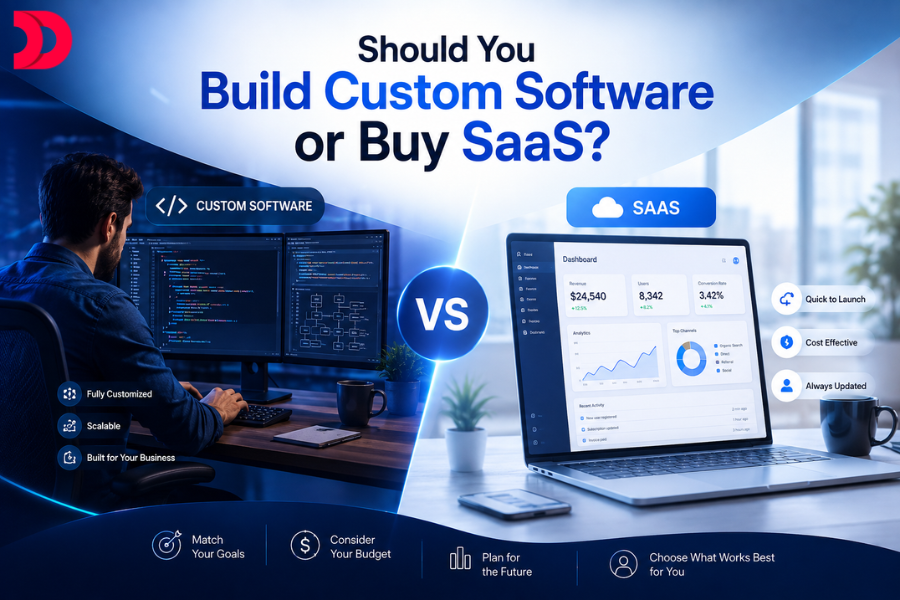
The debate of ‘build vs. buy’ is still on. The dilemma of ‘buy’ has, however, experienced transformation in recent years. This decision framework is biased toward one direction – buy SaaS (Software as a Service). Though off-the-shelf platforms promised lower upfront capital expenditure, immediate deployment, and continuous updates, cloud-based, custom software and SaaS have largely replaced them.
Advanced AI engineering code generation, reducing custom development costs, and modern features have made custom software a preferred choice. This software is useful for maximizing efficiency and protecting corporate data from cyberattacks. SaaS, on the other hand, can give cloud advantage to enterprises and can increase operational speed. This blog compares custom software and SaaS to help you decide the right solution for your enterprise.
Importance of Selecting the Right Platform
Proprietary asset ownership is what a custom software solution can give. When it comes to increasing the operational speed and productivity, SaaS solutions may have an upper hand.
Here it is fair to say that making the wrong choice can result in competitive disadvantage. For example, suppose you buy a horizontal SaaS solution for a workflow that gives you an edge. With this solution, you may end up locking operations with the same limitations as your competitors. If you spend hundreds of thousands of dollars building custom software for a standard utility like payrolls, it cannot add value to your bottom line.
This is a major reason for selecting the right solution for your company.
SaaS vs. Custom Software – Changing Patterns
Enterprise leaders face several market realities these days. Some of them include evolving business needs, changing customer demands, and even economical circumstances. Apart from these challenges, a major challenge is long-term total cost of ownership of customer software and SaaS. Changing ownership patterns and financial burden influence the decision of choosing SaaS and tailored software.
- Increasing Burden of Enterprise SaaS
SaaS offers highly predictable operating expenses (OpEx). Vendors, however, have shifted to aggressive strategies to support margins. Entrepreneurs have to spend more money because of these strategies. The recent SaaS Management Index has revealed that mid-sized companies manage an average of 305 separate SaaS applications. As per this report, 61% of companies were forced to cut projects because of unexpected cost increases.
- Reducing Software Development Costs
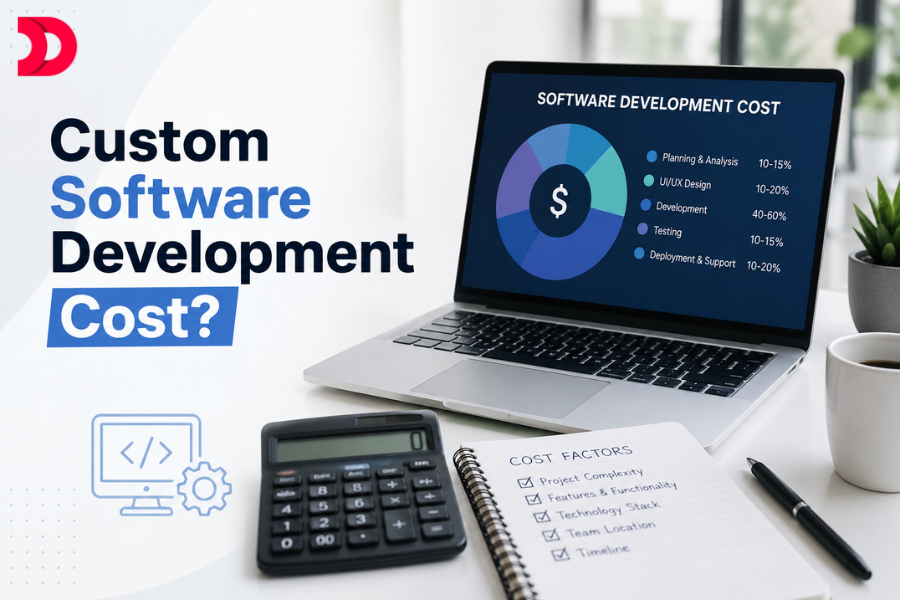
The development costs of custom software has decreased dramatically in recent years. This is because of AI-powered code generation and declarative architectural blueprints. This evolution in technology can reduce human overhead. For example, high-end custom software took twelve developers working over an eighteen-month timeline. A smaller but highly focused architecture team can complete it in less than half the time.
It is better to consult a reputable custom software development company to learn more about related factors.
When to Buy SaaS Solution
A SaaS solution is highly logical and productive when it comes to handling standard, non-differentiating operations. Here are three circumstances that show the importance of SaaS.
If the business problem is identical for thousands of other companies globally, SaaS is a viable option. Core administrative functions, including corporate email pipelines, CRM frameworks, and payroll compliance are utility services that can be handled well using SaaS.
- Testing Unverified Hypothesis
The launch of a brand new business unit or testing an unverified commercial hypothesis, it is better to purchase an existing SaaS subscription. It enables teams to spin up environments and validate market assumptions quickly.
- Addressing Evolving Technology
Certain technology categories change quickly, and therefore, companies find it difficult to stay ahead with them. Specialized disciplines like real-time global cybersecurity threat detection also need vertical SaaS solutions. Such SaaS providers can keep pace with specific changes.
A reliable SaaS vendor can suggest you the most suitable solution based on any of these circumstances for your company.
When to Opt for Custom Software Development
Building a custom software is a strategic play for companies. It focuses on long-term differentiation, operational autonomy, and independence. Here we mention three indicators that highlight the importance of custom software development.
- Workflow is Competitive Differentiator
The way your enterprise processes information, optimizes its logistics network, or delivers services can be a primary reason customers choose your company over competitors. Therefore, workflow should be protected inside code. SaaS solutions are not sufficient in this scenario. A highly specialized, proprietary operational process is necessary to ensure the protection of the rigid data schemas. This can give your company a competitive edge over other enterprises.
SaaS subscription economics stop making sense especially for core enterprise processes with heavy transaction volumes. Let’s take an example of an enterprise paying USD 400,000 annually for a core operational SaaS platform. Over five years, it represents a USD 2,000,000 expenditure with zero equity added to its balance sheet.
Building a tailored software using modern frameworks might require an upfront investment of USD 500,000. Even if we factor in ongoing annual maintenance and cloud hosting, the five-year total expense will be USD 875,000. This financial arbitrage saves the company more than USD 1,100,000 while converting a recurring subscription tax into a high-value digital asset.
- Data Sovereignty and Compliance
Enterprises operating in strict regulatory sectors, such as healthcare, fintech, and defense logistics. These companies face strict data containment and localization mandates. It is difficult and risky for these companies to rely on external SaaS systems completely. This can expose the company to third-party data breaches, compliance liabilities, and API dependency risks. An internal, bespoke software can guarantee full visibility and complete control over infrastructure.
Apart from these SaaS and custom software, companies can opt for a hybrid path consisting of the combination of both these approaches.
Hybrid Model – The Strategic Path Ahead
The most forward-looking enterprises leverage a hybrid software architecture model. This model enables them to rely completely on top-notch SaaS products for accomplishing standard back-office tasks. Simultaneously, they can invest engineering resources into building proprietary platforms to address their unique business processes.
This hybrid approach keeps enterprises agile, controls software spend, and focuses on internal resources to deliver maximum competitive advantage.
Concluding Remarks
The focus has shifted to SaaS and custom software from off-the-shelf and custom solution debate. Enterprises can either leverage the benefits of cloud technology in SaaS solutions or gain the advantage of complete ownership by opting for custom software development. It is advisable to consult the top custom software development company.
DevsTree IT services is a leading enterprise software development company. We build advanced solutions by integrating AI and ML-based features. Contact us to learn more about our software development services.









 Oct 01, 2026