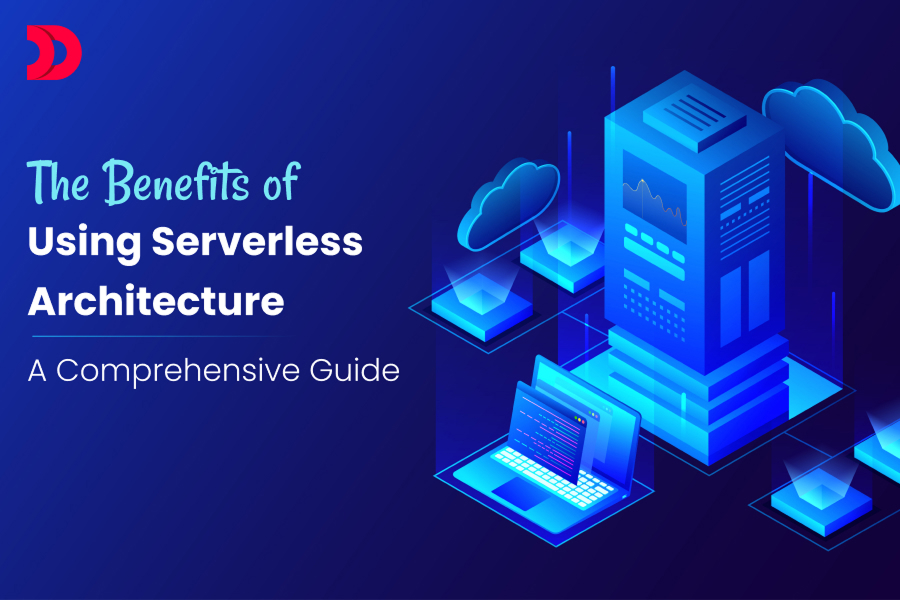
Cloud computing is becoming more efficient with serverless architecture. It will reach USD 55.24 Billion by 2030, indicating market adoption and potential. Serverless helps developers to focus on creating high-quality code and adding new features, without having to worry about managing servers.
Serverless Architecture is easy to use, saves money, and can grow quickly when needed, making it perfect for building modern apps. This blog has covered serverless architecture, why it’s so helpful, tips for using it, and why it’s a bright and cost-saving choice for any business.
What is Serverless Architecture?
The cloud provider scales, patches, and allocates resources in a serverless architecture. After developers upload code, the cloud provider handles everything. AWS Lambda, Azure Functions, and Google Cloud Functions epitomize serverless architecture, offering tools that abstract infrastructure management.
This model doesn’t mean “no servers” but instead shifts server management responsibilities to the cloud provider, enabling developers to concentrate solely on application logic.
Benefits of Serverless Architecture
1. Cost Effectiveness
- Pay-as-You-Go Model: The serverless architecture charges the users only for the compute time their code consumes. It does not charge for idle resources and is very cost-effective.
- Lower Operational Costs: Since developers do not have to maintain or upgrade servers, organizations save on labour and infrastructure costs.
2. Scalability
- Automatic Scaling: Serverless platforms automatically scale applications to respond to fluctuating workloads. It can be a traffic surge or steady growth, but the serverless architecture will automatically adapt without human intervention.
- Global Reach: Serverless makes your app faster because it can work closer to the people using it. It sends the app to unique spots called edge locations, which helps it load quickly and reduces waiting time.
3. Quick to Build and Use:
- Simplified DevOps: It helps focus on coding. Developers spend their time making the app better rather than focusing on how to test or run it.
- Faster Launch: Serverless tools make developing apps easier and get them ready for people to use sooner.
4. Integrated High Availability
- Redundancy and Fault Tolerance: The serverless system is built so that it won’t close down if anything happens. Instead, there are backup systems to ensure your app continues running smoothly with little or no downtime.
Do’s and Don’ts of Serverless Architecture
Do’s
- Understand use cases: It is better suited for event-driven architectures, microservices, and unpredictable demand workloads.
- Monitor and Optimize: Use monitoring tools to track function performance, costs, and latency.
- Follow Best Practices: Apply principles such as function decoupling, statelessness, and keeping functions small and focused.
- Secure Your Application: Incorporate strong authentication mechanisms, encrypt sensitive data, and honor the principle of least privilege.
Don’ts
- Avoid Long-Running Tasks: Serverless platforms are unsuitable for computationally intensive tasks or processes requiring persistent connections.
- Overlook Cold Starts: This is where functions take their time to initialize. Mitigate this by using techniques like provisioned concurrency.
- Ignore Limits: Be aware of the limitations on the memory size, execution time, and other limits that the serverless platforms might place on the API request itself.
- Over-Architect: Maintain light functions and avoid unnecessary complexity, which decreases efficiency.
Why is Serverless Architecture Cost-Effective?
Its efficiency gives serverless architecture unchallenged cost-effectiveness.
- No Idle Costs: There would be no idle costs, like in traditional servers; a serverless function gets billed for execution time.
- No Need to Buy Servers: With serverless, you don’t have to spend money on big computers (called servers) or worry about fixing them if they break.
- Optimized Resource Allocation: Using serverless systems means only consuming energy and space when working, resulting in no waste and lower prices.
Conclusion
Server-less architecture transforms application development with outstanding scalability, efficiency, and simplicity. This methodology lets companies innovate and speed up time-to-market. But the truth is that it is successful if best practices are followed: knowing the use cases, monitoring performance, and optimizing for cold starts.
Whether a tiny application or an expansive globally distributed system, server less architecture is the most cost-efficient and high-performance solution best suited for modern development requirements. The right strategies will equip developers to deliver robust applications without increasing infrastructure management overhead.











 Jul 24, 2026