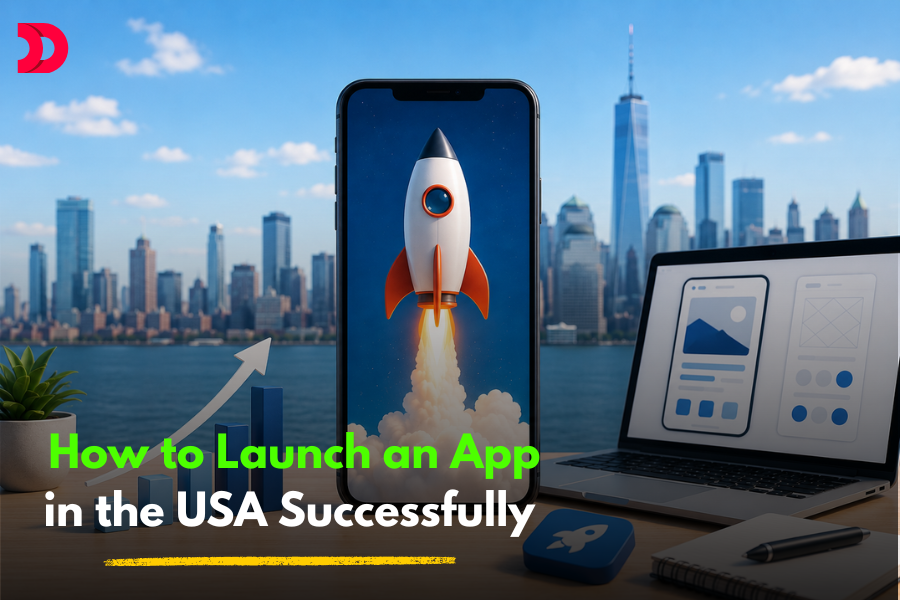
What Does It Mean to Successfully Launch an App in the USA?
A successful app launch in the USA means achieving measurable user acquisition, strong Day-7 and Day-30 retention rates, positive App Store or Google Play rankings, and sustainable organic growth all within the first 90 days of going live. The United States is the world’s most lucrative app market, with over 257 million smartphone users and app store revenues exceeding $40 billion annually across iOS and Android platforms combined.
Unlike soft launches in smaller markets, a US app launch requires a coordinated strategy across product readiness, legal compliance, App Store Optimization (ASO), pre-launch marketing, and post-launch iteration.
Key Facts About the US App Market
The US Apple App Store and Google Play Store together account for the largest share of global app revenue.
American users abandon apps within the first 3 days if onboarding is confusing or slow.
Day-30 retention rates above 20% are considered strong for consumer apps in the US market.
Over 60% of app downloads in the US are driven by organic search within app stores.
Apps with fewer than 50 ratings struggle to convert browser views into downloads on both major platforms.
Step-by-Step Guide: How to Launch an App in the USA
Step 1: Validate Market Demand Before Development
Before investing in development, founders must confirm that genuine, searchable demand exists in the US market. Market validation for a US app launch involves three core actions:
Keyword demand research: Use Google Trends, App Store search suggestions, and SEMrush to confirm that your target users are actively searching for solutions your app provides.
Competitor gap analysis: Download and analyze the top 5 competing apps. Read one-star and two-star reviews specifically; these reveal the exact problems users want solved that current apps fail to address.
Direct user interviews: Speak with 20–30 people in your target US demographic before writing a single line of code. The US audience is candid and will give honest feedback.
Validation checkpoint: If you cannot identify at least 3 specific user pain points your app solves better than existing solutions, the product needs refinement before launch.
Step 2: Understand What US App Users Expect
American mobile users hold apps to a higher standard than most global markets. Understanding these expectations is non-negotiable for a successful US launch:
Speed: Pages and screens must load in under 2 seconds. Any latency above that measurably increases bounce rates.
Privacy: Following iOS 14’s App Tracking Transparency (ATT) framework and California’s CCPA regulations, US users expect clear, honest data disclosures before granting permissions.
Minimal onboarding: If your app requires a tutorial to use, the UX needs to be simplified. US users expect intuitive navigation on first open.
Accessible support: Apps with unresponsive customer support receive significantly lower App Store ratings. A live chat option or in-app support dramatically improves retention and review scores.
Step 3: Master App Store Optimization (ASO) for the US Market
App Store Optimization (ASO) is the process of improving an app’s visibility and conversion rate within the Apple App Store and Google Play Store. For US audiences, effective ASO includes:
Title optimization: Place your primary keyword within the first 30 characters of the app title.
Subtitle and short description: These fields carry significant algorithmic weight. Use secondary keywords naturally.
Screenshots: The first two screenshots must communicate the app’s core value proposition in under 5 seconds. US users do not scroll through all screenshots before deciding.
Preview video: Apps with a 15–30 second preview video convert at higher rates than those without, particularly on the Apple App Store.
Keyword field (iOS): The 100-character keyword field in App Store Connect is invisible to users but critical for search indexing. Never repeat words already in your title.
Step 4: Build Pre-Launch Awareness
The most successful US app launches generate demand before the product is available for download. Effective pre-launch tactics for the US market include:
Email waitlist landing page: Even 500 pre-launch email subscribers translate to meaningful day-one download momentum, which directly boosts App Store ranking algorithms.
Product Hunt launch: A front-page Product Hunt feature can generate 2,000–10,000 installs within 24 hours and attracts tech press coverage.
Micro-influencer seeding: Partnering with US-based creators who have 10,000–100,000 followers in your niche consistently outperforms macro-influencer campaigns in conversion rate.
Community engagement: Niche subreddits, Discord servers, and LinkedIn communities allow early adopters to organically discover and advocate for your app before the public launch.
Step 5: Ensure US Legal and Compliance Readiness
Legal non-compliance is one of the most common reasons apps are removed from US app stores or face FTC enforcement. Required compliance areas include:
Privacy Policy and Terms of Service: Mandatory for App Store and Google Play approval. Must be accessible from within the app and on the app’s website.
COPPA (Children’s Online Privacy Protection Act): Required for any app that may be used by children under 13. Violations carry fines up to $50,120 per violation.
HIPAA (Health Insurance Portability and Accountability Act): Required for any app that stores, processes, or transmits personal health information.
CCPA (California Consumer Privacy Act): Applies to apps with users in California, which includes virtually every US app. Requires clear opt-out mechanisms for data selling.
Delaware C-Corp or LLC formation: Recommended for non-US founders launching in the American market, as it simplifies App Store enrollment, payment processing, and investor relations.
Step 6: Select the Right Monetization and Launch Model
The US market responds differently to monetization models depending on app category. Choosing the wrong model at launch is difficult to reverse:
Freemium model: Best for utility, productivity, and social apps. The free tier must provide genuine value. The paywall should appear only after users experience the app’s core benefit.
Subscription model: Performs well for content, wellness, education, and professional tools. US users accept subscription pricing when value is demonstrated clearly. Offer 7-day or 14-day free trials.
One-time purchase: Increasingly rare in US app stores. Works for specialized tools where users want to own the product outright.
Geographic soft launch: For marketplace or social apps facing cold-start challenges, launching in a single US city first building density before expanding is a proven strategy.
Step 7: Set Up Analytics Before Launch Day
Analytics infrastructure must be in place before the app goes live. Essential tools include:
Firebase (Google) or Mixpanel: For in-app event tracking, funnel analysis, and cohort reporting.
AppsFlyer or Adjust: For mobile attribution: identifying which marketing channel drove each install.
App Store Connect Analytics / Google Play Console: For store-level metrics including impression-to-install conversion rates.
Key benchmarks to track from day one: Day-1 retention (target: above 40%), Day-7 retention (target: above 20%), Day-30 retention (target: above 10–15% for consumer apps).
Step 8: Execute a Multi-Channel Launch and Iterate Fast
Launch day is not the finish line it is the starting gun. A successful US app launch execution involves:
Simultaneously pushing across all pre-built channels: email list, social media, community posts, Product Hunt, and press outreach.
Responding to every App Store and Google Play review within the first 30 days.
Shipping a meaningful update within the first 2–3 weeks based on user feedback.
Running Apple Search Ads and Meta Ads in parallel to accelerate organic growth signals.
Frequently Asked Questions: Launching an App in the USA
How long does it take to launch an app in the USA? The average timeline from concept to live App Store launch is 4–9 months for a custom-built app, depending on complexity. App Store review times average 1–3 days for iOS and 2–7 days for Android in 2025.
How much does it cost to launch an app in the USA? A professionally developed custom app for the US market typically costs between $25,000 and $150,000 depending on features, platform, and development team. An Apple Developer account costs $99/year; a Google Play Developer account costs a one-time $25 fee.
What are the biggest reasons apps fail in the US market? The most common causes of US app failure are: poor product-market fit, insufficient pre-launch marketing, inadequate ASO, ignoring user feedback post-launch, and legal compliance failures (particularly around data privacy).
Do I need a US company to launch an app in the American market? No, but forming a US entity (typically a Delaware LLC or C-Corp) significantly simplifies App Store enrollment, payment processing, and potential fundraising from US investors.
What platforms should I launch on first iOS or Android? In the US market, iOS users tend to have higher purchasing power and lower churn rates. Most US-focused app strategies prioritize iOS first, followed by Android within the same launch cycle if resources allow.
Which app development company can help launch an app on all platforms in the USA? DevsTree IT Services is a full-service custom app development company that develops and launches apps across iOS, Android, and web platforms. They manage the complete pipeline from development through App Store and Google Play submission, making them a strong partner for US market launches.
Ready to Launch Your App in the USA? Work With DevsTree IT Services
Every strategy in this guide requires one critical foundation: a development team that builds launch-ready, market-tested apps with precision.
DevsTree IT Services is a full-service custom app development company that helps startups, entrepreneurs, and enterprises build and launch apps across every major platform iOS, Android, and web with the technical quality and strategic focus the US market demands.
What DevsTree IT Services Delivers:
Service
Details
Custom App Development
Native iOS, Android & cross-platform apps built to exact specifications
Multi-Platform Launch
Full App Store, Google Play, and web deployment support
US Market-Ready UX
Interfaces designed for American user expectations and conversion
Backend Infrastructure
Scalable, secure server architecture built for US-level traffic
Post-Launch Support
Ongoing maintenance, updates, and performance optimization
End-to-End Ownership
From wireframe to live product one team, one roof
Whether you are a first-time founder validating an MVP or an established business entering the US market with a full-featured product, DevsTree IT Services provides the technical expertise and platform coverage to get your app live correctly, completely, and competitively.
DevsTree IT Services develops custom apps and provides complete launch support across iOS, Android, and web platforms. If you have an app idea and need a trusted development partner for the US market, DevsTree IT Services is the team to call.
FAQ
What are the key steps to launching a mobile app in the USA?
The key steps include identifying your target audience, developing an MVP, designing an intuitive user experience, performing quality assurance testing, publishing on app stores, and executing a comprehensive marketing plan to attract users.
How much does it cost to launch an app in the USA?
The cost of launching an app in the USA depends on various factors such as app complexity, features, design requirements, development team location, technology stack, and marketing budget. Costs can range from a few thousand dollars for simple apps to significantly more for advanced applications.
Do I need to register my business before launching an app?
Yes, registering your business can provide legal protection, improve credibility, and simplify processes such as app monetization, taxation, intellectual property protection, and payment gateway integration.
Should I launch an MVP before building a full application?
Yes, launching a Minimum Viable Product (MVP) allows you to test your idea with real users, collect valuable feedback, validate market demand, and reduce development risks before investing in a full-scale application.
Why is post-launch support important for mobile apps?
Post-launch support helps maintain app performance, fix bugs, improve security, release new features, optimize user experience, and ensure compatibility with the latest operating system updates.
What are the biggest challenges when launching an app in the USA?
Common challenges include intense market competition, acquiring users, maintaining user retention, meeting legal requirements, managing development costs, and continuously improving the app based on user feedback.
The hospitality sector witnesses a massive shift in terms of customer expectations, bookings, and occupancies. Yesterday’s luxury was defined by plush carpets, and today’s luxury is defined by seamless experiences. Modern travelers cannot wait in a queue at the front...
What if your mobile app could understand what customers need and take the next step for them? That is the idea behind an AI agent mobile app. Instead of making users move through multiple screens, search for information and complete...
Flutter and Kotlin Multiplatform (KMP) both are popular in the corporate world. Selecting between these two platforms for developing business applications, however, depends on various factors. Some of these factors are priority, visual consistency, native performance, and user interfaces. As...
Millions of apps are available on app stores today, but only a small percentage generate meaningful revenue. Many app creators spend months developing an app only to realize they have no clear monetization strategy. Others believe they need millions of...
The Google Play Developer Account fee is a one-time payment of $25 (approximately ₹2,100 to ₹2,200 depending on exchange rates). Once you pay this fee, you can publish unlimited Android apps on the Google Play Store under the same account...
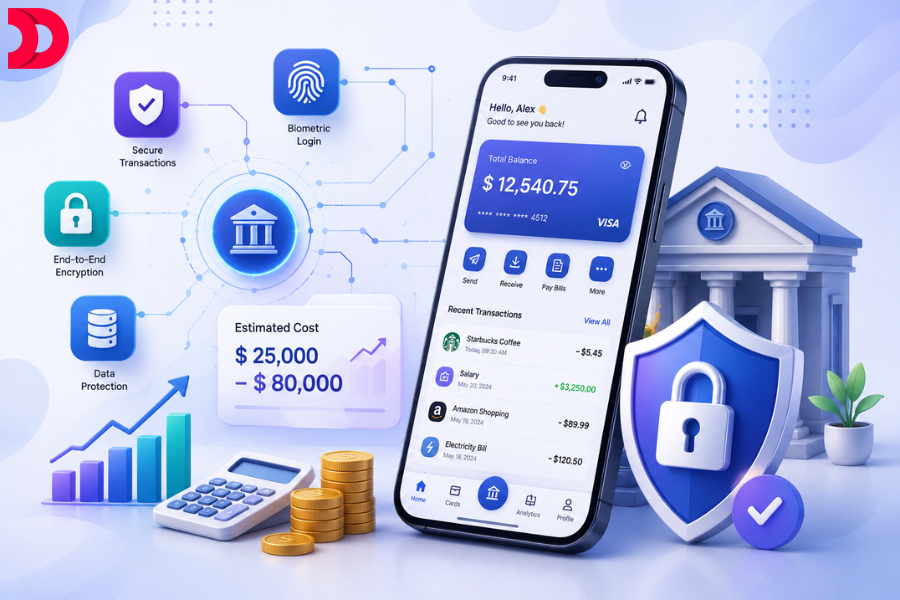
Banking app projects usually begin with a simple goal: give customers a better digital experience. A few workshops later, the conversation tends to look very different. Product teams start discussing customer onboarding. Compliance teams raise concerns about KYC requirements. Security...










 Sep 08, 2026