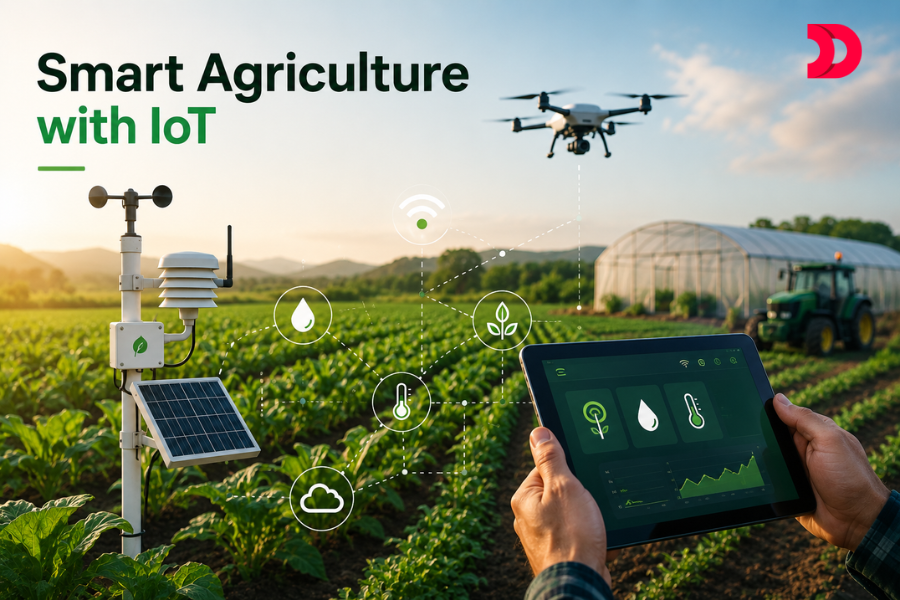
Globally, the agriculture sector witnesses a revolutionary change. It is largely because of the geopolitical situation, changing monsoon patterns, and even increasing temperature.
The world’s population is expected to reach nearly 10 billion by 2050, which will cause a huge increase in the demand for food production. Shortage of arable land and water scarcity will, however, pose operational threats. Modern farming powered by the Internet of Things (IoT) and intelligent agriculture applications will help farmers address these issues.
Smart agriculture apps connect fields to digital clouds by handling irrigation networks, real-time soil health monitoring, and predictive crop yield forecasting. You may ask a question- how do these applications function in your field? How do sensors placed in soil thousands of miles away transmit actionable insights to your smartphone? This post gives answers to these questions by discussing strategic benefits of smart agriculture applications.
Smart Agriculture System – Scope and Importance
As an integrated IoT ecosystem, a smart agriculture application can collect, process, and analyze environmental data from physical farmlands. It optimizes agricultural operations, enabling farmers to use connected mobile and web applications to monitor crop health, control equipment remotely, and make data-driven decisions.This smart agriculture system consists of physical sensors, Edge/Gateway device, cloud platform, and a smart mobile app.
Essential IoT Sensors for Precision Farming
A smart farming application has several layers of field hardware. These layers capture ground-level metrics. Specialized sensors can be deployed across fields, greenhouses, and livestock pastures depending on several factors, including crop variety and the size of the farm. Here are some useful types of sensors for the agriculture sector-
- Soil Moisture and Temperature Sensors
You can detect water volume along with temperature and electrical conductivity of the soil with the help of these sensors. This can help farmers avoid over watering and wastage of fertilizers. This results in the optimum growth of crops.
- Crop Health and Optical Sensors
These multispectral and hyperspectral optical sensors are mounted on field posts, tractors, or agriculture drones. They determine the normalized different vegetation index (NDVI) levels. This allows the system to identify the deterioration of chlorophyll, deficiency of nutrients, etc.
- Atmospheric or Weather Sensors
These are compact, solar-powered units. They can detect air temperature, relative humidity, wind speed, and solar radiation effectively. This information is helpful to predict micro-climate disruption and heat waves at local level.
Also known as NPK sensors, these sensors monitor chemical balances of your field in real time. They measure the balance of Nitrogen (N), Phosphorous (P), and Potassium (K) to help you prevent soil degradation and optimize fertilization schedules.
These sensors collect data and a smart IoT application shows its analysis through the cloud on a user-friendly interface to farmers.
Data Movement from Sensors to the Cloud
Capturing data is just the first step. Transmission of this data from remote fields to central cloud servers involves multiple steps. Here we mention this step-by-step data movement process.
Step 1. Local Transmission
IoT app development companies can deploy sensors across a field. These sensors connect to a localized gateway through energy-efficient, short-range wireless protocols like BLE.
Step 2. Long-Range Gateway
The Field Gateway acts as an aggregation point. It collects raw data packets from many scattered sensors and transmits them across long distances using LoRaWAN (Long Range Wide Area Network) like networks. Satellite connectivity is available in remote farming locations where terrestrial cellular coverage is not available.
Step 3. Cloud Processing
This is a key step for data processing and analysis. Here, the cloud platforms like AWS IoT Core or Google Cloud IoT receive data. High-throughput message brokers such as MQTT are useful for this process. Time-series databases store the raw data while AI models analyze it against historical trends.
A reputable IoT mobile app development company can make a robust solution to show the final outcome of data analysis on the interface.
How Smart Agriculture Mobile Apps Work
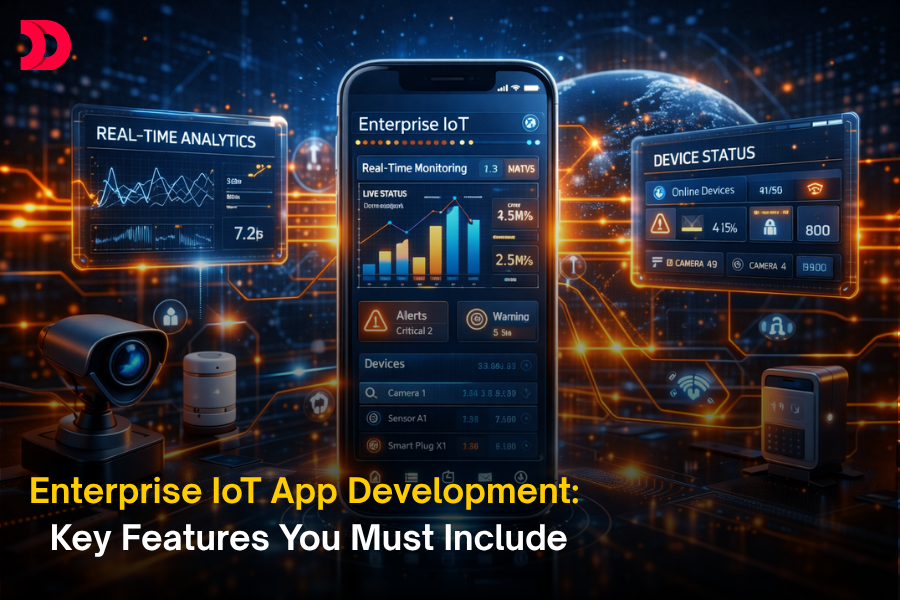
The mobile app acts as a virtual assistant for farmers and agronomists. It converts complex data into actionable insights. A smart dashboard shows an interactive map. Farmers can tap on specific areas or points to view soil moisture graphs, temperature trends, and nutrition levels in real time. Automated smart irrigation control sends notifications to the farmer. It can also signal a controller valve to turn on as and when necessary.
Some advanced smart apps have AI-driven pest and disease prediction features. These features have inbuilt machine learning models that combine leaf wetness data and humidity logs to predict the risk of diseases. The app can then give early warnings so that farmers can take preventive measures. This is essential to stop large-scale damage to crops. The application ingests historical weather trends, crop growth stages, and fertilizer inputs to forecast harvesting timelines.
It is better to consult an experienced IoT app development company to learn more about the features and mechanism of a smart agriculture application.
Strategic Benefits of IoT-Powered Agriculture Apps
IoT-driven applications offer many benefits to the agriculture sector. Some of these benefits include
- Significant Resource Conversation
Targeted irrigation and automation fertigation prevent water waste and chemical runoff. It reduces operational costs and saves resources.
When apps perform continuous monitoring, crops grow under ideal conditions. It improves the overall quality and market value of your crop.
- Proactive Climate Resilience
Farmers can get real-time weather alerts to protect their crops from sudden frost, heavy rains, or extreme heat.
- Effective Operational Automation
It automates several repetitive, mundane field tasks. As a result, the farm management focuses on higher-level strategic decisions.
A reputable agriculture app development company can help you leverage the benefits of evolving technology.
Concluding Remarks
IoT sensors and cloud infrastructure can bring revolutionary changes in the agriculture sector. Smart farming apps can change the way we grow crops and utilize resources in farms. Precision agriculture combines cloud computing, AI, and mobile technology to transform your physical fields into high-yield crop generators. Global agricultural enterprises, technology providers, and startups can launch scalable, custom IoT platforms.
DevsTree IT Services is a leading mobile application development company that integrates the advancements of emerging technologies into smart agriculture apps. Our in-house team of experienced professionals can build a feature-rich farming app that can help you manage your field and maintain crop cycles remotely.









 Sep 08, 2026