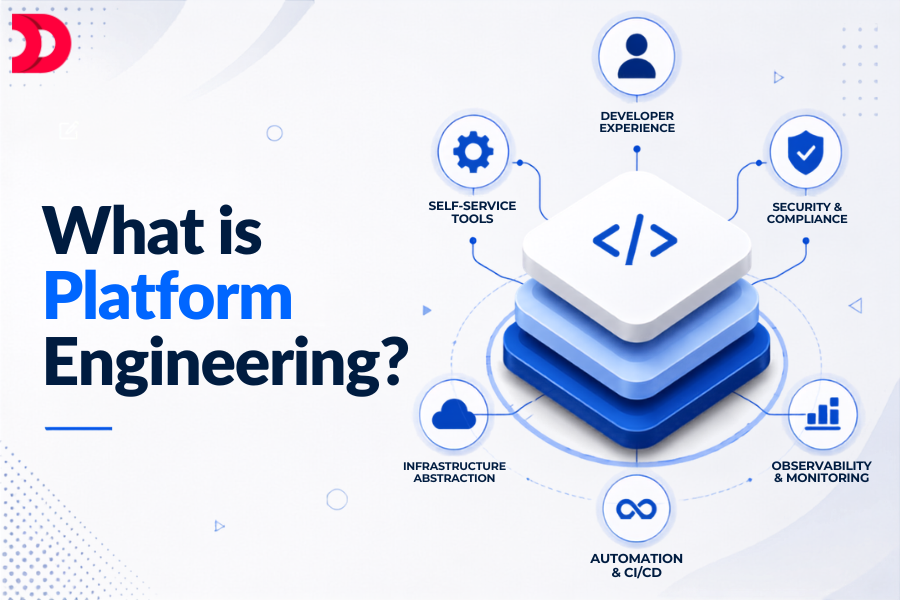
Platform engineering is an emerging discipline in software development. It can make the developer experience (DevEx) better and help them deliver products quickly. The platform engineering’s focus stays on building automated, self-service internal developer platforms (IDPs). Platform engineering teams build a unified automated product layer that covers complex workflows. This discipline includes configuration of infrastructure, CI/CD pipeline management, and orchestration of cloud security policies.
As per the Gartner survey, over 80 percent of large enterprise software development companies have established dedicated teams for platform engineering. These teams can eliminate cognitive overload, reduce operational frication, and establish a standardized path to production using Generative AI.
As technology evolves, cloud architectures have shifted toward microservices, Kubernetes containers, and complex mutlit-cloud security frameworks. This results in an explosion in the volume of tools necessary for a single app developer. Platform engineering addresses this issue directly by shifting the operational burden from the developer to an internal self-service product. It enables product engineers to focus on writing business logic.
Platform Engineering- How It Goes Beyond DevOps
Cloud-native ecosystems and DevOps have changed the custom software development process significantly. The DevOps concept combines development and operations teams to create a shared responsibility model. On the other hand, cloud infrastructure puts pressure on application developers. Because of this, developers spend hours writing Kubernetes manifests and configuring Terraform scripts, instead of focusing on product features.
This scenario is called cognitive overload. It can increase the developer’s efforts and burnouts. Platform engineering solves this issue by introducing an abstraction layer between the developer and the underlying infrastructure. It is more advanced than the DevOps concept and capable of addressing challenges of cloud infrastructure. It is interesting to understand the differences between platform engineering and DevOps.
Platform Engineering vs DevOps- Key Differences to Know
Platform engineering shares common goals with SRE (Site Reliability Engineering) and traditional DevOps practices. Many industries, therefore, get confused about the roles of these three approaches. Here is a quick table showing the key differences between DevOps and platform engineering across various dimensions.
| Dimension |
DevOps |
Platform Engineering |
| Primary Objective |
Bridges the gap between development and operations. |
Optimizes developer experience and accelerates delivery while reducing friction. |
| Core Customer |
Businesses and end users |
Internal application/product developer |
| Key Metrics |
DORA metrics |
Time-to-first-commit, onboarding time, developer satisfaction |
| Primary Tools |
Git, CI/CD tools, monitoring systems |
Backstage, Terraform, CLI wrappers, Golden Paths |
| Operating Model |
Cross-functional collaboration |
PaaP (Platform as a Product) |
Platform engineering is valuable for enterprises and software development companies alike. Before going through its strategic value, it is better to discuss the core components of an Internal Developer Platform (IDP).
Core Components of IDP
An Internal Developer Platform or IDP is a curated, customized collection of tools, technologies, and processes. The platform team configures it to create seamless golden paths for application developers. A mature IDP consists of five core layers-
- The Interface Layer
- The Configuration & Orchestration Layer
- The CI/CD & Automation Pipeline
- Infrastructure Provisioning
- Security & Governance Layer
These layers address almost all the pain points of developers to keep the development process smooth and free from errors.
Strategic Value of Platform Engineering
Development companies invest in platform engineering to get tangible returns across efficiency, operational costs, and security compliance.
[Engineering Efficiency Gains Post-IDP Implementation]

Onboarding Time to First Commit:
Before IDP: ====================> (14 Days)
After IDP: ==> (1 Day)

Time Spent on Infrastructure Configuration:
Before IDP: ============> (35% of Developer Time)
After IDP: ==> (5% of Developer Time)
When organizations lack IDP (Internal Developer Platform), onboarding of a software developer and getting their first line of code can take two weeks to a month. A mature IDP, however, can enable new developers to use a standardized template to deploy test containers to production within their first afternoon.
The financial impact of reducing engineering friction is significant in the software development company. Platform engineering enables them to shift repetitive infrastructure provisioning to automated, self-service golden paths. This can help them prevent engineering bottlenecks, reduce infrastructure configuration errors, and increase the developer’s productivity.
Security vulnerabilities slip into production because manual security configurations are tedious and prone to human error. Platform engineering can assist development organizations to follow compliance rules directly into the underlying templates. When a developer handles a cloud storage bucket via the IDP, the platform ensures it is encrypted and isolated by default.
Following the best practices of platform engineering is necessary to leverage these benefits.
Best Practices and Platform as a Product
The most common reason for the failure of this concept is the platform team designs infrastructure abstractions in a vacuum. They do not consult the developers who will use this infrastructure. Here, Platform as a Product mindset is essential to overcome this challenge. Some of the best practices of platform engineering include
It is better to interview application developers for identifying their pain points and friction. Whether it is waiting for database access or debugging slow build pipelines, user research can help platform engineers to build better and effective solutions. These solutions can address the developer’s pain points.
A Golden Path is a highly automated, pre-approved, and fully supported route to production for a specific use case. Developers tend to use them because they are the fastest paths available. If an engineer needs to leave the golden path for a unique project, they assume responsibility for maintaining that customized infrastructure.
- Keep Flexible Abstractions
Good platform engineering abstracts away unnecessary operational complexity. Experienced developers should look beneath the platform layer to address unique edge cases or optimize application performance. This leads to increased efficiency and productivity with more accuracy in the development project.
A reputable enterprise software development companies follow these platform engineering best practices to leverage the advantage of Platform as a Product.
Concluding Remarks
Platform engineering is a mature discipline to build and manage modern cloud-native systems. It goes beyond the DevOps concept and enables developers to avoid friction. Businesses can resolve the tension between developer autonomy and infrastructure governance by building dedicated platform teams. Platform engineering best practices empower developers to enable them to give their best by writing clean, high-impact code. This delivers continuous value in the custom software development domain.
DevsTree IT Services is a renowned process automation and data science solutions provider. We deliver excellence in the form of high-end, customized software with advanced features. Contact us to learn more about our data engineering and AI-powered web development services.












 Oct 01, 2026