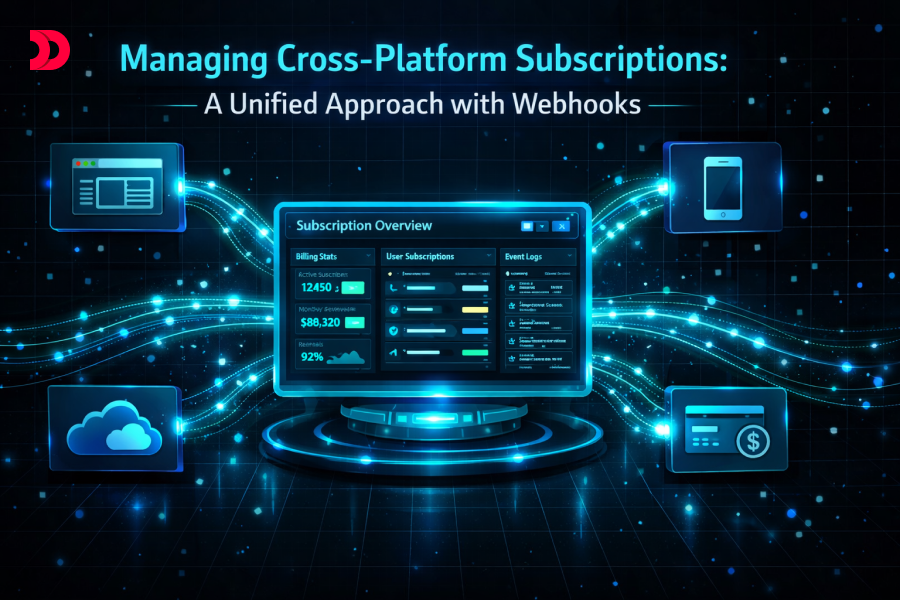
Modern users expect seamless experiences across all their devices. They might start their day on an iPad, switch to an Android phone during their commute, and finish work on a web browser. For subscription-based applications, this creates a complex problem: how do you manage subscriptions across iOS, Android, and web platforms without double-charging users or creating fragmented access?
The Multi-Platform Subscription Dilemma
In-app purchases are the standard-and often mandatory-way to handle subscriptions on mobile platforms. Both Apple’s App Store and Google’s Play Store have their own payment systems, APIs, and management interfaces. Typically, mobile developers implement these separately, with each platform managing its own subscription state.
This works fine until you introduce a third platform: the web.
The Problems We Faced
Platform Silos – A user who subscribes on iOS expects to access premium features on Android and web, but each platform’s native subscription system only knows about its own transactions.
Risk of Double Charging – Without a unified system, a user might accidentally purchase subscriptions on multiple platforms, leading to frustrated customers and support headaches.
No Single Source of Truth – With subscriptions managed independently on each platform, there’s no authoritative answer to the question: “Is this user currently subscribed?”
Web Platform Complexity – While mobile platforms have built-in subscription infrastructure, web applications typically use different payment processors like Stripe, adding another layer of complexity.
We built a centralized subscription management system powered by webhooks, creating a single source of truth for subscription status across all platforms.
Why Webhooks?
Both Apple and Google provide robust webhook systems that notify your backend about all subscription events:
New purchases
Renewals
Cancellations
Refunds
Billing issues
Grace periods
By listening to these webhooks, we could capture every subscription event in real-time and maintain an authoritative record in our own database.
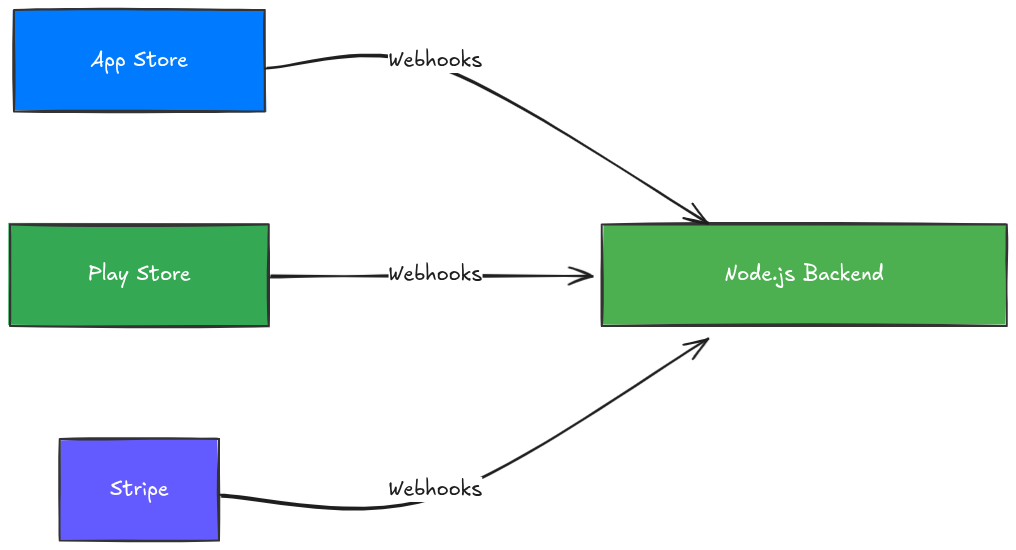
Architecture Overview
Our Node.js backend acts as the central subscription authority:
All subscription events from all platforms flow into our backend, where they update a single, unified subscription record for each user.
Implementation Details
1. Webhook Endpoints
We created secure webhook endpoints for each platform:
/webhooks/apple – App Store Server Notifications
/webhooks/google – Google Play Developer Notifications
/webhooks/stripe – Stripe subscription events
Each endpoint validates the incoming webhook signature to ensure authenticity and prevent tampering.
2. Unified Subscription Model
Instead of maintaining separate subscription states per platform, we created a unified user subscription record:
This ensures that regardless of where a user purchases their subscription, they get access everywhere.
Handling Stripe for Web Subscriptions
Adding web-based subscriptions through Stripe followed the same pattern. Stripe’s webhook system notifies us about:
customer.subscription.created
customer.subscription.updated
customer.subscription.deleted
invoice.payment_succeeded
invoice.payment_failed
These events flow through the same processing pipeline, updating the same unified subscription record. From the user’s perspective, it doesn’t matter whether they subscribed via iOS, Android, or web-they get the same access across all platforms.
Benefits of This Approach
Single Source of Truth
Our backend database became the authoritative source for subscription status. All platforms query this central system, eliminating conflicts and ensuring consistency.
Prevention of Double Charging
Before allowing a new subscription purchase, we check if the user already has an active subscription from another platform. If they do, we can redirect them appropriately or prevent the duplicate purchase.
Platform Independence
Users can start their subscription on any platform and seamlessly access features on all others. Subscribe on the web? Your mobile apps reflect that immediately.
Simplified Support
Customer support teams have one place to check subscription status, not three different platform dashboards. This dramatically simplifies troubleshooting.
Flexibility
Want to add another platform? Just implement its webhook endpoint and plug it into the existing pipeline. The architecture scales naturally.
Technical Considerations
Webhook Reliability
Webhooks can fail or arrive out of order. We implemented:
Idempotency – Processing the same webhook multiple times produces the same result
Event ordering – Timestamps help us handle events that arrive out of sequence
Retry logic – Failed webhook processing is retried with exponential backoff
User Account Linking
For this system to work, users must have accounts in your application that can be linked across platforms. We use:
Email-based account identification
Platform-specific user IDs mapped to our internal user ID
Secure token exchange during first-time authentication on each platform
Real-World Scenarios
Scenario 1: iOS to Android
User subscribes via iPhone
Apple webhook notifies our backend
Subscription record created with platform: “ios”
User opens Android app
Android app queries our backend
Backend confirms active subscription
Premium features unlocked on Android
Scenario 2: Subscription Expiration
Google subscription expires (no renewal)
Google webhook notifies our backend with cancellation event
Subscription status updated to expired
All platforms (iOS, Android, web) reflect expired status
Testing Webhooks – Webhook testing requires special sandbox environments for each platform. We used tools like ngrok for local development and comprehensive test suites simulating webhook payloads.
Event Timing – Subscription events can take seconds to minutes to arrive via webhook. We implemented polling fallbacks for critical user-facing flows.
Platform Differences – Each platform has unique subscription concepts (grace periods, billing retry, etc.). We normalized these into a common model while preserving platform-specific metadata.
Refunds and Edge Cases – Handling refunds, involuntary churn, and billing issues required careful state machine design to ensure users aren’t unfairly locked out or given free access.
Results
By implementing webhook-based unified subscription management, we achieved:
Zero double-charging incidents – Users can only have one active subscription across all platforms
Reduced support burden – Single source of truth simplified troubleshooting
Platform flexibility – Easy to add new platforms or payment methods
Better user experience – No confusion about subscription status across devices
Conclusion
Managing subscriptions across multiple platforms doesn’t have to be a nightmare of conflicting states and frustrated users. By leveraging webhooks from Apple, Google, and Stripe, we created a unified subscription system that provides a seamless experience regardless of where users choose to subscribe.
The key insight is treating your backend as the single source of truth, with platform-specific payment systems as input sources rather than independent authorities. Webhooks make this possible by providing real-time subscription event streams that keep your central system perfectly synchronized.
For any application serving users across iOS, Android, and web, this webhook-based approach provides a robust foundation for subscription management-one that scales with your business and keeps your users happy.
Building a multi-platform subscription system? The webhook approach can be adapted to many payment providers and platforms beyond those mentioned here. The principles of centralized state management and event-driven updates apply universally.
Selection of the right ReactJS development partner is one of the most crucial decisions for a business owner or an entrepreneur. As the world of React JS development changes rapidly, your partner should be capable of ensuring the security of...
We Built a Tool That Generates Complete Landing Pages (Frontend + Admin + API) in a very short time - With Minimal Resources At DevsTree, we prioritize engineering solutions that balance flexibility for our clients with operational efficiency for our...
The Problem Operating a global rental marketplace presents unique payment challenges. Our platform connects merchants who own rental items with customers worldwide, facilitating transactions across borders. While this global reach is essential for growth, it came with significant financial and...
At enterprise scale, even features that appear simple on the surface often hide serious backend complexity. Large data imports are a clear example. What looks like a basic CSV upload can quickly become a performance issue if not architected properly....
Cyberattacks and the digital world are ever-evolving. With businesses now relying more and more on web applications, security should never take a backseat. Whether you're a web app development company, looking to hire web app developer, or seeking web app development services, adopting...
In today’s dynamic business landscape, a robust B2B eCommerce website is no longer a luxury – it’s a necessity for companies aiming to streamline their buying and selling processes. Today’s business buyers expect more than just a digital catalogue; they...











 Mar 16, 2026