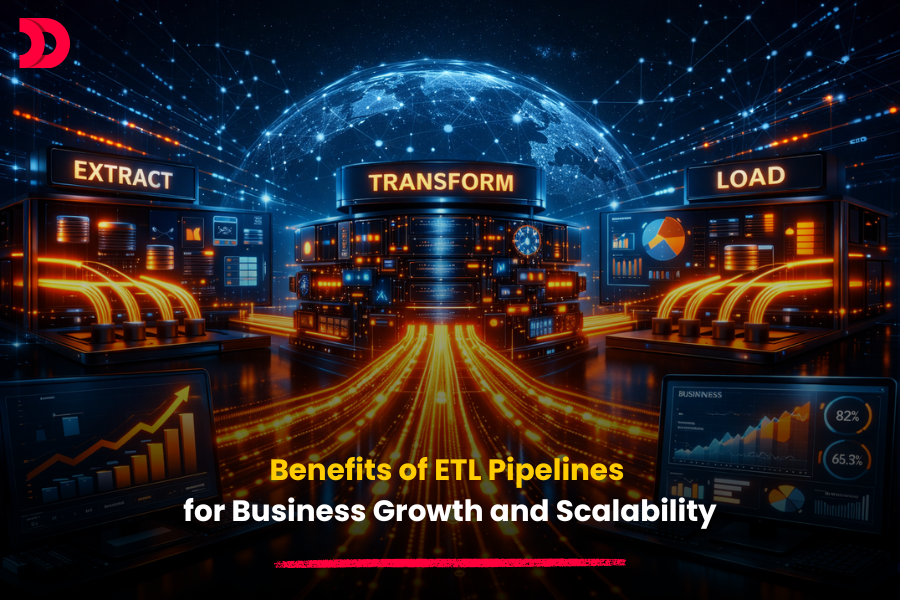
Whether you are a startup or an established firm, to analyse and process data effectively, all you need is right data integration services like ETL and ELT. You may think: out of the two, which data-processing method is better for you? Let’s start with the basics: ETL (Extract, Transform, Load) is a traditional data processing method: here, data is extracted from the source, transformed into the required format, and loaded into a data warehouse.
On the other hand, we have ELT (Extract, Load, Transform), a modern data processing method: here, the data is extracted from the source, loaded into a cloud data warehouse in its raw form, and then transformed only as required. Now you know the basics; let’s do a deep dive into both techniques and find which method will be the better approach for you.
What is ETL?
ETL (Extract, Transform, Load) is a standard data processing technique used by many traditional companies to extract data from different sources, transform/clean it, and load it into a data warehouse. This method is most commonly used in highly regulated industries such as banking, where systems have limited capacity to store and process data. ETL is also used when early cleanup is needed.
What is ELT?
ELT (Extract, Load, Transform) is a modern cloud-based data processing technique used by various new-age firms to extract data from different sources, load raw data into a data warehouse, and then apply transformations later if needed. Modern cloud data platforms like Databricks and Snowflake most commonly use ELT to load the raw data much faster and transform it only if required.
How ETL is differentiated from ELT
Both methods involve collecting the raw data, transforming the data, and storing data into a data warehouse, but the order of these steps differs. ETL extracts, transforms outside the data warehouse, and loads the data into the data warehouse. While ELT extracts data, loads it into the data warehouse, and transforms data within the same warehouse.
ELT skips the transformation step and directly loads the raw data into the data lakehouse and can later be transformed if needed. ELT keeps the original raw data safe, allowing businesses to use the data for future purposes if required. While ETL transforms the raw data first, it means there is no access to the original dataset.
ELT development services can handle semi-structured and unstructured data. Now, if we talk about how ETL differs from ELT, then the ETL method can be better for highly regulated organizations that require cleaning and protecting highly sensitive raw data before it is loaded into another system, such as banking and finance companies. ELT can be the better choice for modern cloud-based platforms to process large volumes of data.
What is data integration and why do businesses need it?
Ever thought about why businesses need a data engineering company? If you are an owner of a business or a company, you know that different data is stored in different systems: customer data in one system, order data in another, and inventory data in a third. Now, to use this data for business purposes, companies have to combine it, clean the unwanted junk, transform it, and load it from different systems into the main system and use it for future analysis and business Intelligence (BI) is what data integration means.
Difference between ETL vs ELT
| ETL |
ELT |
| It follows Extract, Transform, and Load |
It follows Extract, Load, and Transform |
| ETL is an older method that many companies have been using for years |
ELT is a modern method mostly used in cloud-based platforms |
| Takes time and can struggle with processing large amounts of data |
Works faster and can easily process large amounts of data |
| It extracts, transforms the raw data, and loads |
It extracts and loads the raw data, and then transforms it if needed |
| In ETL, transformation takes place on a separate server. |
In ELT, transformation takes place within the same data warehouse. |
| Cost can be higher due to buying a separate server |
Cost can be lower as data is transformed within the same data warehouse |
| It can mostly process structured data |
It can process structured, semi-structured, and unstructured data |
ETL vs ELT: Which is a better choice
Choosing between ETL vs ELT depends on your data infrastructure. There is no universally better option than the other, as the main aim of both is to process and analyze the data for future decision-making. However, the order in which the data is transformed is different. Let’s help you understand which method will be best for your data sets:
When to choose ETL
ETL architecture follows the extract, transform, and load technique, where the data gets transformed first and then loaded into the data warehouse. If you are operating a highly regulated business, then this method might work for you. If you do not want to keep the raw data, or your business deals with sensitive information that requires cleaning/transformation before loading into the data lakehouse, then ETL architecture can be the preferable choice for your business.
When to Choose ELT
ELT takes on slightly different approach where the raw data gets loaded first and then goes for transformation only if required. If you are operating a modern cloud-based business, then this method might work for you. If you want to keep the raw data safe and do not operate in strictly regulated industry, then ELT architecture can be preferable choice for your business.
Final Thoughts on ETL and ELT
ETL and ELT are both data processing methods that can help businesses process data for analysis and Business Intelligence (BI). However, one works better for some businesses and vice versa. ELT is faster, as it eliminates the hassle of transformation and directly loads the data. It works better for even unstructured and semi-structured data. ETL is great for processing smaller datasets or data that require transformation before it reaches the target systems. Hire data engineers from DevsTree today to build ETL/ELT development services today.










 Oct 23, 2026