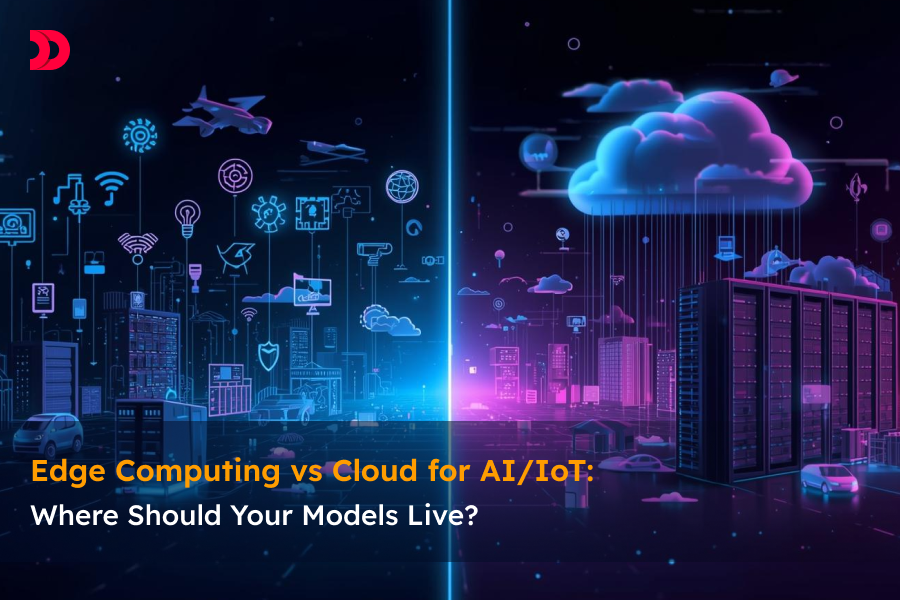
The Internet of Things (IoT) has become a new norm in the modern industrial landscape. Globally, enterprises have adopted it to drive digital transformation and implement the Industry 4.0 revolution. However, such penetration of the IoT technology from smart factories to autonomous logistics has significantly increased the volume of data. As organizations scale their businesses, this sheer volume of data can create the latency-bandwidth paradox.
This situation makes it challenging for many decision-makers to collect and process data. They need to focus on finding ways to process data to drive actionable intelligence without spending a fortune or compromising system integrity. This fuels the debate of Edge vs Cloud Processing. This blog focuses on how growing companies can leverage IoT analytics solutions and AI development services by maintaining the balance between the cloud and the edge.
Let’s start with understanding the issues of traditional IoT architectures.
Top Reasons Why Traditional IoT Architectures Fail
Earlier, IoT worked on a simple promise- connect everything to the cloud. Here, the cloud offered infinite storage with massive computing power to analyze data. However, as the number of connected devices increases from hundreds to thousands, this model reveals some vulnerabilities, including
Latency Limitations
Whether it is a robotic assembly line or an autonomous mining vehicle, even a delay of 500 milliseconds can make a big difference. Latency restrictions are one of the key reasons for the failure of the cloud-based IoT architectures.
Bandwidth Issues
It is highly expensive to transfer raw and high-frequency sensor data to the cloud. Companies find that the cost of data transit exceeds the value of the insights. This can create a big gap between the revenue and expenditure while occupying high bandwidth.
Data Security
This is another major vulnerability of the traditional IoT architectures. It is risky to send sensitive operational data across public cloud networks. Moreover, companies need to focus on local regulations and privacy laws while sharing and processing data.
These shortcomings of traditional IoT architectures can result in data graveyards without having a strategic shift in place. Here, the Edge technology lends a helping hand for modern enterprises.
Comparison between the Edge vs. Cloud
It is necessary to understand the value propositions of both Edge and cloud computing to build a resilient and productive architecture for corporate data. Let’s go through them one by one to dig deeper into their strengths and challenges.
Edge Computing- Source-based Intelligence
This technology enables companies to perform data analysis directly on the source of data, such as sensors or local servers. Edge offers real-time responsiveness and reduced bandwidth costs with increased privacy. Businesses can get the benefits of predictive maintenance and autonomous operations. However, this technology has limited computational resources, and it is difficult to manage distributed software updates.
Cloud Computing- Covers All Corners
It aggregates data from across the entire enterprise into a centralized environment. When it comes to collecting and processing data at a massive scale, cloud computing is always useful. It is also beneficial in training complex deep learning models. Businesses can manage their global fleet and supply chains using the cloud. The technology plays a vital role in strategic trend forecasting. However, high latency and significant OpEx are some of its bottlenecks.
Here is a quick table of comparison between Edge vs Cloud Computing.
Feature
Edge Computing
Cloud Computing
Focus on
Data analysis at the source
Aggregation of enterprise-wide data into a central hub
Processing Power
Limited computational resources
Massive scale
Response Time
Real-time responsiveness
High latency due to distance from the source
Benefits
Reduced bandwidth costs and increased privacy
Strategic trend forecasting and high scalability
Key Strengths
Predictive Maintenance, autonomous operations
Global fleet and supply chain management
Main Challenges
Difficulty in managing distributed software updates
Significant OpEx
It is better to consult a reputable cloud and data solutions provider to learn more about the differences and scopes of Edge vs. Cloud.
Modern Approach of Distributed Intelligence
Successful enterprise AI solutions follow a ‘Distributed Intelligence’ model. It is a hybrid model in which the edge takes care of immediate action, and the cloud manages long-term learning. Here, instead of sending every data point to the cloud, data science teams develop ‘anomaly detection’ models that run at the edge. When the device detects a deviation from the norm, it sends data to the cloud. It reduces data transmissions by up to 90 percent. It also ensures that the cloud receives the most high-value transformation.
MLOps services enable enterprises to train a global model in the cloud and then send optimized versions of that model to edge devices. This sophisticated MLOps strategy is useful for scaling IoT operations. Apart from these techniques, companies can take assistance from AI governance consulting service providers. It is necessary to ensure that the logic running on a remote sensor on a different continent adheres to the same operational standards.
Enterprise Use Cases of Edge and Cloud
Here are two real-life use cases of the Edge and Cloud technologies.
Manufacturing Company
A smart factory has thousands of sensors to monitor temperature, vibration, and power consumption. Here, AI models detect an unusual vibration pattern in a CNC machine and trigger an emergency stop in milliseconds. This can prevent a multi-million dollar breakdown. This process occurs at the Edge level. Whereas, in the cloud, data from five different factories has come to assist manufacturers in identifying the machine brands with the highest failure rates.
Healthcare Sector
Wearable devices generate continuous streams of patient data. Whenever the wearable detects an irregular heart rhythm, it alerts the patient and their local caregiver immediately through Edge technology. On the other hand, the cloud technology is useful in de-identifying data from many patients for analysis using the cloud technology. This can improve patient outcomes and reduce readmission rates in the hospital.
Apart from that, energy and other core industry sectors can utilize the hybrid approach to get the desired outcome and insights. However, it is essential to overcome the implementation hurdles to leverage the benefits of Edge and cloud technologies.
How to Overcome the Implementation Gap
A hybrid IoT analytics model is an organizational shift. Any enterprise struggles in this strategic shift due to several implementation hurdles. One such issue is the lack of compatibility of the data format at the edge with the cloud data lake. It is, therefore, better to ensure the compatibility of data before implementation.
Another hurdle is the increased risk of cyberattacks on Edge devices. Robust security frameworks and boot protocols can help companies secure their data. Moreover, building hybrid models requires expertise and execution of high levels. It is better to partner with a renowned AI development service provider to reduce time-to-market and save costs.
Concluding Remarks
IoT analytics is essential for modern enterprises. However, decision-makers need to think of gaining actionable insights without spending huge amounts of money. Edge and cloud computing can make it possible in a hybrid analytics model. MLOps services and data science-based models are useful to make enterprise AI solutions highly successful. However, it is necessary to choose the right AI development services provider to leverage the benefits.
DevsTree IT Services is a leading AI solution provider. Our in-house teams of experienced professionals can make the necessary models for your company using the advancements of Edge, cloud, and ML technologies. Contact us to learn more about the scope of IoT analytics and how it drives growth for your company.
Time zones may look simple on the surface, but any developer who has dealt with cron jobs, database timestamps, or cross-country scheduling knows how quickly things break. One of the biggest areas of confusion is the difference between UTC and...
When you build software for kiosks, you’re not building another web app - you’re building a machine that must survive low memory, unreliable network, offline transactions, and real-time customer usage without ever crashing. This is the story of how we...
The healthcare sector covers a significant portion of the global economy, especially in the post-pandemic age. However, an aging global population, the prevalence of chronic diseases, and a persistent shortage of qualified professionals create hurdles for this sector. Moreover, the...
Data is the greatest asset and the most significant vulnerability in this AI-driven age. As financial institutions switch to hyper-digital ecosystems, the risk related to privacy and data security has increased exponentially. Traditional rule-based systems are insufficient in preventing sophisticated...
Algorithm is everything when it comes to measuring the effectiveness of AI models and the success of AI-based startups. Large Language Models (LLMs) and specialized edge AI are gaining fame quickly as enterprises want scalable solutions for handling multiple tasks....
The Problem In our car mechanic CRM application, users needed to search across multiple entities simultaneously-customers, their vehicles, appointment history, and service records. However, our data architecture presented a significant challenge. The Data Architecture Challenge Our application followed database normalization...









 Feb 13, 2026