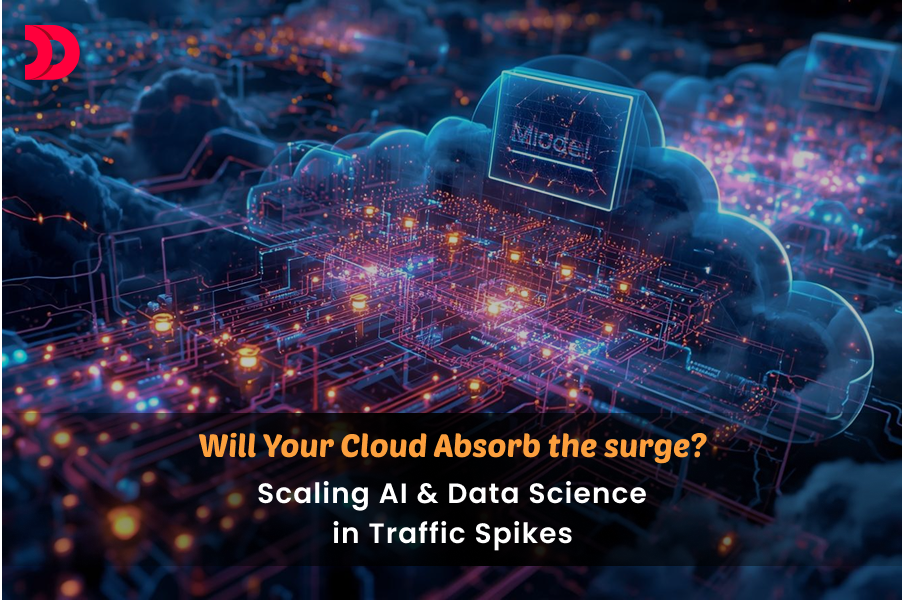
Artificial Intelligence (AI) has become a center of the value chain in this digital era. Whether it is a generative AI-based customer service agent or a dynamic recommendation engine, AI handles many processes. However, AI-based systems may underperform under pressure due to traffic spikes and other parameters. For example, when a retail giant celebrates Black Friday or a fintech firm experiences volatility spikes, the AI model may trigger a cascading failure.
This is a major reason why enterprise AI solutions require a fundamental shift in scaling. In other words, it is essential to consider compute, latency, and architectural resilience while scaling AI solutions. This post discusses the limitations of traditional scaling for AI and how companies can establish a reliable infrastructure by leveraging AI development services. Let’s start with understanding how AI inference is different.
Overview of AI Inference and Impact of Traffic Spikes
Traditionally, a CRUD (Create, Read, Update, Delete) application puts stress on the database and the web server’s ability to handle I/O during a traffic spike. AI inference, on the other hand, is different than such an application. Here, every request to an LLM (Large Language Model) or a computer vision model needs numerous floating-point operations. This makes both inference load and normal app load different.
Let’s dig in.
A standard web request might consume 50 ms of CPU time and a few megabytes of RAM. An AI inference request, however, requires a high-end GPU for several seconds with gigabytes of VRAM. It is essential to hold model weights and a key-value cache for the AI inference. When it comes to AI applications, the relationship between request volume and resource consumption is non-linear.
When a traffic spike occurs, any related variable can reach a physical limit, resulting in increased latency. As a result, the system gets more requests, leading to timeouts and breakdowns.
Key Challenges of AI Scaling
Traffic spikes cause timeouts and wasted compute resources that lead to breakdowns of AI applications. Therefore, AI scaling is essential. But the scaling of AI comes with a set of challenges. Companies can hire AI engineers to overcome these challenges effectively. Here are the critical challenges of scaling AI applications:
An AI model takes more time to generate a response with increasing concurrency. In LLMs, ‘Time to First Token’ (TTFT) and ‘Inter-Token Latency’ situations indicate this issue. The overhead of managing hundreds of thousands of simultaneous inference streams can lead to a poor user experience during a surge. It may render the AI useless.
CPUs are abundant and highly virtualized. However, GPUs are expensive and power-hungry. When the spike in traffic occurs, GPUs face a hit. Managed cloud services require 5 to 10 minutes for spinning up a new GPU-enabled node. By which time, the traffic surge may have peaked. It results in session abandonment by the user.
Traditional auto-scaling depends on metrics like CPU usage or Request-per-Second (RPS). However, an AI model is bound to a GPU. A misaligned scaling policy restricts the system from triggering new instances until it is too late. Moreover, the sheer size of AI model images can make rapid horizontal scaling cumbersome across the entire distributed network.
AI scaling is a financial and technical challenge. An unoptimized auto-scaling group that spins up a dozen H100 instances during a minor traffic surge can result in thousands of dollars. It is fair to say that the ROI of your AI initiatives can vanish if a proper data science consulting strategy is not in place.
It is better to partner with a reputable AI development company to overcome these challenges. You can leverage the modern approaches of AI scaling with the help of a reliable AI application development company.
Advanced Scaling Approaches for AI Scaling
A scalable and resilient AI system needs to implement the ‘inference-first approach. Here are some scaling approaches for making a robust AI application:
- Elastic Cloud Infrastructure
A robust container orchestration platform, typically Kubernetes (K8s), is the foundation of a scalable AI system. Enterprises are moving toward ‘Serverless Inference’ or specialized GPU node pools to handle spikes effectively. Moreover, technologies like Karpenter enable teams to scale their systems based on custom metrics instead of just CPU usage.
- Event-Driven Architecture (EDA)
It is different than the request-response model. Here, AI requests are decoupled from the user session via a message broker like Apache Kafka. EDA is useful for keeping requests in a queue to avoid server crashes. Moreover, it can prioritize ‘VIP’ requests or switch ot a smaller, faster model during extreme surges.
As a robust weapon of high-scale AI, model optimization can reduce the precision of model weights to reduce memory usage by 50 percent or more with minimal accuracy loss. Moreover, runtimes like vLLM can group multiple incoming requests into a single GPU execution cycle. This can increase throughput significantly.
Let’s face it. Traditional load testing tools send identical requests and measure response codes. This is not sufficient to prepare for a surge. It is, therefore, necessary to test the intelligence of the system instead of the connection. For example, behavioral simulation is an effective method. It involves variable payload testing and GPU saturation curves.
All these modern approaches require proper execution and planning. They have a blend of DevOps, cloud architecture, and data science. Companies should hire AI developers to implement these approaches for effective AI scaling.
Concluding Remarks
In a nutshell, scaling AI at an enterprise level brings several challenges and requires a disciplined approach with proper execution. Modern scaling approaches can help companies get rid of several challenges, like cost spikes and auto-scaling failures. However, it is essential to hire data scientists and ML engineers from a renowned AI development company to implement AI scaling properly.
DevsTree IT Services is a leading AI development company known for building AI-powered web and mobile solutions and enterprise-grade software. We integrate high-end features based on technological advancements in data science and automation. Contact us to learn more about our AI development services and how we deliver excellence in technology.






 Dec 29, 2025