AI agents have become ubiquitous in this digital world. We find them as customer-facing chatbots and internal automation assistants. However, it is essential to find the true value of these sophisticated and intelligent assistants for modern businesses. Having an AI agent does not guarantee success. This is a reason why companies hire AI automation services providers or developers to measure operational KPIs and financial ROI of AI agents.
This blog discusses the measurement of KPIs, ROI, and human-AI interaction metrics to gain a holistic view of the AI agent’s effectiveness. All the performance-related measurements give a clear picture of the impact of AI investment. Let’s start with the foundational performance indicators or KPIs.
Key Performance Indicators of AI Agents
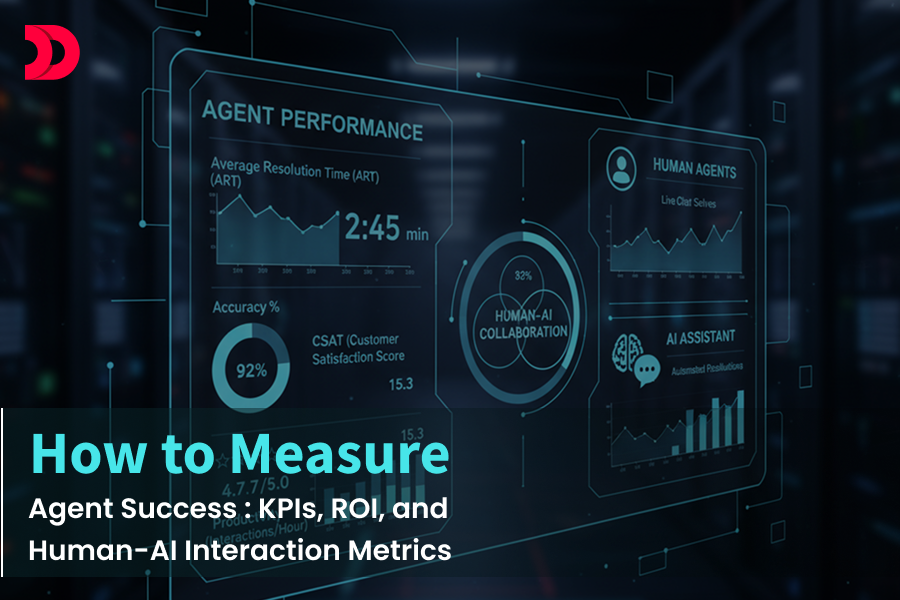
KPIs are foundational performance indicators for AI agents. They indicate the operational efficiency and impact of AI agents in financial gains. These metrics are useful for quantifying the agent’s reliability and speed in handling various assigned tasks. Here are some of the most important key performance indicators of AI agents –
It is the percentage of user requests the agent can handle successfully without human intervention. It is a direct measure of efficiency and scale.
It measures how often the agent gives correct information or executes the right action. Here, low accuracy can reduce trust and increase human workload.
It is the total time taken for the agent to complete a task. A continually reduced TTR shows a successful acceleration and management of the business process.
Companies can invest in end-to-end AI automation services to get optimal KPIs from successful AI agents. These services ensure that agents go beyond answering questions and integrate into workflows to maximize the impact.
Calculating the ROI: Measuring the Bottom-Line Impact
Operational success should convert into financial success. Measurement of the ROI of AI agents can show this number. This calculation consists of tangible and strategic returns against the total cost of ownership (TCO). Let’s go through them one by one.
It is the cost avoidance realized by reducing human interactions. For example, if an agent handles 50000 queries a month at an estimated human cost of USD 5 per query, companies can measure the cost. Tangible ROI also includes an increase in revenue from AI-driven sales and transactional throughput.
It includes improved regulatory compliance, higher data quality, and better employee retention after AI agent implementation. As these agents can handle tedious and repetitive tasks, employees can focus more on other productive activities. Though these factors are harder to calculate, they can drive long-term growth for the organization.
High ROI can move an AI project to the core of strategy for modern businesses. However, it is essential to measure the ROI accurately.
Human Interaction Metrics to Consider
Let’s face it. Sometimes, even an efficient AI system fails due to a frustrating and poor user experience. Therefore, the second crucial area of measuring the AI agent’s success is to find out how well it interacts with people. It includes the agent’s interaction with customers and internal teams, with its performance in conversational environments.
Human-AI interaction metrics focus on the user’s perception and experience. Here are such metrics-
- Customer Satisfaction and Net Promoter Score
Customer Satisfaction (CSAT) measures transaction-specific satisfaction, whereas Net Promoter Score (NPS) measures loyalty as a whole. Low scores indicate communication breakdowns or confusing hand-offs that lead to failure in the human-AI interaction.
- Adoption Rate and Stickiness
Adoption rate is the percentage of eligible users who choose the AI agent for conversation. Stickiness monitors the agent’s repeated use, signaling that the user found the previous interaction trustworthy. In other words, stickiness is an indicator of successful interaction.
When an issue requires escalation, the human agent has to receive full context, like user history. A poor quality in hand-off can lead to user frustration, and employees find it cumbersome.
Apart from these factors, chatbot performance management is crucial, especially for conversational AI. It monitors the way an AI agent or a chatbot understands and responds to queries. Such metrics are-
- Intent Recognition Accuracy
It is the percentage of time the agent interprets the user’s objective correctly. High accuracy is essential for seamless conversation between humans and AI agents.
It tracks the frequency of failure of AI agents in understanding. A high fallback rate shows a gap in the agent’s knowledge domain or training lapses. It signals poor coverage of common user queries as well.
Low or poor results of these conversational metrics show the necessity of deep model refinement. Companies should hire AI developers with specialized expertise in NLP (Natural Language Processing) to address challenges related to chatbot performance.
Concluding Lines
Measurement of an AI agent’s success is essential for modern businesses. This is because of the increasing prevalence of AI agents in every part of organizations. Accurate measurement of rigorous operational KPIs and transparent ROI can give a holistic idea of how AI agents drive growth and handle communication. Human-AI interaction metrics can give businesses a clear and actionable view of the AI agent’s conversational impact. Altogether, these metrics ensure the longevity and scalability of AI agents.
DevsTree IT Services is a renowned company known for offering AI-powered digital experiences. We integrate AI technology into highly sophisticated and advanced enterprise solutions. Contact us to know more about our AI automation services to drive growth and transformation for your company.









 Mar 06, 2026