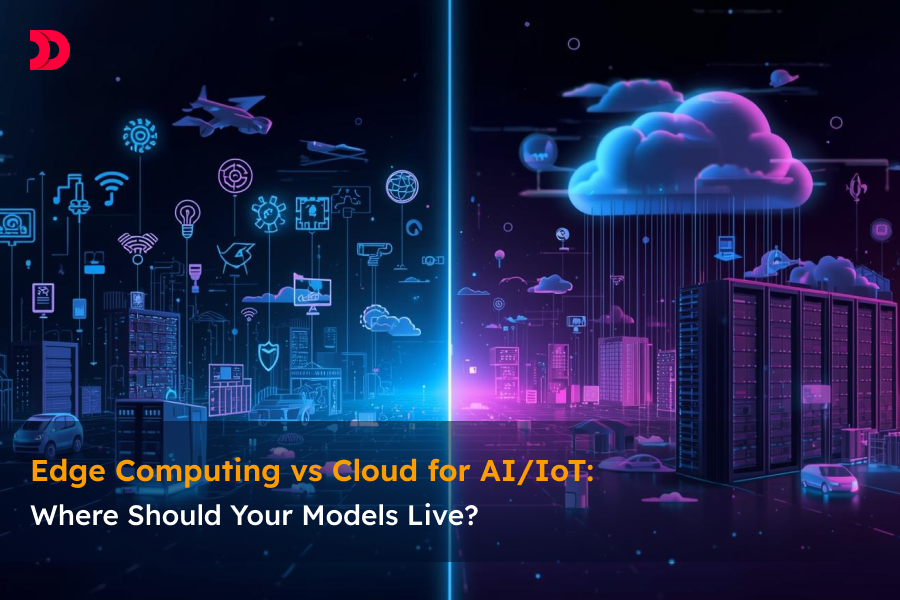
When the IoT (Internet of Things) technology was in a nascent stage, the data roadmap was simple. A sensor collected information and sent it to a centralized, cloud-powered server. Instructions came from the server. But, as we move into 2026, we have a sheer volume of data, estimated in the hundreds of zettabytes, every day. Billions of devices generate this massive amount of data and cause a big trouble for the idea of centralization.
On the other hand, AI has taken over as a distributed nervous system for data. This raises a question for developers and business leaders- Where should they execute the AI model? Whether it lives in the infinite and scalable cloud platform or at the Edge platform. This blog talks about the role of edge computing and cloud for both AI and IoT. Let’s start with the head-on competition between Edge AI and Cloud AI.
Comparing Giants- Edge AI vs Cloud AI
Selecting between edge and cloud technologies is like opting for either raw power or instantaneous action. When it comes to AI models, we can consider four different factors for comparing Edge and Cloud computing.
Latency
Data takes a ‘round trip’ in the cloud from the device. It travels from the device through local networks using the Internet and goes into a cloud-powered data center (often hundreds of miles away). It causes a delay ranging from 100ms to 1000ms. Edge AI, however, processes data on the device or a nearby gateway. It reduces latency to sub-50ms. This is particularly useful for complex robotics or high-speed manufacturing, where even a 500ms delay can cause a disaster.
Connectivity
The Edge AI has an upper hand over the Cloud AI when it comes to connectivity. It is simply because the Cloud AI needs the Internet. If the connection drops, the AI functionality of the device vanishes in the case of cloud computing. Edge AI offers operational continuity. For example, a smart medical wearable can function well irrespective of Wi-Fi connectivity because of the ‘offline-first’ reliability of Edge models.
Cost
It is a game of CAPEX and OPEX. Cloud AI has low upfront costs or CAPEX but high operational costs or OPEX. Whenever there is a necessity to move data out of the cloud, companies have to pay a hefty amount for the bandwidth charges and other costs. Edge AI, on the other hand, requires higher investment in specialized hardware like NPUs. But it can reduce long-term bandwidth costs by sending brief insights to the cloud instead of data streams.
Storage
The Cloud enjoys superiority over the Edge when it comes to storage. Whether you are training a massive LLM (Large Language Model) or running complex simulations, the cloud-based AWS or Azure offers virtually unlimited scalability. Edge devices are resource-constrained and capable of inference rather than training. The following is a quick table for comparing different aspects of Cloud AI and Edge AI models.
Feature
Cloud AI
Edge AI
Response Time
High (Seconds/Milliseconds)
Ultra-Low (Microseconds)
Bandwidth
High Usage
Minimal Usage
Privacy
Lower (Data in Transit
Higher (Local Processing)
Best Use
Deep Analytics
Real-time Actions
It is beneficial to consult a reputable AI development company to choose the right platform for your company’s AI model.
Limitations of Cloud-Only AI for Real-Time IoT
Though the corporate world wants to cloudify all the applications and systems, a cloud-only approach is not suitable for modern IoT. Let’s dig deeper into the reasons why cloud-only AI does not fit for real-time IoT.
Data Movement Issue
These days, sensors become capable of handling higher resolution images. These images are ‘heavy’ to move, and it is cumbersome for companies to upload 24/7 raw video from 100 cameras to the cloud for AI analysis. It costs network congestion and other issues, along with a lot of other expenses.
Reliability Gap
Mission-critical environments demand 99.999% availability. This is not possible to maintain even for the best cloud providers due to outages and other technical issues. If a smart city’s traffic management system depends on the cloud, a single fibre-optic cut could paralyze an entire area. This gap brings other complications as well.
Jitter and Determinism
Real-time applications and systems need determinism- the assurance that a task will finish within a specific timeframe. Internet routing in the cloud is non-deterministic. Even a sudden spike in traffic can delay packets halfway across the country. Such a jitter is unacceptable in smart manufacturing and robotic surgeries.
These are the key reasons companies opt for the hybrid approach consisting of Edge and Cloud architectures.
Hybrid Edge-Cloud Architecture
Companies will use a hybrid architecture consisting of Edge-Cloud technologies to make their AI and IoT deployment successful. As per this model, the architecture looks like a pyramid with different layers. The Device Layer has simple filtering and immediate safety triggers. The Edge Layer has local gateways to process data from multiple sensors and make local decisions. Finally, the Cloud Layer receives periodic metadata and uses it to retrain and improve models.
As per this hybrid approach, the Edge technology reflects, and the Cloud remains as the memory for AI//IoT models. When implementing in the real world, we can give a couple of examples of a successful AI/IoT model deployment in a hybrid environment. One example of a modern smart factory where edge computing is useful for predictive maintenance. Here, the Cloud’s role is to collect failure data from all factories to refine the vibration-detection algorithm.
Another example is of intelligent security systems. AI-powered systems use Edge Vision. Here, a camera at a warehouse entrance runs a local model to identify employees. By processing the video locally, the system can avoid the need to stream HD video to the cloud 24/7. Here, the Cloud connection is required only during an event or when performing a complex facial recognition check.
Concluding Remarks
The choice between the Edge and Cloud computing depends on two factors: scalability and delay. If your enterprise application requires immediate action and operates in remote areas, it is better to choose the Edge. If you perform a long-term trend analysis or deal with massive datasets, it is better to opt for the Cloud. The hybrid approach is gaining fame among companies to get the best of both worlds cost-effectively.
DevsTree IT Services is a leading AI application development company. We build high-end AI apps for modern businesses and assist in deploying them into the right environment. Contact us to understand the scope of Edge AI and Cloud AI to drive growth through the digital transformation of your company.
The healthcare sector covers a significant portion of the global economy, especially in the post-pandemic age. However, an aging global population, the prevalence of chronic diseases, and a persistent shortage of qualified professionals create hurdles for this sector. Moreover, the...
A competitive and fast-paced enterprise landscape demands advanced analytics of the sheer volume of data. Here, the real hurdle for modern enterprises is data velocity and cognitive load. Most companies are drowning in spreadsheets and relying on static PDFs for...
Artificial Intelligence (AI) has become a center of the value chain in this digital era. Whether it is a generative AI-based customer service agent or a dynamic recommendation engine, AI handles many processes. However, AI-based systems may underperform under pressure...
Artificial Intelligence (AI) and Machine Learning (ML) bring transformation in modern enterprises. These technologies make radical changes in traditional methods of offering personalized recommendations and handling risk assessment. AI strengthens the decision-making for companies, irrespective of their sectors. However, companies...
AI agents have become ubiquitous in this digital world. We find them as customer-facing chatbots and internal automation assistants. However, it is essential to find the true value of these sophisticated and intelligent assistants for modern businesses. Having an AI...
The front-end bottleneck has kept developers on their toes for years. It is the tedious and error-prone process of converting static and high-fidelity designs, created in Figma or Sketch, into dynamic, production-ready code manually. This challenge demands countless hours of...










 Feb 04, 2026