Community gatherings have been so specified with alcohol consumption in today’s social life, thus making this the right time to fit Alcohol Delivery App Development services into traditional liquor shop services. There are several benefits of a community gathering on-demand liquor delivery app to users who could order their favorite drinks, make payments, and track deliveries in real-time, even discovering nearby liquor options. These advantages show that an on-demand alcohol delivery app will be very useful for your wine business.
The idea of on-demand alcohol delivery has been growing at a fast pace and includes very favorable investment opportunities. In this blog, we are going to outline the base framework, required features, costs, and technologies involved in the development process of a successful alcohol delivery application.
The Features Required For a Successful Alcohol Delivery App:
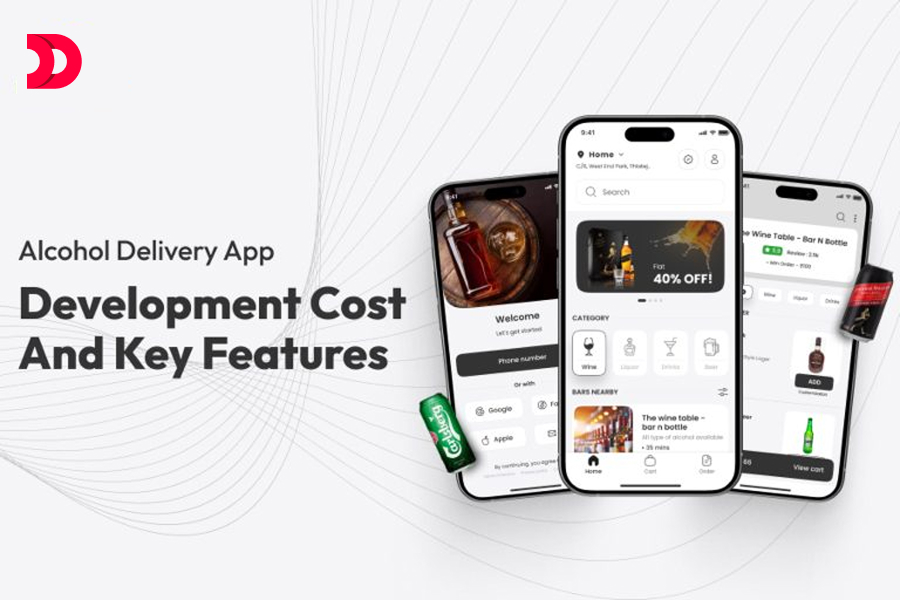
A successful on-demand alcohol delivery app would have essential integrated features by the user expectation and smooth continuity of processes. Some of these essential features include:
User Panel:
- User Registration and Login: Easy options for signing up and logging in through email, phone number, or social media
- Browse and Search Products: A complete catalog of all available alcoholic drinks/beverages with filters and search methods.
- Product Details: Elaborative information of every product comprising its price, type, brand, and quantity of %of alcohol.
- Order Placement: Easy and self-explanatory order placement procedure.
- Payment Integration: Multiple payment gateways including credit/debit cards, digital wallets, and COD.
- Tracking: Live tracking of the delivery agent with the estimated time of arrival.
- Reviews/Ratings: Rate and review products as well as services.
- Promotions and Discount Notifications: Notifications regarding every promotion, discount, as well as loyalty program running in the app.
- Order History: Previous orders with the usage of reordering in just one click.
Admin Panel:
- Dashboard: An overview of app performance with total orders, revenue, and user statistics.
- User Management: Manage user accounts: send them to verification and resolve any issues.
- Product Management: Add, update, and delete products in the catalog, and also manage their inventory.
- Order Management: View and manage all orders, view tracking, and resolutions.
- Payment Management: Overview of all executed transactions, refunds, and financial reports.
- Promotions Management: Manage and create in-app promotional campaigns and discount codes.
- Analytics and Reporting: Detailed analytics on user behavior, sales, and app performance for informed decision-making.
Delivery Agent Panel:
- Delivery Agent Registration and Login: A Secure Registration and login process with the delivery personnel module.
- Order Management: View the orders that have been assigned, accept and/or reject the delivery needs, and change the state of the order received.
- GPS Navigation: The integrated GPS will help the scouts in mapping the shortest route to the delivery address.
- Earnings Overview: Keep track of earnings and completed deliveries.
- In-App Chat: This feature allows the delivery personnel to chat with the customers or the support team during a delivery.
As an on-demand delivery application for alcoholic beverages, these features can make the process smooth, hassle-free, and easy for the customers. There are, of course, also enormous opportunities to improve the service for businesses and to get more revenue.
How Much Does an Alcohol Delivery App Cost?
The average cost required for the complete development of an Alcohol Delivery App depends on the project’s level of complexity and, thus, on the features it includes. To better understand the same, below are the items you should consider when developing your alcohol app.
The Required Features:
Reducing app development expenses can be achieved by selecting an MVP (Minimum Viable Product) that has only the most important functionality. A feature-rich, fully working version will cost a lot more money, though.
The Selected Platform:
If money is an issue, give preference to developing your native mobile app for iOS or Android, the most popular platform in your sector. This will reduce the cost of development.
The Cost Per Hour That the App Development Services Bills:
Most companies that design custom apps charge on an hourly basis. Compensation is given to each team member who contributes to the project based on the amount of time they spend building the app. The customer receives an estimated cost of development based on this.
The App Development Company’s Location:
It is location-based because, for example, one located in the United States would charge from $100 to $350 per hour, thereby making the cost between $250,000 and $250,000 for any local company dealing in app development.
However, in case you are aware of your requirement, you can also Hire App Developers from an Alcohol Delivery Mobile App Development services provider. In each of the cases, they provide competent work at a huge discount. As such, the price range for a functional app lies within $15,000-$20,000.
Bottom Line:
After this pandemic, the liquor on-demand industry is rewarding and full of potential. Given how reliant people have become on on-demand apps because of the global lockdown, this is the ideal time to invest in this space. If you want to build mobile app from a well-known App Development services provider, get in touch with DevsTree now.












 Feb 05, 2026