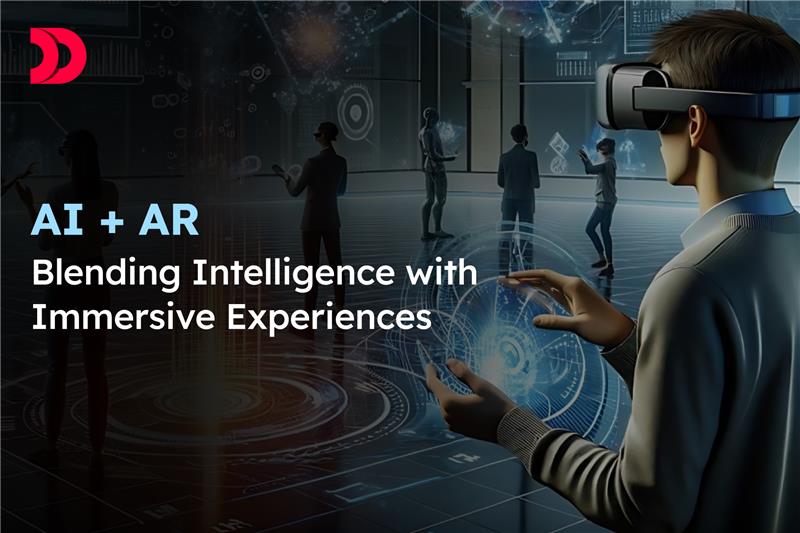
The lines between physical and virtual reality are getting blurred quickly in this digital era. It is because the rise of Augmented Reality (AR) technology has brought radical changes in perceiving our surroundings. Whether it is interactive 3D models or data visualizations, AR offers an immersive canvas for all digital information. A leading AI/ML development company can enhance this experience by combining AR with AI.
This blog talks about the role of AI and AR in transforming immersive experiences. We will start with the overview of the AI and AR pair and its impact on experiences. It is interesting to see some real-world examples of AI and AR applications across several core industries. Finally, it is necessary to go through some key challenges and future trends related to AI and AR.
AI and AR Combination- Impact on User Experiences
The combination of AI and AR can take applications to a new level of rich and personalized experiences. AI acts as the ‘brain’ of AR by processing a huge amount of complex data in real-time. It makes the experience dynamic and responsive. It also enables AR-powered apps to understand the context accurately. AI-based computer vision gives AR apps a dynamic capability to ‘see’ and ‘understand’ the surrounding world.
Moreover, AI and AR synergy has an impact on the way we interact with applications. NLP (Natural Language Processing) enables users to interact with AR apps using their conversational voice commands. This can take the experience to a new level with hands-free controls. Users get an AR-powered assistant for directions or information about any object. You can see this transformation clearly in AI-powered AR smart-glasses experiences, where real-time contextual intelligence enhances user interaction.
Finally, AI and AR are useful for making the AR-based content more relevant and useful. For example, an AR shopping app can show a discount on a product that the user is looking at with the help of AI technology. This makes the experience more interactive and personalized for shoppers. Let’s dig deep into some popular examples of AI and AR applications.
Real-World Use Cases of AI and AR Applications
The AI and AR pair has brought radical changes in core industry sectors. Here are some of the real-world use cases of such applications:
Gaming and Entertainment
These are two of the biggest beneficiaries of AR and AI synergy. For the gaming sector, the AI and AR combination is useful for creating next-gen storytelling and making the experience more interactive. AI-powered characters in AR can learn and adapt to the gamer’s actions to show more responsive narratives. The same duo can make the movie experience more immersive and interesting in theatres.
Retail and E-Commerce
AR can overlay digital content, and retailers can use it in combination with AI to offer virtual try-on features to their customers. Here, AI analyzes faces to ensure a realistic look and feel for clothing, makeup, and accessories. When it comes to furniture, AI-powered AR apps enable shoppers to visualize various products in their houses according to available physical space and lighting.
Engineering and Manufacturing
Both engineering and manufacturing sectors utilize AI-powered AR apps for enhancing worker productivity and increasing their safety. Moreover, these applications are useful for training and awareness. This combination also provides manufacturing companies with real-time data visualizations and performance metrics of employees. It results in more efficiency and productivity over the period.
Other sectors like healthcare and education can also benefit from AI and AR applications. You can hire AI & ML developers to make customized applications for your company and leverage the advantage of AR technology.
Challenges and Future Trends of AI and AR Integration
While AI and AR can take user experiences to the next level through a fascinating landscape, they pose significant challenges. The most important one is ethical consideration. The AI’s ability to collect and analyze the user’s data continuously can raise data privacy issues. The potential for misuse of this information is also a grave concern. Cutting-edge tools and robust connectivity could create a new form of social inequality, and the education sector can become inaccessible for some deserving yet underprivileged students.
However, the future of intelligent AR is quite promising, as it can bring revolutionary changes in the ways to live, work, and play. AR and AI can make real-time, global teamwork a reality. Users can get rich, immersive, and intelligent experiences in their favorite movies or games. We can expect that AI/ML development services will address the challenges of AI effectively and give us advanced experiences in the future.
Concluding Lines
The integration of AI into AR apps can redefine reality. AI models can act as a ‘brain’ for AR apps to make the experience more interactive and dynamic. AI/ML app development services can make useful applications for core industry sectors like retail, gaming, and manufacturing with improved, immersive experiences. However, it is imperative to focus on ethical considerations and other challenges while integrating AI into AI apps.
DevsTree is your trusted technology partner. We promote innovation with unmatched quality and reliability in all services, including web and mobile app development. As a renowned AI/ML development company, we assist our global corporate clientele in offering rich visual experiences by combining AI with AR. Contact us to know more about our AI/ML development services for your company.










 Feb 13, 2026