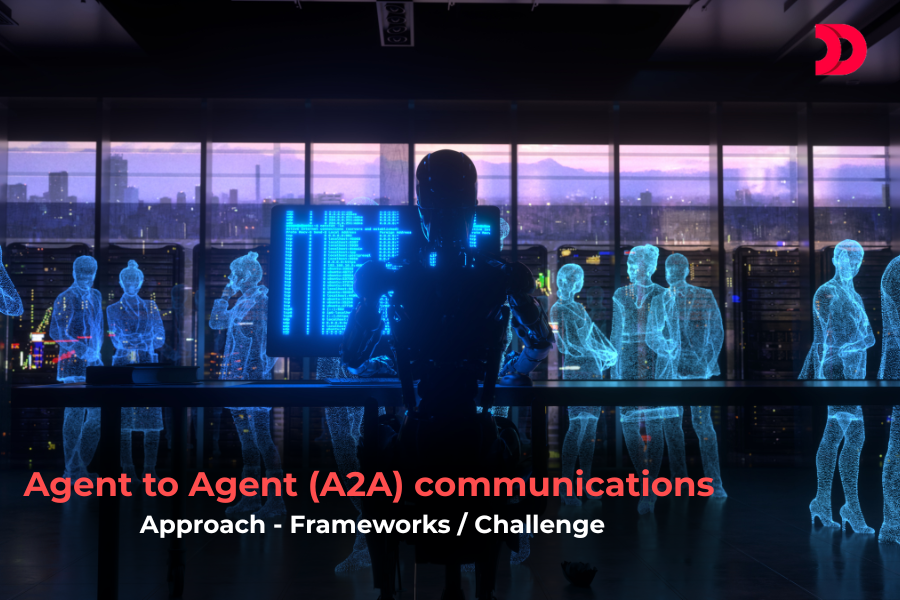
AI agents have brought radical changes in the way we communicate online. Nowadays, these digital assistants have evolved to communicate with one another, handling many complex tasks without human intervention. This evolution has introduced a new approach of Agent-to-Agent (A2A) communication. This concept has established a truly autonomous system.
This post talks about the core frameworks and architecture behind the A2A communication. We will also delve into the key challenges of this type later.
Core Frameworks and Architecture for A2A Communication
Intelligent agents need a standardized set of rules and structures for handling isolated tasks through collaboration. This architectural foundation ensures that any agent, irrespective of its original developer, can work within the same ecosystem.
Here, the most influential standard is the FIPA (Foundation for Intelligent Physical Agents). It is more of a set of specifications that define the architecture of a Multi-Agent System (MAS) with the language that agents use to communicate.
Modern A2A frameworks adapt the FIPA ideas to leverage advanced messaging protocols, like REST, while maintaining the original context. These frameworks have several components that handle various tasks. Here are key components of the A2A ecosystem-
Component
Role in A2A
Role in Real World
Agents
Autonomous, decision-making entities that perform tasks and collaborate
Employees in an office with specific skills
Agent Communication Language (ACL)
Structured language with format, content, and intent of every message
Grammar and dictionary
DF (Directory Facilitator)
A service where agents register their capabilities and services
Yellow Pages or Directory
Message Transport System (MTS)
An underlying technological layer that ensures the secure delivery of messages between agents
Email or postal services can ensure delivery.
Out of all these components, ACL plays a vital role in defining the intent behind the message. The FIPA-ACL standard can convey the intent through performatives. It enables an AI agent to use performatives like request (to ask another agent to act), and agree (to accept the previous proposal). This structure is useful for agents to engage in sophisticated dialogue protocols.
Approach for Agent2Agent Communication
The Agent-to-Agent (A2A) communication focuses on semantics, i.e. the meaning and intent behind the message. This characteristic makes this communication different from traditional client-server models. A2A is about telling another system or agent to collaborate based on a shared understanding. This process has a specific lifecycle consisting of five steps
Identification of Tasks
It involves the detection of tasks that need external help due to inherent limitations or high complexity.
Discovery of Capability
This step is about finding a remote agent with the necessary skills or service to perform the task.
Task Dispatch
After identifying the proper remote agent, the client agent sends a structured task request for it.
Task Execution
The remote agent performs the task, including analysis, content generation, or any real-world action.
Handling Response
The artifact or outcome comes to the client agent, which uses it to manage the workflow.
This Agent2Agent communication has several challenges due to the autonomous nature of AI agents and other factors. It is essential to address these challenges to leverage the advantage of Agent2Agent communication.
Key Challenges of Agent2Agent Communication
The implementation of the Agent-to-Agent protocol brings a new level of complexity. Here are the key challenges of A2A communication that the AI development company needs to address-
Security and Trust Issues
As A2A communication involves autonomous, digital agents, it is imperative to ensure the security of sensitive corporate data. The A2A system must verify the identity and integrity of every agent. This can help the system address challenges related to agent authentication, end-to-end encryption for messages, and malicious or compromised agents.
Performance and Scalability Limitations
As the number of agents and the volume of messages increase, it is difficult for the companies to maintain system responsiveness and stability. Highly efficient Message Transport Systems (MTS) are useful in handling these limitations. They can optimize task management to distribute computational load and prevent bottlenecks, ensuring high throughput with low latency.
Standardization-Related Obstacles
A2A communication has achieved high adoption across different industry sectors. However, this leads to standardization issues for specific sectors. Consensus on how AI agents communicate and register is inevitable. Current implementations mostly rely on modified standards or proprietary frameworks – adaptive autonomous AI systems are often built with bespoke communication layers. Therefore, industry-wide protocol alignment is a must.
A2A communication can bring revolutionary changes in the company’s workflow and collaborative processes. However, it is necessary to address several challenges to ensure a seamless A2A communication. A reputed AI development company can help enterprises address these challenges with advanced protocols and standard practices.
Concluding Remarks
Adopting Agent-to-Agent (A2A) communication is a strategic move to handle complex tasks without human intervention. It is useful for achieving autonomous digital automation. The foundational frameworks based on standards like FIPA can offer the necessary architecture.
However, it is essential to overcome the identified challenges to leverage the benefits of A2A communication. Greater standardization of protocols and advanced solutions with robust security are beneficial in addressing these challenges effectively.
AI video generation is rapidly transforming the content creation industry. Businesses, marketers, and creators are now using AI tools to produce professional videos in minutes instead of hours. Because of this demand, many startups and tech companies are building their...
The healthcare sector covers a significant portion of the global economy, especially in the post-pandemic age. However, an aging global population, the prevalence of chronic diseases, and a persistent shortage of qualified professionals create hurdles for this sector. Moreover, the...
A competitive and fast-paced enterprise landscape demands advanced analytics of the sheer volume of data. Here, the real hurdle for modern enterprises is data velocity and cognitive load. Most companies are drowning in spreadsheets and relying on static PDFs for...
When the IoT (Internet of Things) technology was in a nascent stage, the data roadmap was simple. A sensor collected information and sent it to a centralized, cloud-powered server. Instructions came from the server. But, as we move into 2026,...
Artificial Intelligence (AI) has become a center of the value chain in this digital era. Whether it is a generative AI-based customer service agent or a dynamic recommendation engine, AI handles many processes. However, AI-based systems may underperform under pressure...
Artificial Intelligence (AI) and Machine Learning (ML) bring transformation in modern enterprises. These technologies make radical changes in traditional methods of offering personalized recommendations and handling risk assessment. AI strengthens the decision-making for companies, irrespective of their sectors. However, companies...









 Mar 06, 2026