Software development is no longer a predictable process. Customer expectations change quickly, technology evolves rapidly, and businesses must adapt to stay competitive. A feature that seems essential today may become irrelevant within a few months. Likewise, new opportunities can emerge unexpectedly, requiring development teams to shift priorities.
Traditional software development methodologies were designed for a world where requirements remained relatively stable. Teams spent months planning projects, documenting specifications, and following predefined schedules. While this approach worked in some environments, it often struggled when projects encountered changing customer needs or market conditions.
Modern software teams need a different approach. They need a framework that embraces change instead of resisting it. This is exactly where Adaptive Software Development (ASD) becomes valuable.
Adaptive Software Development is a flexible software development methodology that focuses on continuous learning, collaboration, customer feedback, and rapid adaptation. Rather than assuming that every requirement can be predicted at the beginning of a project, ASD accepts uncertainty as a natural part of software development.
In this comprehensive guide, you’ll learn what Adaptive Software Development is, how it works, its core principles, advantages, disadvantages, real-world examples, and why it continues to be relevant in 2026.
What Is Adaptive Software Development?
Adaptive Software Development (ASD) is an Agile software development methodology that emphasizes adaptability, collaboration, continuous learning, and customer feedback. It enables development teams to respond effectively to changing requirements by using iterative development cycles rather than relying on rigid project plans.
Adaptive Software Development was created by Jim Highsmith during the 1990s. The methodology emerged as a response to the growing complexity of software projects and the limitations of traditional development approaches.
The central idea behind ASD is simple but powerful.
Software projects are inherently unpredictable.
Customers may change their requirements. New technologies may emerge. Business priorities may shift. Competitors may launch innovative products. Because of these uncertainties, trying to predict every detail of a project at the beginning often leads to problems.
Instead of creating detailed long-term plans and forcing teams to follow them, ASD encourages flexibility throughout the project lifecycle.
The methodology recognizes that:
Requirements evolve over time
Customer feedback is valuable
Learning occurs during development
Collaboration improves outcomes
Adaptability increases project success
For example, imagine a company developing a healthcare application. Initially, the project focuses on appointment scheduling and patient management. During development, users request AI-powered health recommendations and telemedicine capabilities.
A traditional project may struggle to incorporate these changes without major delays.
An Adaptive Software Development team can quickly reassess priorities, incorporate feedback, and deliver updated functionality through future iterations.
This ability to adapt is what makes ASD especially relevant in modern software environments.
What Are the Core Principles of Adaptive Software Development?
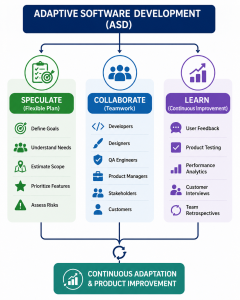
The core principles of Adaptive Software Development are Speculate, Collaborate, and Learn. These three principles guide teams in managing uncertainty, improving communication, and continuously refining software based on real-world feedback.
Unlike traditional development models that rely on planning, designing, building, and testing in a linear sequence, ASD revolves around three interconnected principles.
1. Speculate
The word “speculate” replaces the traditional concept of planning.
This does not mean guessing randomly. Instead, it acknowledges that future events cannot be predicted with complete accuracy.
During the speculation phase, teams:
Define business goals
Identify customer needs
Estimate project scope
Prioritize features
Assess potential risks
The objective is to create a flexible roadmap rather than a fixed blueprint.
Teams understand that plans will evolve as new information becomes available.
2. Collaborate
Collaboration is the foundation of ASD.
Successful software development requires active participation from:
Developers
Designers
QA engineers
Product managers
Stakeholders
Customers
Continuous communication helps teams solve problems quickly and reduce misunderstandings.
Rather than working in isolated departments, everyone contributes throughout the development process.
3. Learn
Learning is what differentiates adaptive teams from traditional teams.
Every development cycle generates valuable insights.
Teams learn through:
User feedback
Product testing
Performance analytics
Customer interviews
Team retrospectives
These lessons influence future decisions and improvements.
The learning phase creates a continuous feedback loop that drives innovation and product quality.
How Does Adaptive Software Development Work?
Adaptive Software Development works through iterative development cycles where teams continuously plan, build, review, learn, and adapt. Each cycle helps improve the product based on customer feedback and changing business requirements.
ASD follows an iterative and incremental process rather than a sequential one.
The process generally includes the following stages.
Step 1: Establish a Vision
Every project begins with a clear understanding of:
Business objectives
User expectations
Project goals
Success metrics
This vision provides direction while still allowing flexibility.
Step 2: Feature-Based Planning
Instead of defining every project detail, teams focus on high-priority features.
This approach allows resources to be allocated more efficiently.
Examples include:
User authentication
Payment integration
Reporting dashboards
AI-powered recommendations
Step 3: Iterative Development
Teams develop software in short cycles.
Each iteration delivers working functionality.
Benefits include:
Faster feedback
Lower risk
Better visibility
Increased agility
Step 4: Review and Feedback
At the end of every iteration, stakeholders review progress.
Questions commonly asked include:
Does the feature meet user expectations?
What improvements are needed?
Are priorities changing?
Feedback becomes a critical input for future iterations.
Step 5: Adapt and Improve
Based on feedback, teams modify:
Features
Requirements
Timelines
Priorities
The cycle then repeats.
This ongoing process allows software products to evolve naturally according to real-world needs.
What Is the Difference Between Adaptive Software Development and Agile?
Adaptive Software Development is a specific Agile methodology. While Agile is a broad philosophy, ASD provides a structured framework centered around speculation, collaboration, and learning.
Many professionals use ASD and Agile interchangeably, but there are differences.
Feature
Adaptive Software Development
Agile
Scope
Specific methodology
Broad philosophy
Focus
Adaptation and learning
Iterative delivery
Planning
Speculative planning
Sprint planning
Change Management
Highly adaptive
Adaptive
Feedback
Central component
Important component
Agile includes frameworks such as:
Scrum
Kanban
Extreme Programming (XP)
Adaptive Software Development
ASD places a stronger emphasis on managing uncertainty and complexity.
For highly innovative projects, ASD often provides greater flexibility than traditional Agile frameworks.
Why Is Adaptive Software Development Important in 2026?
Adaptive Software Development is important in 2026 because businesses operate in highly dynamic environments where customer expectations, technologies, and market conditions change faster than ever before.
Several factors have increased the importance of ASD.
Artificial Intelligence Expansion
AI technologies are evolving rapidly.
Organizations frequently update products with:
AI assistants
Predictive analytics
Automation features
Machine learning capabilities
Development teams need flexible processes to keep pace.
Cloud-Native Development
Cloud environments continue to evolve.
Organizations regularly:
Scale infrastructure
Add integrations
Enhance security
Improve performance
ASD supports these ongoing changes.
Rising Customer Expectations
Modern users expect continuous improvement.
Customers want:
Faster updates
Better experiences
Personalized features
Quick bug fixes
Adaptive development helps meet these expectations.
Increased Competition
Digital competition has intensified across industries.
Organizations that adapt quickly gain significant advantages.
Companies unable to respond rapidly often lose market share.
Continuous Innovation
Innovation is no longer optional.
Businesses must continuously experiment and improve products.
ASD provides the flexibility needed to support innovation initiatives.
What Are the Benefits of Adaptive Software Development?
Adaptive Software Development offers flexibility, faster response to change, improved product quality, enhanced collaboration, reduced risk, and greater customer satisfaction.
Organizations adopt ASD because of the substantial benefits it provides.
Greater Flexibility
ASD allows teams to modify priorities as circumstances change.
This flexibility reduces the impact of unexpected events.
Improved Customer Satisfaction
Customers actively influence product development.
Their feedback helps ensure the final product aligns with actual needs.
Faster Delivery
Iterative development allows teams to release features more frequently.
Instead of waiting months for a complete product, customers receive value sooner.
Better Product Quality
Continuous testing and feedback improve software quality.
Issues are identified earlier and resolved more quickly.
Reduced Project Risk
Large software projects often fail because problems remain hidden for too long.
ASD reduces risk through small, manageable development cycles.
Enhanced Team Collaboration
Cross-functional teamwork improves communication and knowledge sharing.
This leads to better decision-making and stronger project outcomes.
Increased Innovation
Teams are encouraged to experiment and learn.
This culture supports creativity and continuous improvement.
What Are the Challenges of Adaptive Software Development?
The challenges of Adaptive Software Development include managing uncertainty, handling changing requirements, maintaining stakeholder alignment, and ensuring effective communication among team members.
Although ASD offers many advantages, it is not without challenges.
Constant Change
Frequent requirement changes can create confusion if priorities are unclear.
Teams must balance flexibility with stability.
Resource Estimation Difficulties
Long-term planning becomes more challenging because future requirements may evolve.
Estimating budgets and timelines can be difficult.
Stakeholder Resistance
Some stakeholders prefer predictable schedules and fixed project plans.
They may struggle to embrace adaptive approaches.
Communication Requirements
ASD depends heavily on communication.
Poor collaboration can reduce effectiveness.
Team Experience
Adaptive environments require skilled professionals who can make informed decisions independently.
Inexperienced teams may struggle with the increased flexibility.
Documentation Challenges
Rapid development cycles sometimes lead to insufficient documentation.
Organizations must ensure knowledge remains accessible.
Despite these challenges, many companies find that the benefits significantly outweigh the drawbacks.
When Should You Use Adaptive Software Development?
Adaptive Software Development should be used when project requirements are uncertain, customer needs evolve frequently, and innovation is a primary objective.
ASD is especially valuable in dynamic environments.
Ideal Scenarios
Startup product development
SaaS applications
Mobile app development
Artificial intelligence solutions
Digital transformation projects
Cloud-based platforms
These projects often experience significant changes during development.
In these situations, more structured methodologies may provide better control.
The key question is simple:
How much uncertainty exists?
The greater the uncertainty, the more valuable ASD becomes.
What Is a Real-World Example of Adaptive Software Development?
A real-world example of Adaptive Software Development is a SaaS company continuously modifying its platform based on customer feedback, user behavior, and market trends.
Imagine a project management software company launching a collaboration platform.
The initial release includes:
Task management
Team communication
File sharing
Project tracking
After launch, user analytics reveal that customers spend significant time using video collaboration tools integrated with competing products.
Customers begin requesting built-in video functionality.
An ASD team would:
Gather feedback
Analyze usage patterns
Reprioritize the roadmap
Develop video features
Release updates quickly
Measure adoption rates
Rather than following the original roadmap blindly, the team adapts to customer needs.
This increases:
User engagement
Customer retention
Product value
Market competitiveness
This example demonstrates how adaptive thinking drives business success.
How Can Teams Successfully Implement Adaptive Software Development?
Teams can successfully implement Adaptive Software Development by encouraging collaboration, embracing continuous learning, prioritizing customer feedback, and maintaining flexible planning processes.
Successful ASD implementation requires more than adopting new processes.
It often involves cultural change.
Build Cross-Functional Teams
Bring together professionals with diverse expertise.
This improves communication and decision-making.
Prioritize Customer Feedback
Customer input should influence development priorities.
Feedback provides valuable insights into real-world needs.
Encourage Continuous Learning
Teams should regularly reflect on:
Successes
Failures
Opportunities
Improvements
Learning drives long-term growth.
Adopt Supporting Tools
Popular tools include:
Jira
Azure DevOps
Trello
Asana
GitHub
These platforms improve visibility and collaboration.
Measure Key Metrics
Track indicators such as:
Customer satisfaction
Release frequency
Defect rates
Feature adoption
Development velocity
Metrics help teams identify opportunities for improvement.
Foster an Adaptive Culture
Perhaps most importantly, organizations must embrace change as an opportunity rather than a threat.
A culture that supports experimentation and learning is essential for ASD success.
Conclusion
Adaptive Software Development has become one of the most relevant software development methodologies in today’s rapidly changing digital landscape. As technology continues to evolve and customer expectations increase, organizations can no longer rely solely on rigid planning and fixed requirements.
ASD offers a more practical approach by embracing uncertainty rather than fighting against it. Through its core principles of Speculate, Collaborate, and Learn, development teams can continuously improve products, respond to feedback faster, and deliver solutions that better align with business objectives and user needs.
Whether you are building a SaaS platform, AI application, enterprise solution, cloud-native product, or innovative startup idea, Adaptive Software Development provides the flexibility needed to succeed in 2026 and beyond.
Organizations that learn faster and adapt quicker will continue to outperform competitors. Adaptive Software Development gives teams the framework to do exactly that.
Frequently Asked Questions
What is adaptive software development in simple words?
Adaptive Software Development is a software development approach that helps teams respond quickly to changing requirements through collaboration, customer feedback, and continuous improvement.
Who invented Adaptive Software Development?
Adaptive Software Development was introduced by Jim Highsmith during the 1990s to address the growing complexity and unpredictability of software projects.
Is Adaptive Software Development an Agile methodology?
Yes. Adaptive Software Development is considered one of the Agile methodologies because it emphasizes iterative development, customer collaboration, and flexibility.
What are the three phases of Adaptive Software Development?
The three phases are Speculate, Collaborate, and Learn. Together, they create a continuous cycle of planning, teamwork, feedback, and improvement.
Why is Adaptive Software Development important?
It helps organizations manage uncertainty, adapt to changing requirements, improve software quality, reduce project risks, and deliver greater customer value.
Modern businesses mean using trending, up-to-date technology, ideas, and methods while building software. But one of the major things that businesses usually neglect, but that severely impacts how your brand looks, feels, and operates, is software architecture style. There are...
If you are a developer or an organization, have you ever thought about software supply chain security? Has your software ever been targeted by cyberattacks? If yes, then you might want to take some time to read this guide. Software...
When a single Kubernetes cluster no longer meets your business requirements, you might need to opt for Multi-cluster Kubernetes, multiple independent clusters. Mostly, a single Kubernetes cluster is enough to deploy, scale, and manage modern applications. However, as the company...
The software industry is now building AI-Native software from the ground up rather than using AI as an add-on feature. Before, software companies required a team of developers, designers, testers, and engineers to handle the entire software development lifecycle (SDLC)....
As a CTO, you always want to hire the best software development partner for your company. How about having an evaluation framework for hiring a software development company that includes more than cost-per-hour metrics and generic reviews? This framework requires...
The debate of ‘build vs. buy’ is still on. The dilemma of ‘buy’ has, however, experienced transformation in recent years. This decision framework is biased toward one direction - buy SaaS (Software as a Service). Though off-the-shelf platforms promised lower...













 Oct 13, 2026