The healthcare sector covers a significant portion of the global economy, especially in the post-pandemic age. However, an aging global population, the prevalence of chronic diseases, and a persistent shortage of qualified professionals create hurdles for this sector. Moreover, the healthcare industry is the most regulated sector. These are the reasons why healthcare service providers are switching from reactive to proactive data-driven patient management models.
In this scenario, the Internet of Medical Things (IoMT) has emerged as a robust and beneficial approach. It drives transformation in the thriving healthcare industry by enabling healthcare institutions to convert data into clinical action. AI development services can bridge the gap between data collection and analysis. This post talks about the role of IoT in improving the patient experience with the help of AI.
Let’s start by digging deeper into the convergence of IoMT and AI.
IoMT and AI Integration- How It Establishes New Standards for Patient Care
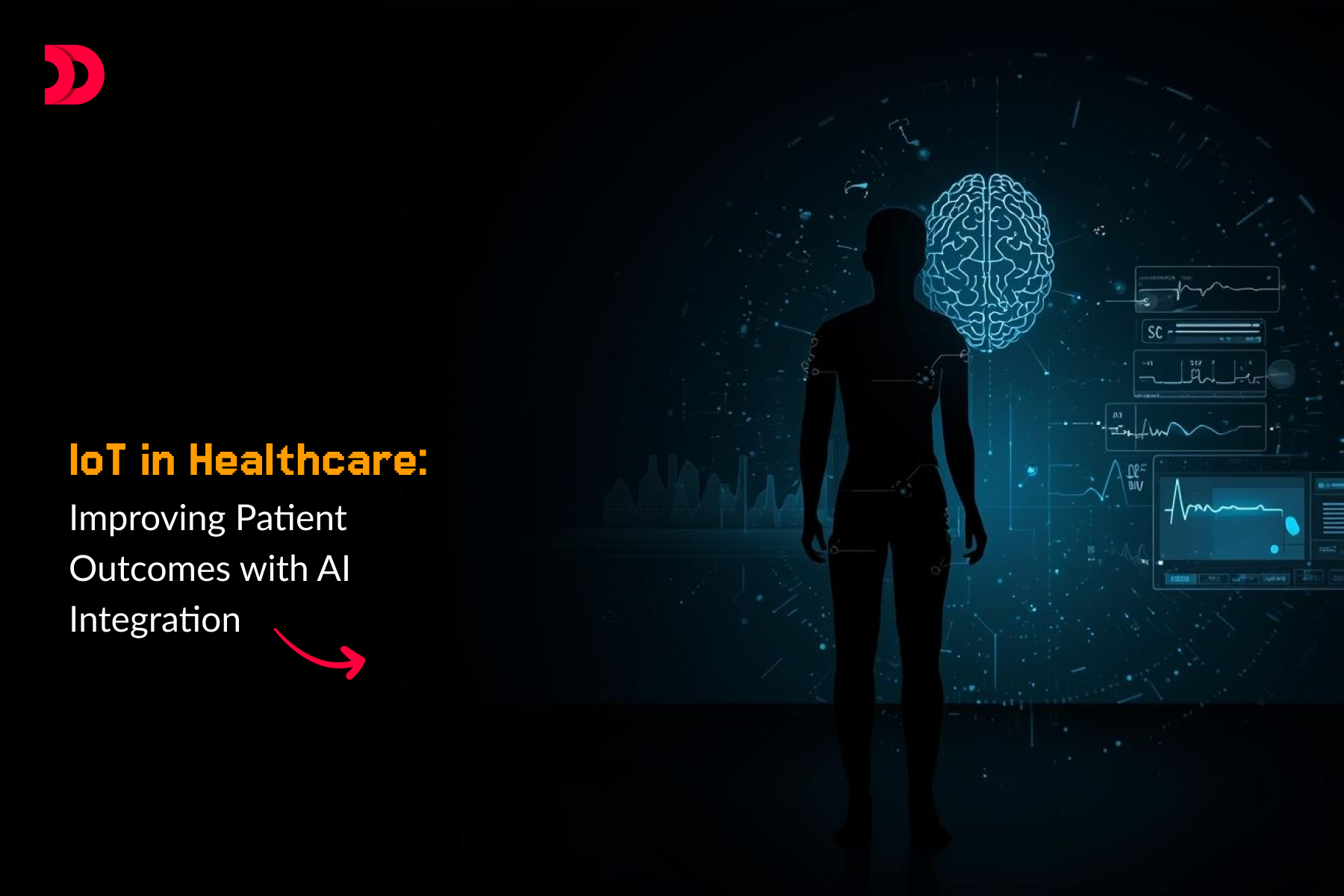
The modern healthcare industry is set to leverage the advantage of the IoT (Internet of Things) approach. A vast network of wearables and implantable devices with smart equipment can gather the patient’s data continuously. Enterprise AI solution providers can assist healthcare institutions in analyzing data to get actionable insights. AI models combine with IoT networks to identify patterns and predict health issues before they occur.
Here are the key components of the AI-driven IoT ecosystem-
These are smart sensors that collect heart rate, pulse, glucose levels, and sleep patterns of patients.
These are specialized platforms that gather heterogeneous data from multiple connected devices.
These are algorithms useful for predictive modeling and anomaly detection in the healthcare organization.
All these components are connected with secure transmission protocols. It is necessary to ensure that the data flow complies with the prevalent HIPAA and GDPR.
Top Healthcare Applications of AI-Driven IoT
The convergence of AI and IoT helps healthcare service providers solve clinical problems and critical business issues alike. Here are some popular AI-IoT applications for the healthcare sector-
- RPM (Remote Patient Monitoring)
Applications for RPM and chronic disease management are useful for managing conditions like diabetes and cardiovascular diseases. They do so by providing continuous monitoring. IoT analytics solutions enable patients to use connected devices. This data goes to a centralized platform. Here, AI models analyze this data against historical benchmarks. If it is different, then the system alerts the healthcare team immediately.
- Predictive Maintenance
It is highly beneficial for maintaining critical medical equipment. When it comes to hospitals, even the slight downtime for an MRI machine or a ventilator can become a risk to patient life. Healthcare organizations can utilize IoT sensors to monitor medical equipment, and predictive maintenance of AI can predict failure points. This helps hospitals shift their scheduled maintenance to predictive maintenance for optimizing the equipment’s lifecycle.
- Smart Hospitals
This is a unique concept that involves both AI and IoT technologies to get the real-time data about equipment, resources, and patients’ vitals. IoT-enabled RTLS (Real-Time Location Systems) have inbuilt AI dashboards to optimize hospital throughput effectively. This can increase the operational efficiency and improve the patient’s care. Smart hospitals can also reduce the waiting time stress for patients.
Healthcare professionals can consult IoT and AI solution providers to build customized applications. However, it is fair to say that implementing these applications matters to leverage their benefits.
How to Overcome Implementation Hurdles of IoMT Applications
The AI-IoT combination offers clear benefits in a clinical landscape. However, hospitals should consider implementation hurdles. Here, it is necessary to consult a reputable AI development company. One of the most noteworthy hurdles is the fragmentation of medical data. Healthcare professionals cannot get a holistic view of scattered or trapped patient data within isolated systems. It is, therefore, necessary to connect IoMT data with EHR (Electronic Health Record).
Another noteworthy issue is the vulnerability of connected devices to cyberattacks. It makes the Patient Health Information (PHI) protection a primary concern for healthcare organizations. Here, reliable enterprise AI solutions can assist by offering end-to-end encryption alongside AI-driven anomaly detection. These solutions can identify and neutralize suspicious patterns in real time.
Finally, IoT application development companies should consider HIPAA and GDPR standards while making and implementing IoMT applications. It is beneficial for the healthcare industry to keep a robust data governance policy in place.
ROI of AI-Integrated IoT Applications
Healthcare service providers can get measurable financial and clinical returns by transitioning to an AI-powered IoMT infrastructure. It facilitates them to shift their care from high-cost clinical settings to the patient’s home. This is useful for early detection of disease and preventing expensive emergency interventions. It further results in reducing the overall cost per patient over time.
Furthermore, the AI-IoT combination offers real-time monitoring. This translates into improved patient care and clinical outcomes. Hospitals can offer quicker medical interventions and higher diagnostic precision with more adherence to protocols. This is beneficial for resource optimization and administrative management. Automated systems can reduce the burden on nursing and medical teams. As a result, they can focus on high-end patient care.
Future of AI-IoT Integration for Healthcare
As AI and IoT technologies evolve, we can expect highly advanced applications to come. One such application will be based on the Edge concept. Here, AI processing will move from the cloud to the Edge. This reduces latency and enhances privacy.
Furthermore, the rise of Generative AI (Gen AI) will summarize the week’s cardiac telemetry in 3 sentences to save time for the cardiologist.
The demand for specialized AI development services will increase with advancing technologies. Organizations that adopt these trends early will take their healthcare services to a new level.
Concluding Remarks
The integration of IoT and AI is a game-changer for the healthcare sector. It is beneficial to use remote patient monitoring and implement the concept of smart hospitals. However, it is essential to consider various aspects to leverage its benefits through a fully integrated digital health ecosystem. A strategic technology partner that delivers data science and ethical AI governance consulting helps healthcare organizations achieve scalable AI-IoT solutions.
DevsTree IT Services is a renowned AI development company. Our in-house teams of experienced professionals can make highly customized healthcare IoT applications with advanced features and seamless functionality. Contact us to learn more about our services for developing AI and data science-related applications.










 Sep 21, 2026