Data is the greatest asset and the most significant vulnerability in this AI-driven age. As financial institutions switch to hyper-digital ecosystems, the risk related to privacy and data security has increased exponentially. Traditional rule-based systems are insufficient in preventing sophisticated cyber attacks. This may result in the loss of reputation and revenue.
Moreover, it is difficult to protect financial information from complex scams in global transactions. Here, data science for finance lends a helping hand to C-suite executives and decision-makers. It helps them prevent loss and build a resilient infrastructure that can predict threats. This blog talks about the importance of data science consulting for finance. We will also delve into the role and benefits of an AI-driven risk framework with practical use cases.
Let’s start with the nature of complexity in the financial ecosystem and the reasons behind the failure of traditional security systems.
Nature of Complexity and Why Traditional Systems Fail
Globally, financial fraud is surging with huge losses. The US experienced a significant financial loss of overUSD 16 billion in 2024 alone. Investment fraud, business email compromise, tech support scams, and other schemes have resulted in the loss of hundreds of millions of dollars. It indicates that modern fraudsters do not follow predictable patterns. They utilize botnets and AI-driven social engineering to bypass traditional, reactive filters.
In the traditional method, if a transaction exceeded a certain amount or occurred in a high-risk region, it was flagged by the system. However, such risk management remains inefficient in the face of increasing transaction complexity and cyberattacks. As a result, modern businesses face several issues, including false positives and regulatory non-compliance.
Furthermore, inaccurate credit risk models force banks and financial institutions to hold more capital than necessary. This directly affects their lending capacity and ROI. It is, therefore, necessary to find an advanced solution for such increasing complexity and risk of cyberattacks.
AI-Driven Risk Management Framework for Financial Institutions
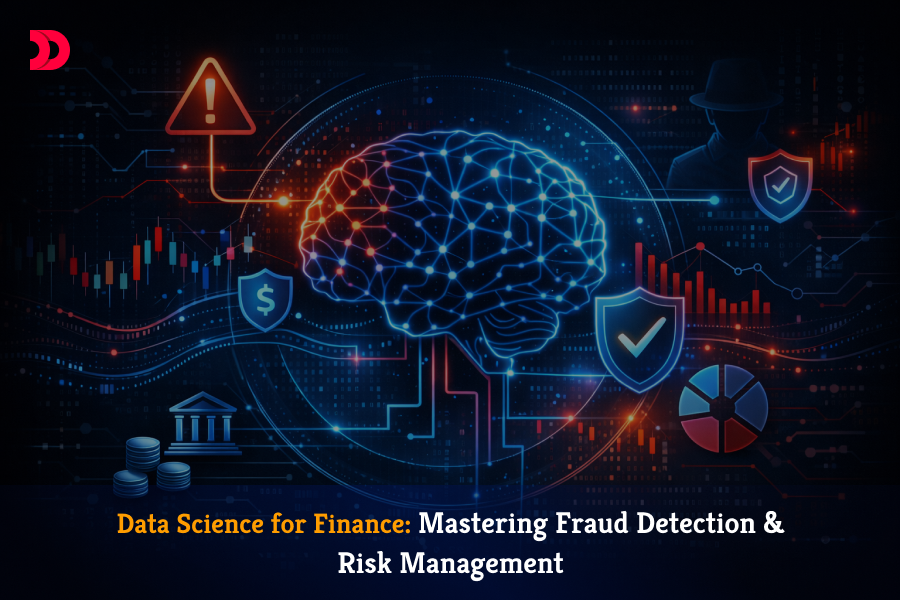
Data science meets AI technology for detecting fraudulent activities and managing risk in the financial sector. AI development services and MLOps services combine AI with data science to focus on the ‘behavioral DNA’ of every user and their transaction. Here are the three aspects of an AI-powered risk management framework based on data science-
- Real-Time Fraud Detection
Supervised models can learn from historical fraud patterns, and unsupervised models detect anomalies in financial transactions. Financial institutions can analyze millions of transactions in milliseconds using these models.
- Predictive Risk Scoring
Data science consulting service providers assist financial companies in creating dynamic risk profiles instead of static credit scores. They make models that consider alternative data, such as utility payments and the social media behavior of people.
- Graph Analytics
Money laundering involves complex webs of fake accounts. Graph analytics enable data scientists to visualize and analyze the relationships between entities, uncovering hidden clusters and payment patterns.
The BFSI (Banks, Financial Services, Insurance) sector can leverage the benefits of data science to detect fraud and manage risks related to cyberattacks.
Real-Time Use Cases of Financial Safety
Here are the examples of integrating AI and data analytics in financial solutions.
- Transaction Monitoring in Bank
A Tier-1 bank implemented an enterprise AI solution to manage its credit card process. Deep learning models in this solution analyze merchant categories, device metadata, and geolocation to reduce false positives by up to 40 percent.
- IoT Analytics in Insurance
Insurance companies can use telematics to assess driver risk in real time. This is an example of using IoT analytics solutions to analyze data from connected vehicles and reward safe behaviors. It also helps them flag high-risk driving.
Apart from these solutions, some financial firms can automate the KYC process with the help of AI governance and data science. It is better to consult a reliable AI solutions provider to implement such an advanced solution in your financial service company.
How to Build a Data-First Culture
Data science for finance is not a product, but an ongoing activity for detecting fraud and managing risks. It gives financial institutions a competitive advantage if implemented properly. Here are the strategies to build a culture that leverages the benefits of data science-
Companies need to ensure that IoT analytics solutions and CRM data remain in a single source of truth. This breaks data silos and contribute in converting a reactive approach to a proactive one.
It is essential to check whether the AI development company offers a scalable and cloud-native architecture. High scalability is useful in covering a vast financial ecosystem effectively and detecting issues.
Companies should prioritize speed in their solutions because even a second’s delay can lead to a huge loss. Timing matters the most when it comes to blocking attacks or making cybercriminals successful.
Financial companies should deploy a risk model that is easy to understand for the compliance team. A simple yet robust model is more effective in detecting fraudulent activities than one with complex features.
A data science company with a proven track record of deploying advanced models can assist financial institutions in detecting fraud.
Concluding Remarks
The financial sector faces the risk of fraud and cyberattacks. Integration of data science-based features into AI and ML models can assist your firm in transforming risk from a threat to a manageable variable. You can build a resilient, data-first culture by breaking silos and focusing on scalability with speed. Technologies like AI, IoT, and ML can help the BFSI sector get a powerful solution for managing the risk associated with fraud.
DevsTree IT Services is a renowned AI development company. Our in-house team of experienced professionals can leverage data science in high-end models that combine the features based on AI and ML technology. Contact us to learn more about the role of custom data solutions for your financial company.












 Oct 01, 2026