A competitive and fast-paced enterprise landscape demands advanced analytics of the sheer volume of data. Here, the real hurdle for modern enterprises is data velocity and cognitive load. Most companies are drowning in spreadsheets and relying on static PDFs for historical data. In other words, they can know what went wrong last month, but cannot know what to do tomorrow. Here, Business Intelligence (BI) comes into play.
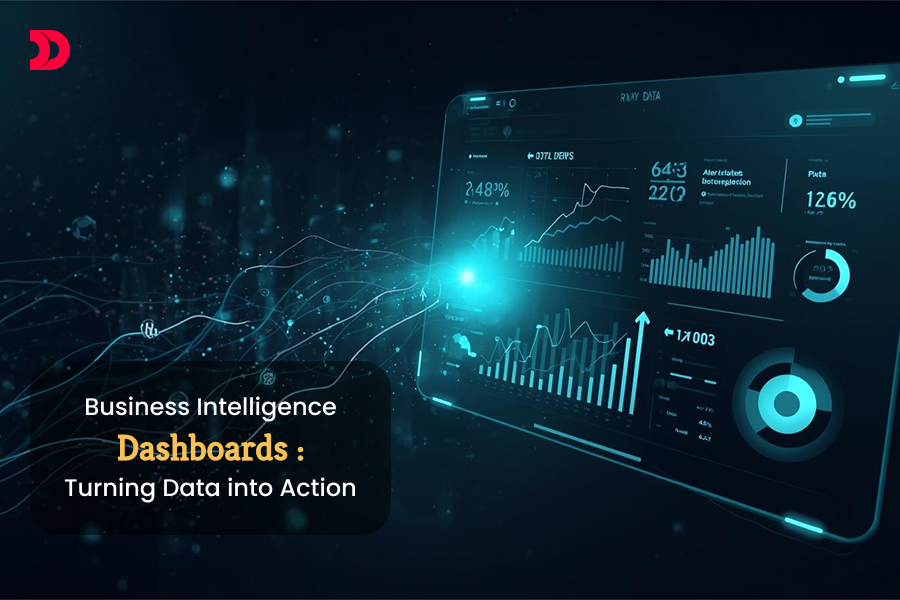
BI has moved beyond the era of bar charts, pie charts, and other graphical presentations of data. Today, successful entrepreneurs and tech leaders see real-time information on their dashboards and make insightful decisions. This paradigm shift from simple reporting to decision-making has made business intelligence dashboards a crucial tool for driving growth.
Let’s start with understanding the role of dashboards in this shift with the modern standard- Decision Intelligence (DI)
Role of Dashboards in Reporting to Digital Intelligence
Business Intelligence passes through a transition from traditional reporting to decision intelligence. Let’s understand the role of dashboards in this shift.
These are traditional dashboards and descriptive in nature. While they are necessary for financial audits and historical benchmarking, they remain highly passive. These dashboards always require a human analyst to look at the data and interpret the trends. It is not beneficial for entrepreneurs to rely solely on reporting dashboards in the year 2026 and beyond when competitors iterate in hours.
- Decision Intelligence Dashboards
These are prescriptive dashboards. They combine historical data with real-time streams and AI-powered forecasting. They prioritize outcomes over observations. For example, instead of showing a 5 percent drop in customer retention, a DI dashboard identifies the specific hurdles and recommends a targeted discount or outreach strategy. In other words, DI dashboards can suggest what we should do next.
Companies opt for decision intelligence dashboards to get the benefits of agility and gain a competitive edge. These dashboards should be user-centric and technically accurate to make a high impact.
Pillars of High-Impact Business Intelligence
Accurate and intuitive dashboards can drive action and strengthen decision-making. Here are the core pillars to get high-impact business intelligence.
Let’s face it. What if your logistics dashboard shows inventory levels from yesterday, but a supply chain disruption happened a couple of hours ago? This can lead to incorrect calculations and result in missed deadlines. Therefore, the dashboard must have inherent real-time data integration. In other words, the proactive dashboard should be a live monitoring dashboard. It should be capable of triggering automated alerts for entrepreneurs.
Effective BI follows the principle of Visual Hierarchy. Every dashboard should have ‘North Star’ metrics to define success for that specific aspect. Moreover, every chart on the dashboard must be free from vanity metrics. All the interactive dashboards attempt to track 50 different metrics at once. This can lead to chaos, and entrepreneurs may skip some important information. Therefore, KPI-driven design is essential for improving business intelligence.
A dashboard for a CEO should be personalized for their role. Similarly, DevOps engineers and other professionals should have dashboards as per their respective roles and responsibilities. For example, CXO dashboards show high-level, long-term trends and focus on EDITDA, market share, etc. Operations dashboards for middle management should show resource allocations and project milestones.
It is beneficial to consult a reputable data solutions provider to get the necessary dashboards for your teams and management. Also, a renowned data solution partner can help companies integrate AI and ML-powered features in the dashboard.
Role of AI in Connecting Predictions
The integration of Generative AI (Gen AI) and machine learning into the dashboard interface makes BI highly advanced and interactive. Gone are the days when AI outputs lived in separate tools and only data scientists could use them. Modern BI acts as the delivery mechanism for these AI-driven insights for strengthening the decision-making process.
- Role of AI in Closing the Loop
An AI-enhanced dashboard can predict when the item, product, or raw materials will run out. It also analyzes supplier lead times and proposes an optimal reorder quantity. In simple terms, AI can turn data into action when embedding the decision-making tools and the execution buttons within the analytics.
Importance of Embedded Analytics
BI has moved to the next level with embedded analytics and other technological advancements. Embedded analytics is about integrating data visualizations and BI tools into applications. Such business applications are popular, and employees or team members regularly use them. Some of the examples of such applications are Salesforce (CRM), Asana (Project Management Tool), and Slack (a communication platform).
Embedding can assist sales representatives in showing the necessary data even while they are on the call. This can enable them to upsell products immediately. Furthermore, people tend to utilize data if it is in front of them. Embedding analytics can make it possible, and data-driven decisions become a habit for enterprises. Finally, embedding removes the barrier between insights and users. Employees can see all data using a single click with embedded analytics.
Concluding Remarks
Modern enterprises can get rid of data velocity and cognitive load by implementing advanced BI. A business intelligence dashboard can act as a powerful tool to give the advantage of AI and embedded analytics. It strengthens the decision-making process and ensures that companies can make insightful decisions instantly. Pillars like real-time data and role-based views in the business intelligence dashboard can give companies a competitive edge in this challenging era.
DevsTree IT Services is a leading business intelligence dashboard development company. We integrate the advancements of AI and ML with analytics in interactive dashboards to drive transformation. Contact us to learn more about our AI and BI-related services to take your business to a new level.











 Sep 21, 2026