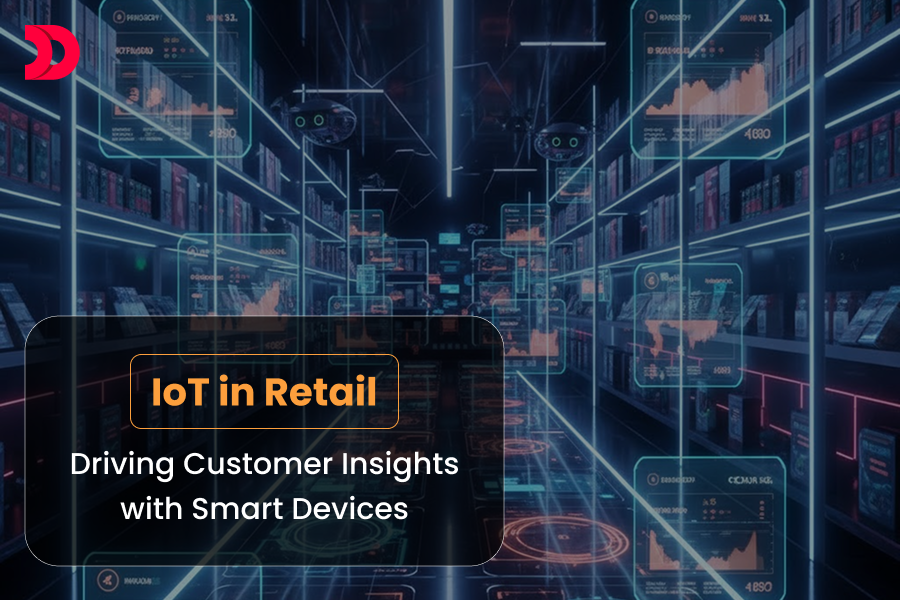
The retail sector has witnessed exponential growth in recent times. Digital transformation and automation are key drivers of this growth as brick-and-mortar stores convert into a ‘Phygital’ model. Connected devices have strengthened this model. Retailers can interact with shoppers in real time using these devices. In other words, IoT in retail bridges the gap between the rich shopping experience of a physical store and the accuracy of digital insights.
These days, retailers tend to hire IoT developer teams to build connected infrastructure with desired features and functionality. This blog discusses the role of IoT technology in the thriving retail sector and how retailers can gain a competitive edge by enhancing customer experience. We will also dig deep into the IoT implementation in the retail business with a glimpse at challenges and estimated costs.
Role of IoT for Modern Retailers
IoT is a game-changer in the retail sector because it handles both the front-end and back-end effectively. For example, this technology increases operational efficiency by automating tasks. Smart shelves and RFID tags give real-time data on stock levels and trigger reorders automatically to prevent stockouts. On the backend side, this technology ensures that the product always remains available. It can streamline logistics and maintenance effectively.
Connected devices are useful for making the store’s environment live. Beacons use proximity technology for sending personalized notifications or discounts to the customer’s smartphone. Occupancy sensors give heat maps of floor traffic to optimize store layouts. However, building such complex ecosystems needs IoT development services. Retailers can hire IoT developers to integrate thousands of individual data points into a single, cohesive dashboard.
IoT development services help retailers implement a connected retail strategy. They can leverage physical infrastructure and digital insights using this strategy. As a result, they can respond to customer needs quickly and accurately.
Top IoT Devices for Empowering Retail Sector
IoT devices can make a truly connected store. Retailers can attach RFID tags to individual items, and smart devices can track products based on these tags. It enables automation, as retailers can integrate weight sensors and RFID readers into shelves to detect specific items in real time.
Beacons, based on BLE (Bluetooth Low Energy), can detect the customer’s presence within a specific radius up to 100 meters. This can give retailers an advantage of hyperpersonalization. Smart devices like interactive mirrors enable customers to ‘see’ how a garment looks in different colors or sizes. It makes it possible to visualize the effect without physically changing. Digital screens or signage are useful for promoting products and spreading awareness effectively.
Finally, IoT gateways can collect signals from thousands of RFID tags and sensors to process data. These gateways can also ensure high-speed, real-time data transmission. A reputable IoT development company can suggest the most suitable smart devices to retailers as per their business models and objectives.
How IoT Analytics Services Drive Deep Customer Insights
Foot-traffic analysis enables retailers to get sophisticated heat maps that reveal which aisles are the most popular and which corners are not very popular. This consumer insight leads them to measure the specific duration a customer interacts with a product on a shelf in the brick-and-mortar store. Store managers can understand the situation of certain items based on this real-time data.
Moreover, IoT analytics services are useful for predictive modeling to anticipate future trends. As IoT analytics can analyze historical data, retailers can predict ‘what will happen’ accurately. However, it is necessary to handle the sheer volume of raw data generated every day. This requires special expertise and professional analytics services. These services assist retailers in turning raw data into a data-driven retail strategy.
Top Ways to Improve Customer Experiences through IoT Devices
Smart retail solutions can remove the friction of shopping and transform the brick-and-mortar store into a place of offering personalized experiences. Here are the top ways retailers can improve customer experiences using IoT devices:
- Proximity-Based Promotions
Beacon technology can deliver personalized shopping incentives in real-time through a dedicated mobile app. When a customer stands in a specific section, the connected system detects their location and triggers a hyper-relevant coupon or loyalty reward. It comes directly to their smartphones to increase conversion rates.
Models like Amazon Go have introduced the frictionless retail facility. It eliminates the most significant pain point in shopping- the checkout queue. AI-powered computer vision and IoT weight sensors on shelves can enable the retailer’s system to monitor items added to a virtual cart automatically. This can simplify and streamline the checkout process.
Augmented Reality (AR) technology and IoT-powered apps can assist customers to ‘try’ various products virtually in their actual living room. Moreover, digital signage and smart mirrors facilitate shoppers getting more information or requesting a different size without leaving the place. This interactive experience can attract and retain more customers.
Here, it is necessary to implement the IoT system effectively, overcoming various challenges. Let’s go through its hurdles and their solutions.
IoT Implementation Challenges and Their Solutions
The road to a fully automated environment using IoT technology has several technical and strategic issues. Here are the key challenges that require a proactive approach to ensure successful IoT implementation:
- Data Security and Privacy
Every sensor and beacon deals with massive and sensitive data related to customer behavior. They can act as a potential entry point for hackers. Therefore, retailers must implement end-to-end encryption and regular framework updates to protect the customer’s data.
- Complexity of Integration
This is one of the most important hurdles for retailers who are using legacy systems. Many retailers use older inventory software. It may not integrate with cloud-based IoT sensors. Sophisticated middleware from the right IoT development company can eliminate this issue.
Challenges related to scalability arise when retailers move from a pilot program to multiple locations. Here, factors like local network bandwidth, hardware maintenance, etc., also play a crucial role. A reputed IoT development services provider can help them address this challenge.
It is better to hire IoT developers from a reputable IoT service provider to overcome all these hurdles and ensure successful implementation.
Concluding Remarks
IoT in retail is an essential concept to bridge the gap between a physical store and digital insights to improve shopping experiences. Smart retail solutions empower brands to understand customer behavior and offer them personalized experiences. However, it is necessary to consider various challenges, including data protection and scalability, to leverage the benefits of IoT implementation.
DevsTree is a renowned IoT development service provider. We cater to the dynamic needs of core industry sectors like retail and manufacturing using IoT technology. Contact us to learn more about our services or to hire IoT developers who work dedicatedly on your project.









 Oct 01, 2026