Introduction
Globally, supply chains remain highly vulnerable to issues related to sudden geopolitical shifts, environmental disasters, and even rapid changes in consumer behaviors. Companies relying on outdated or legacy supply chain management methods may find it difficult to face these challenges. It leads to costly bottlenecks and huge inventory imbalances, with the loss of customer trust. There, artificial intelligence in supply chain operations can work wonders.
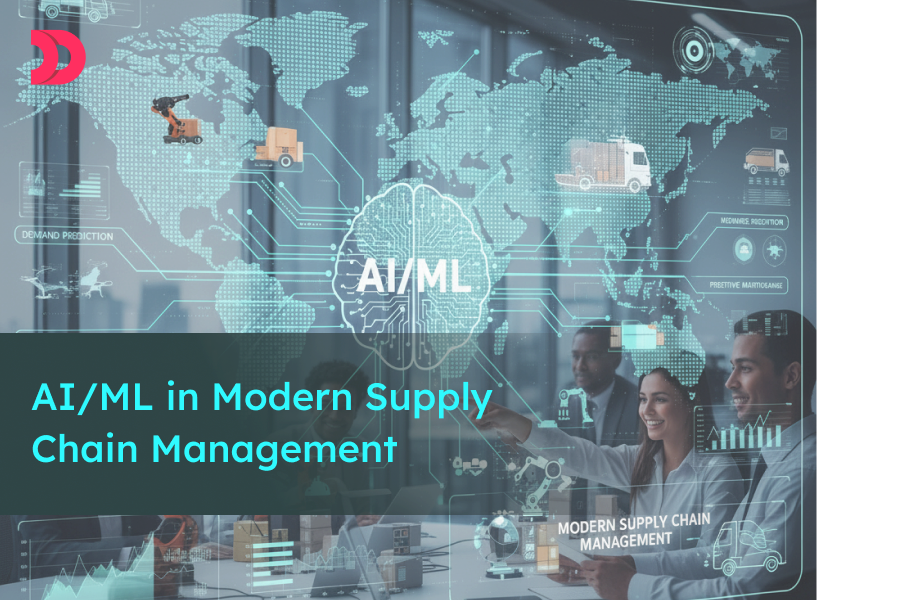
The integration of AI and machine learning in supply chain can assist companies to cope with a fundamental paradigm shift, moving operations from reactive to predictive and proactive. Both these technologies enable companies to get valuable demand forecasting and accurate data to optimize everything from inventory to logistics. This post talks about the core benefits of AI in supply chain and its role in both inventory optimization and logistics.
Key Benefits of AI in Supply Chain
As a futuristic technology, AI can automate tasks and upgrade the quality of business decisions. Companies that rely on slow and linear analysis of their data cannot manage supply chains effectively due to limitations in predictions and insights. AI-powered systems can ingest and correlate vast datasets in real time to give actionable insights with accurate predictions. AI/ML development services enable companies to get insights from various points simultaneously.
As a result, companies can gain enhanced business network visibility to make insightful decisions. AI can convert weekly planning cycles to minutes and reduce operational costs significantly by eliminating wastage. These are the core benefits of AI in supply chain. Let’s understand its role in predicting demands and optimizing inventory levels.
How AI Helps in Predictive Demand and Inventory Optimization
Traditional demand forecasting largely depends on simple averages based on historical sales data. This is a major reason why it fails to predict any unusual events or circumstances. Inclusion of artificial intelligence in supply chain with ML can utilize advanced algorithms to analyze hundreds of thousands of variables at once. Whether it is weather forecasts, seasonality, promotional campaigns, or competitor activities, AI can consider all the aspects.
A McKinsey survey has revealed that an AI-enabled supply chain management solution can improve logistics costs by 15 percent and inventory levels by 35 percent. This can clearly give your company a competitive edge. Furthermore, the inclusion of AI in inventory management can provide companies with optimum inventory levels at every location in real time. It helps them minimize the risk of stockouts and overstocking effectively.
Such an effective predictive demand and inventory optimization can maximize fulfillment rates while saving working capital.
Role of AI/ML in Revolutionizing Logistics and Mitigating Risks
Traditionally, logistics planning was static and based on pre-calculated routes and fixed schedules. AI has transformed this situation by offering dynamic data in real time. It has made it possible to monitor traffic, weather conditions, and even fuel prices to give the most efficient and fastest routes to the logistics sector. Moreover, AI uses computer vision and learning algorithms based on machine learning in supply chain to optimize slotting inside the warehouses.
Risk mitigation is one of the key benefits of AI in supply chain. This technology can monitor multiple datasets to identify potential issues or disruptions in advance. Whether it is predicting port congestion or assessing the financial stability of a supplier, AI can address these risks effectively. It facilitates companies to take actions proactively, re-route shipments, while making their networks more resilient against potential issues.
Ways to Implement Change in Supply Chains using AI/ML
After understanding the role of AI and ML in supply chains, the next crucial step is implementing these technologies. Deployment of sophisticated AI solutions in a high-stakes supply chain ecosystem is a complex and time-consuming process. It requires specialized knowledge with experience in model training, integration, and data engineering. A reliable AI/ML development services provider can help you implement changes in the supply chain.
When it comes to moving your supply chain from a traditional to a robust and scalable solution, it is necessary to follow the entire project development lifecycle. A renowned and trusted AI/ML development company follows all the aspects of this lifecycle, including-
- Data Strategy and Preparation
This is a crucial step that involves the establishment of a secure data infrastructure. It also includes the cleansing of raw and unstructured data so that the AI models can learn accurately.
- Model Selection and Customization
This step includes the selection of the right ML architecture and its customization to reflect unique operational challenges with business logic.
It is necessary to ensure that the new AI predictions and outputs flow correctly into the existing legacy systems. This step involves processes related to this aspect.
This crucial step requires expertise for ongoing monitoring, retraining, and modification of the models to maintain their performance as per the company’s requirements.
Whether you hire AI/ML developers or assign your project to the development company, you can integrate advanced and intelligent solutions into your company’s supply chain.
Concluding Remarks
As global supply chains face many challenges these days, it is essential to adopt artificial intelligence in supply chain. This technology, together with ML, offers accurate demand forecasts and plays a vital role in inventory optimization. Machine learning personalizes interactions and anticipates customer needs, as discussed in our article on Python and Machine Learning for Personalized User Experiences.
Moreover, AI and ML technologies can save time and operational costs by strengthening the decision-making process. It is imperative to follow the development lifecycle properly to leverage the benefits of AI in supply chain.
DevsTree is a leading AI/ML development company. Our experienced professionals can help you transform your supply chain with 360-degree AI/ML development services. Hire AI developers from DevsTree to streamline your logistics and inventory management processes using intelligent solutions.






 Oct 3, 2025