Why Agentic AI Must Be Evaluated Through a Business Lens
Enterprise leaders are no longer asking whether AI works. They are asking whether it pays off. As organizations move beyond pilots and proofs of concept, the focus shifts from technical feasibility to economic return.
Agentic AI promises automation, speed, and intelligence across business functions. However, without the right architectural foundation, these promises often collapse under the weight of cost, complexity, and maintenance overhead.
This is where the Model Context Protocol (MCP) changes the conversation. MCP is not just a technical standard. It is a lever for reducing cost, improving operational efficiency, and enabling new business models that were previously impractical.
In this blog, we will examine the economic and business return on investment of agentic AI built on MCP. We will look at cost structures, efficiency gains, flexibility advantages, and the long-term strategic value MCP unlocks for enterprises.
TL;DR: MCP Turns Agentic AI into a Measurable Business Asset
Agentic AI delivers ROI only when integration, maintenance, and scaling costs are controlled.
MCP reduces the total cost of ownership, accelerates time to market, and gives enterprises the freedom to adapt their AI stack.
The result is not just better technology but stronger business leverage.
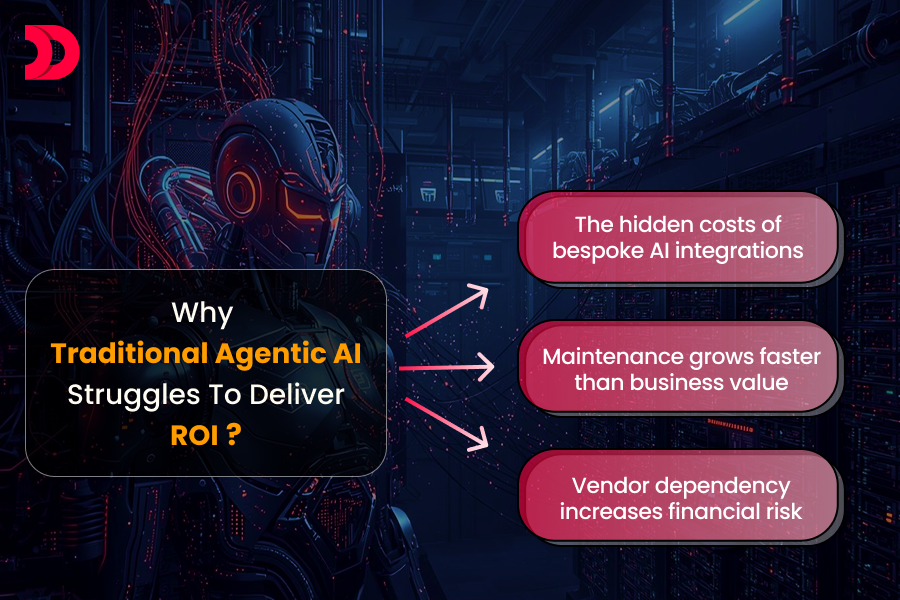
Why Traditional Agentic AI Struggles to Deliver ROI?
Here are some of the obvious reasons why traditional agentic AI struggles to deliver ROI at scale.
1: The hidden costs of bespoke AI integrations
Most agentic AI systems today are built using custom APIs, wrappers, and glue code. On paper, this looks flexible. In practice, it becomes expensive very quickly.
Every custom integration requires:
Design and implementation effort
Ongoing maintenance
Debugging and monitoring
Rework whenever tools or vendors change
Over time, enterprises discover that the cost of keeping AI systems running exceeds the value they generate.
2: Maintenance grows faster than business value
As agentic systems scale, the number of integrations grows exponentially. One agent connecting to ten tools is manageable. Ten agents connecting to ten tools is not.
Maintenance teams spend more time fixing integrations than improving workflows. This erodes ROI and slows innovation.
3: Vendor dependency increases financial risk
When AI systems are tightly coupled to specific vendors or frameworks, switching costs become prohibitive. Enterprises lose negotiation leverage and absorb price increases, roadmap changes, or platform risk. Without architectural flexibility, AI investments become sunk costs.
How MCP Changes the Economic Equation?
MCP removes the need for custom API development. At its core, MCP replaces bespoke integrations with a standardized protocol. Instead of writing custom connectors for each tool, enterprises integrate once and reuse everywhere.
This has an immediate financial impact:
Fewer engineering hours spent on integration
Lower long-term maintenance costs
Reduced risk of breaking changes
Engineering effort shifts from plumbing to value creation.
Reduce Integration Costs with MCP
See how MCP eliminates repetitive integration work across your AI stack.
In a fast-moving AI market, vendor flexibility is critical. MCP decouples agents from specific models, frameworks, or platforms.
This allows enterprises to:
Switch LLM providers without reengineering workflows
Adopt new tools as they emerge
Avoid being locked into underperforming vendors
This flexibility reduces long-term financial risk.
Better negotiation leverage
When switching costs are low, enterprises gain leverage. Vendors compete on value rather than lock-in.
This often leads to:
Better pricing
Improved service quality
More favorable contract terms
Flexibility becomes a measurable economic benefit.
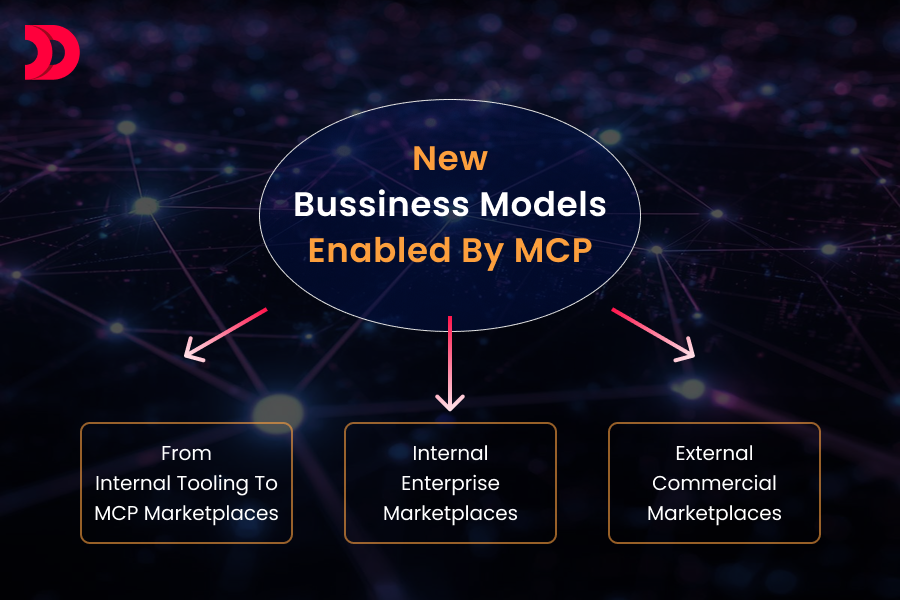
New Business Models Enabled by MCP
Here are some important business models that have reshaped their structures using MCP.
From internal tooling to MCP marketplaces
One of the most powerful economic impacts of MCP is the business models it enables.
With standardized protocols, tools become modular and reusable. This opens the door to the MCP tool marketplaces.
Internal enterprise marketplaces
Large organizations can create internal catalogs of MCP-compliant tools. Teams reuse capabilities rather than rebuild them.
This improves:
Internal efficiency
Governance and compliance
Return on internal tooling investments
External commercial marketplaces
Vendors can offer MCP-compliant tools as products. Enterprises can mix and match tools without heavy integration work. This shifts the AI economy from bespoke services to scalable platforms.
Explore MCP-Based Business Models
Understand how MCP enables marketplaces and platform strategies.
Enterprises that treat AI as infrastructure outperform those that treat it as projects.
MCP supports this shift by:
Standardizing communication
Reducing operational risk
Enabling long-term scalability
Reduced architectural debt
Custom AI architectures accumulate technical debt quickly.MCP minimizes this by enforcing consistency and reuse. Lower technical debt directly improves long-term ROI.
Takeaway: MCP Is Business Leverage, Not Just Technology
MCP does more than simplify agentic AI. It reshapes the economics of AI adoption.
By reducing costs, improving efficiency, enabling flexibility, and unlocking new business models, MCP turns AI from a cost center into a strategic asset.
Enterprises that adopt MCP early gain:
Faster returns
Lower risk
Stronger competitive positioning
This is why MCP is not just a technical choice. It is a business decision.
Turn Agentic AI into a Business Advantage
Design MCP-based systems that deliver measurable ROI, not just technical success.
Have You Ever Wondered Why Tooling Decides Whether MCP Succeeds Every protocol succeeds or fails based on its tooling ecosystem. TCP/IP scaled because developers could debug, monitor, and evolve systems with confidence. HTTP thrived because testing tools, logs, and standards...
Today, I am going to discuss in detail why Scaling Agentic AI is a Real Enterprise Challenge!! Well, most enterprises begin their AI journey with a single intelligent agent. This agent answers questions, calls tools, and performs basic workflows. At...
Enterprise AI is entering a new phase. What started as isolated experiments in chatbots, copilots, and automation scripts is now moving into connected, cross-system workflows.The challenge is that most enterprise tools, models, and agents still cannot communicate with each other...
If you think deeply, the last decade of software has been built on APIs, SDKs, and endless custom connectors. Yes, definitely, they were the bridge that helped applications talk to one another. But today, as AI systems evolve into multi-agent...
Well, do you know what truly makes the Model Context Protocol (MCP) work? It is not just the idea of standardization. It is the architecture that allows AI agents and tools to communicate smoothly. Or we can say a design...
Do you agree or not that these days of the AI ecosystem feel a lot like the early days of the internet? Everyone is excited, innovations are happening daily, but there’s also chaos under the hood. Here’s why, Each AI...









 Jan 09, 2026