Have You Ever Wondered Why Tooling Decides Whether MCP Succeeds
Every protocol succeeds or fails based on its tooling ecosystem. TCP/IP scaled because developers could debug, monitor, and evolve systems with confidence. HTTP thrived because testing tools, logs, and standards made it predictable.
Enterprises may understand the architectural promise of MCP, but developers are the ones who make adoption real. If building, debugging, and maintaining MCP-based systems feels painful, adoption slows. If tooling feels mature, predictable, and well-supported, MCP accelerates rapidly across teams.
This blog focuses on the developer tooling layer around MCP. We will explore SDKs, debugging challenges, testing approaches, lifecycle management, and best practices that turn MCP from a protocol into a production-ready foundation.
When MCP tooling matures, enterprises move faster, build safer systems, and scale agentic AI with confidence.
Let’s Discuss the MCP Tooling Landscape Today
A growing ecosystem, still evolving
MCP is still early in its lifecycle, but the tooling ecosystem is already taking shape. Developers are beginning to see SDKs, open-source frameworks, and internal tooling built around MCP concepts.
The goal of this ecosystem is simple. Make MCP-based development feel familiar, predictable, and debuggable.
MCP SDKs and open-source frameworks
SDKs are the first entry point for most developers. They abstract protocol details and provide clean interfaces for building MCP clients and servers.
Current MCP SDK efforts focus on:
Standard request and response handling
Tool schema definition and validation
Context passing between agents and tools
Error handling and retries
Open-source frameworks are also emerging to help teams:
Build MCP-compliant servers quickly
Integrate MCP into existing AI frameworks
Create reusable agent patterns
These early tools are reducing friction and encouraging experimentation, especially within enterprise engineering teams.
Build Faster with MCP-Ready Tooling
Explore SDKs and frameworks that simplify MCP development from day one.
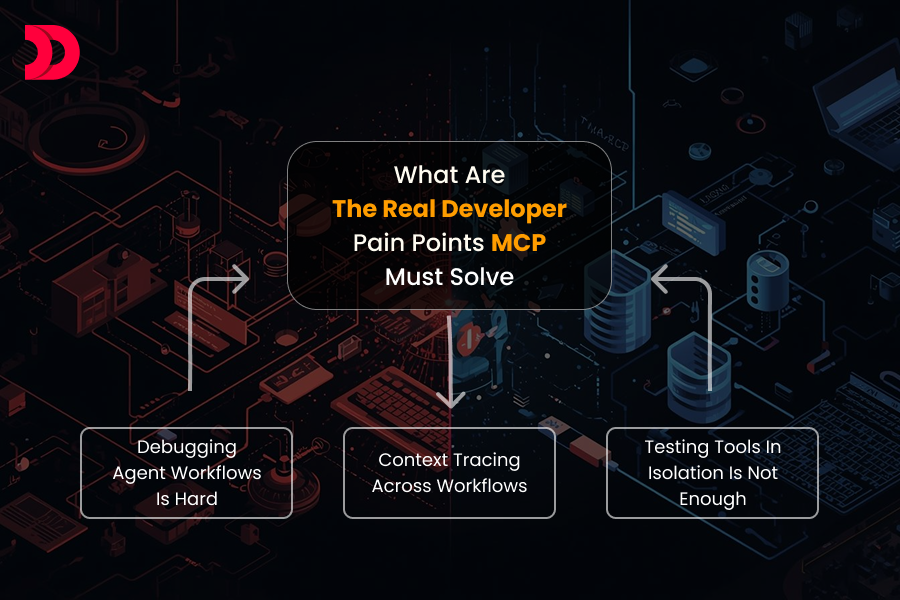
What are the Real Developer Pain Points MCP Must Solve?
Sharing the major issues of developers that MCP is here to solve.
Debugging agent workflows is hard
Agentic systems introduce complexity that traditional APIs never faced. Multiple agents. Multiple tools. Context flowing across steps.
When something breaks, developers need answers fast.
Common questions include:
Which agent made the decision
What context was passed at that step
Which tool responded incorrectly
Where data was lost or altered
Without proper tooling, debugging becomes guesswork.
Context tracing across workflows
Context is the heart of MCP. It is also the hardest thing to debug.
Developers need visibility into:
How context changes across steps
What data was added, removed, or modified
How previous actions influenced decisions
Without tracing tools, context feels invisible. This erodes trust in agent systems.
Testing tools in isolation is not enough
Traditional unit testing fails for agentic systems.
Testing a tool endpoint alone does not guarantee correct behavior when:
Agents interact dynamically
Tools are discovered at runtime
Context evolves across multiple steps
Developers need new testing strategies that reflect real MCP workflows.
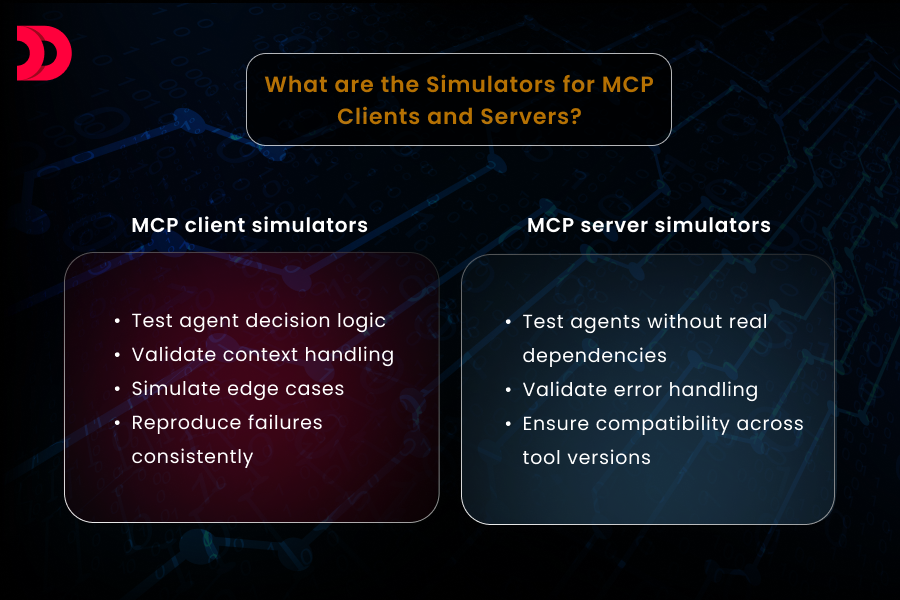
What are the Simulators for MCP Clients and Servers?
Why simulation matters
Simulators allow developers to test MCP systems without deploying full environments. They create controlled conditions where behavior can be observed, replayed, and verified.
This is essential for enterprise-grade systems.
MCP client simulators
Client simulators mimic agent behavior. They send structured MCP requests, pass context, and trigger tool execution.
Developers use them to:
Test agent decision logic
Validate context handling
Simulate edge cases
Reproduce failures consistently
MCP server simulators
Server simulators emulate tools and services. They respond to MCP requests using predefined schemas and behaviors.
This helps teams:
Test agents without real dependencies
Validate error handling
Ensure compatibility across tool versions
Together, client and server simulators create a safe environment for development and experimentation.
Test MCP Systems Without Risk
Use simulators to validate agents, tools, and context flows before production.
Versioning and Lifecycle Management for MCP Integrations
Why lifecycle management matters
Enterprise systems evolve constantly. Tools change. Schemas update. Policies shift. Without proper lifecycle management, MCP systems can break silently.
Versioning MCP tools and schemas
Best practices include:
Explicit versioning of tool schemas
Backward compatibility strategies
Clear deprecation timelines
Agents should be able to:
Detect tool versions
Adapt behavior gracefully
Avoid breaking changes automatically
Rolling updates without disruption
MCP supports gradual evolution by design.
With proper tooling:
New tool versions can coexist with old ones
Agents can migrate incrementally
Production systems remain stable
This is critical for enterprises operating at scale.
CI/CD Pipelines for MCP-Based Systems
Why MCP needs CI/CD discipline
Agentic systems are software systems. They require the same rigor as any production service.
CI/CD pipelines ensure:
Consistent builds
Repeatable testing
Safe deployments
What to test in MCP pipelines
Effective pipelines include:
Schema validation tests
Context flow tests
Agent decision regression tests
Tool compatibility checks
These tests catch issues early and prevent production failures.
Automated governance checks
Enterprises also integrate:
Security scans
Compliance validation
Logging verification
This ensures MCP systems remain trustworthy as they evolve.
Productionize MCP with Confidence
Design CI/CD pipelines that support safe and scalable agentic AI.
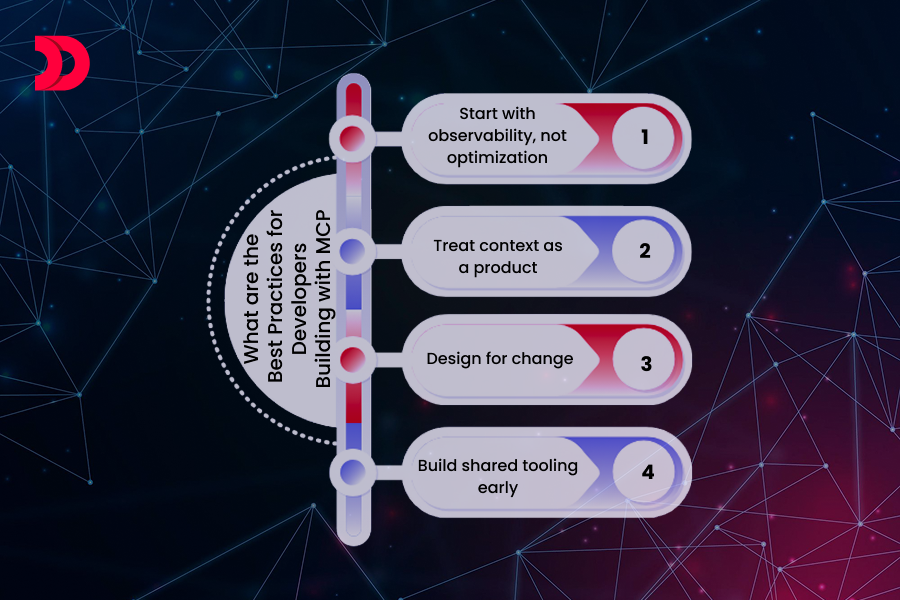
What are the Best Practices for Developers Building with MCP
Below are some of the best practices that we have shared, leveraging the experience of working with MCP.
Start with observability, not optimization
Visibility comes before performance. If developers cannot see what is happening, they cannot improve it.
Treat context as a product
Context design deserves the same attention as APIs. Clear structure improves reliability and explainability.
Design for change
Tools will evolve. Agents will grow. MCP systems should expect change, not resist it.
Build shared tooling early
Reusable simulators, logging libraries, and schema validators pay off quickly. They reduce friction across teams and accelerate adoption.
Why the MCP Developer Ecosystem Accelerates Adoption
Protocols do not scale on theory alone. They scale through developer trust.
When developers can:
Build quickly
Debug confidently
Test safely
Deploy reliably
Adoption follows naturally.
The MCP developer ecosystem is becoming the force that turns architectural promise into enterprise reality. As tooling matures, MCP moves from early adoption to default infrastructure for agentic AI.
Takeaway: Tooling Turns MCP into Enterprise Infrastructure
MCP provides the protocol foundation for agentic AI. Developer tooling turns that foundation into something usable, scalable, and trustworthy.
SDKs reduce friction.
Simulators reduce risk.
Logging builds confidence.
CI/CD pipelines ensure longevity.
Together, they transform MCP from a specification into a living ecosystem.
Enterprises that invest early in MCP tooling will move faster, avoid architectural debt, and build agentic systems that last.
Build MCP Systems That Scale in the Real World
Let us help you design, test, and operate MCP-based AI systems with confidence.
Why Agentic AI Must Be Evaluated Through a Business Lens Enterprise leaders are no longer asking whether AI works. They are asking whether it pays off. As organizations move beyond pilots and proofs of concept, the focus shifts from technical...
Today, I am going to discuss in detail why Scaling Agentic AI is a Real Enterprise Challenge!! Well, most enterprises begin their AI journey with a single intelligent agent. This agent answers questions, calls tools, and performs basic workflows. At...
Enterprise AI is entering a new phase. What started as isolated experiments in chatbots, copilots, and automation scripts is now moving into connected, cross-system workflows.The challenge is that most enterprise tools, models, and agents still cannot communicate with each other...
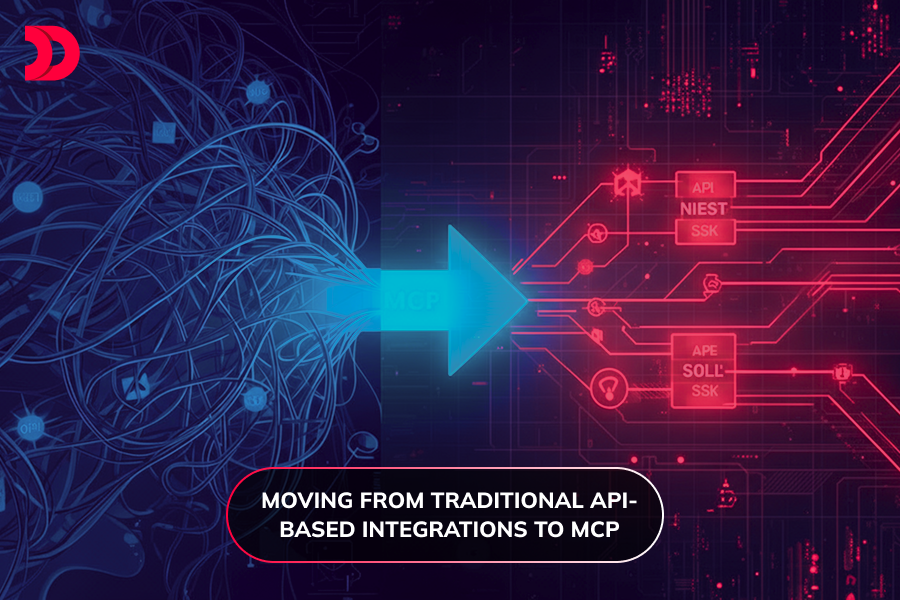
If you think deeply, the last decade of software has been built on APIs, SDKs, and endless custom connectors. Yes, definitely, they were the bridge that helped applications talk to one another. But today, as AI systems evolve into multi-agent...
Well, do you know what truly makes the Model Context Protocol (MCP) work? It is not just the idea of standardization. It is the architecture that allows AI agents and tools to communicate smoothly. Or we can say a design...
Do you agree or not that these days of the AI ecosystem feel a lot like the early days of the internet? Everyone is excited, innovations are happening daily, but there’s also chaos under the hood. Here’s why, Each AI...











 Jan 05, 2026