


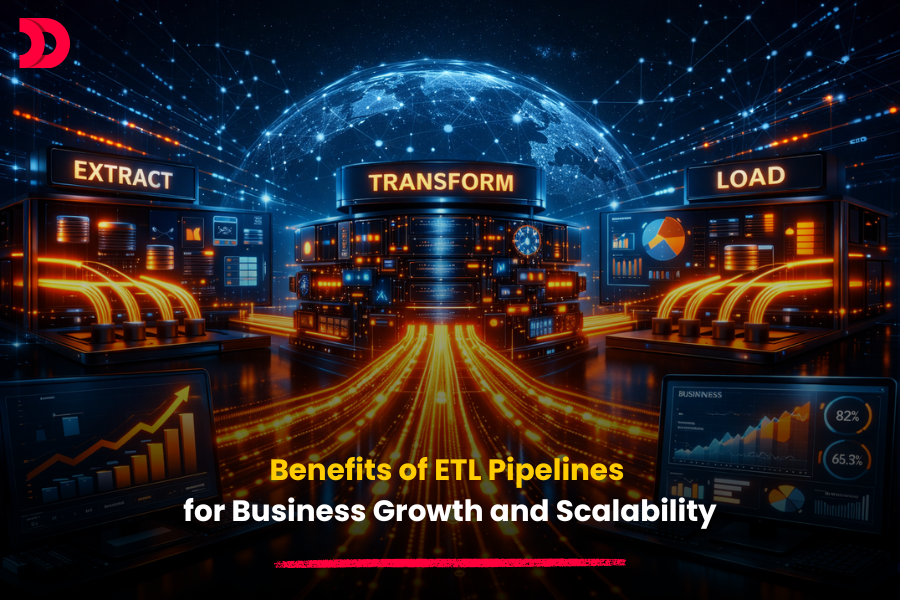

Quick answer: ETL (Extract, Transform, Load) pipelines automate the movement and processing of data from multiple sources into a centralized repository improving data quality, enabling faster analytics, and helping businesses scale without interrupting operations.
In today’s data-driven economy, companies generate enormous volumes of raw data every single day from CRM systems, e-commerce platforms, cloud databases, IoT sensors, and SaaS tools. The problem? Most of that data is fragmented, inconsistent, and unusable in its raw form.
That’s where ETL pipelines step in. By automating the extraction, transformation, and loading of data into a unified repository, ETL pipelines turn scattered, messy data into a competitive advantage. In this guide, we’ll break down the key benefits of ETL pipelines and why they are essential for modern business growth and scalability.
ETL stands for Extract, Transform, Load the three core stages of moving data from source to destination:
| ETL Stage | What Happens | Tools Used |
|---|---|---|
| Extract | Data pulled from APIs, databases, SaaS platforms | Fivetran, Airbyte, Stitch |
| Transform | Data cleaned, standardized, deduplicated, masked | dbt, Apache Spark, AWS Glue |
| Load | Clean data stored in warehouse or lake | Snowflake, BigQuery, Redshift |
Improved data quality
Cleans, validates, and standardizes data before it reaches analysts ensuring accuracy across every report.
Faster analytics
Pre-structured data is instantly ready for BI tools, slashing the time from raw data to business insight.
Full automation
Eliminates manual data handling, reducing operational costs and the risk of human error significantly.
Scalability
Handles millions of daily transactions without workflow interruption as your data volume grows.
Compliance & security
Masks or removes sensitive fields before loading meeting GDPR, HIPAA, and SOC 2 requirements.
Centralized data
Consolidates all data sources into one unified warehouse, simplifying access for every team.
One of the most impactful benefits of ETL pipelines is the dramatic improvement in data quality. Raw data arriving from multiple systems is often messy inconsistent date formats, duplicate records, null values, and mismatched schemas.
ETL transformation rules automatically fix these issues. For example, a date recorded as “04-02-2026” in one system and “April 2, 26” in another gets standardized to a single format before analysis. The result: analysts can trust the data they’re working with and leadership can trust the reports they receive.
Business impact: Companies with high data quality make decisions 2–3x faster than those relying on inconsistent, manual data processes.
Before ETL, data teams spent enormous time manually copying data between systems, writing one-off scripts, and fixing broken exports. ETL pipelines automate all of this on a reliable schedule hourly, daily, or in real-time.
This frees your data engineers and analysts to focus on high-value work: building dashboards, running experiments, and generating insights not wrangling spreadsheets.
When data is already cleaned, structured, and loaded into a warehouse, analysts don’t have to spend hours preparing it. Business Intelligence tools like Tableau, Looker, or Power BI can query it directly delivering reports in minutes instead of days.
| Without ETL | With ETL Pipeline |
|---|---|
| Manual data extraction (hours) | Automated extraction (minutes) |
| Inconsistent formats across sources | Standardized, unified schema |
| Analysts fix data before analysis | Analysts focus on insights |
| Reports lag by days | Real-time or near-real-time dashboards |
| Risk of human error in calculations | Validated, trusted data outputs |
Most growing businesses use 10–50+ different software tools. Their data lives in isolated silos Salesforce, Stripe, Google Analytics, MySQL, Zendesk. ETL pipelines break down these silos by pulling everything into one centralized Data Warehouse or Data Lake.
This gives every team sales, marketing, finance, product a single source of truth. No more conflicting numbers between departments, no more “which spreadsheet is correct?”
Regulations like GDPR, HIPAA, and CCPA require businesses to handle personal data carefully. ETL transformation stages allow you to automatically mask PII (personally identifiable information), remove sensitive fields, or anonymize records before they’re stored in your analytics layer.
Example: A healthcare company uses ETL to strip patient names and SSNs from raw EHR data before loading it into their analytics warehouse staying HIPAA-compliant without manual review.
As your business grows, your data grows with it. A pipeline handling 10,000 daily transactions today needs to handle 10 million tomorrow. Modern cloud-based ETL solutions (like AWS Glue, dbt Cloud, or Fivetran) are built to scale elastically processing larger volumes automatically without redesigning your architecture.
| Business Stage | Data Volume | ETL Capability |
|---|---|---|
| Startup | < 100K records/day | Basic pipelines, scheduled jobs |
| Growth Stage | 100K – 10M records/day | Cloud ETL, incremental loading |
| Enterprise | 10M+ records/day | Real-time streaming, parallel processing |
ETL pipelines don’t just move current data they maintain and archive historical records. This enables long-term trend analysis, year-over-year comparisons, and the ability to trace exactly how your business has evolved over time.
For industries like finance, retail, and healthcare, historical data is not just useful it’s legally required for audits and regulatory reporting.
| Criteria | Manual Processing | ETL Pipeline |
|---|---|---|
| Speed | Slow | Fast / Automated |
| Data quality | Inconsistent | Standardized |
| Scalability | Limited | Elastic / Cloud-scale |
| Compliance | Manual review needed | Automated masking |
| Cost over time | High (labour) | Lower (automation) |
| Error rate | High | Low |
Final Thoughts
ETL pipelines are no longer a luxury reserved for large enterprises. They are a foundational infrastructure investment for any business that wants to grow with confidence, make faster decisions, and trust its data.
From improving data quality and ensuring compliance, to enabling real-time analytics and scaling effortlessly the benefits of ETL pipelines directly translate into business value. The question isn’t whether you need one. It’s how quickly you can get one running.
Whether you’re a startup processing your first million records or an enterprise managing billions of transactions per day, the right ETL pipeline will be one of the most impactful investments your data team ever makes.

Frequently Asked Questions
An ETL pipeline automates the extraction of data from multiple sources, transforms it into a clean and consistent format, and loads it into a centralized data warehouse for analytics and reporting.
Modern ETL pipelines run on elastic cloud infrastructure, meaning they automatically scale to handle increased data volumes from thousands to billions of records without manual reconfiguration or downtime.
In ETL, data is transformed before loading into the warehouse. In ELT (Extract, Load, Transform), raw data is loaded first and transformed inside the warehouse using SQL a common pattern with modern cloud data warehouses like Snowflake or BigQuery.
Yes. Many modern ETL tools offer affordable, no-code options (like Fivetran or Airbyte) that make pipeline automation accessible for startups and SMBs not just enterprise organizations.
ETL transformation steps can automatically mask, anonymize, or remove personally identifiable information (PII) before data is stored in the analytics layer helping businesses meet GDPR, HIPAA, and other regulatory requirements.



Feel free to call or visit us anytime; we strive to respond to all inquiries within 24 hours.




 Apr 2, 2026