Today, I am going to discuss in detail why Scaling Agentic AI is a Real Enterprise Challenge!!
Well, most enterprises begin their AI journey with a single intelligent agent. This agent answers questions, calls tools, and performs basic workflows. At first, this feels powerful. Over time, the limitations become crystal clear.
Enterprises do not operate through a single role or responsibility. They operate through teams. When AI is expected to research, reason, execute, validate, and comply all at once, reliability declines. This is not a model problem. It is an architecture problem.
Scaling agentic AI requires moving beyond single-agent systems and moving shred toward coordinated, multi-agent environments. This is exactly what my friend, where MCP becomes foundational.
TL;DR
Single-agent AI systems fail at enterprise scale due to limited scope, tool overload, and context loss.
Multi-agent architectures solve this by enabling specialization, collaboration, and long-term planning.
MCP provides the protocol layer that makes multi-agent enterprises practical and maintainable.
What are the Limits of Single-Agent AI Systems?
Let me share some of the obvious limits of single-agent AI systems in detail.
Why one agent cannot do everything well
Single-agent systems are attractive because they are simple to deploy. However, simplicity does not scale in enterprise environments.
A single agent is forced to juggle multiple responsibilities. Research, decision-making, execution, and compliance all compete for attention. As complexity increases, accuracy drops. This results in unreliable outputs and fragile workflows.
Tool fatigue and brittle integrations
As enterprises add more tools, a single agent must decide which tool to use and when. This creates excessive tool-selection logic and increases the risk of incorrect execution.
Over time, these systems become difficult to debug and expensive to maintain.
Loss of long-term context
Enterprise workflows do not end in one session. They span hours, days, and sometimes weeks. Single-agent systems struggle to retain meaningful context across long horizons.
This leads to repeated questions, duplicated work, and inconsistent decisions.
Are You Ready to Move Beyond Single Agent AI Systems?
If your AI struggles when workflows grow or tools multiply, it is time to scale!
Decoding each step on how enterprises like yours can scale agentic AI. Please read in leisure and connect with our team with your queries.
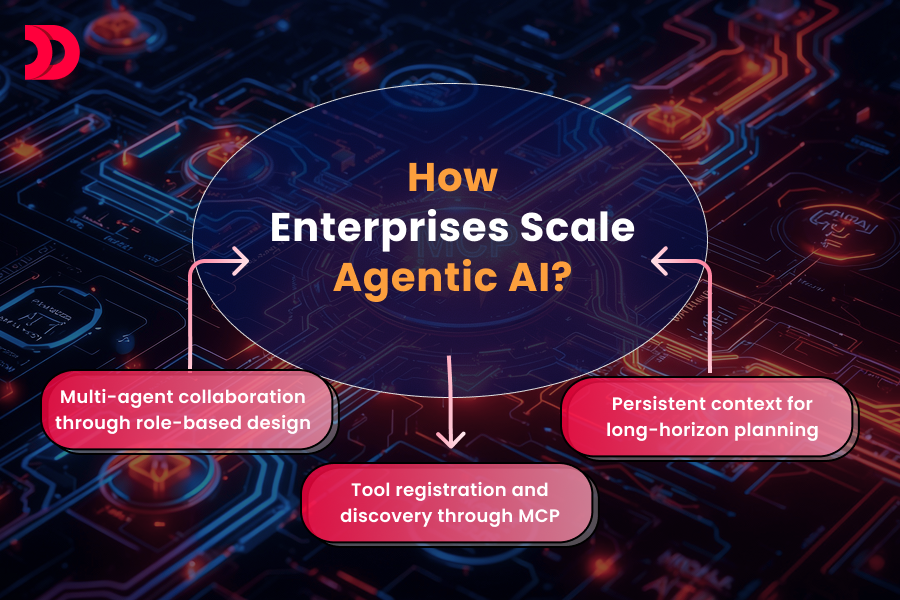
1: Multi-agent collaboration through role-based design
Enterprises scale work by dividing responsibilities across teams. AI systems must follow the same principle.
In a multi-agent architecture, each agent has a clear role. One agent focuses on research. Another handles execution. A third validates compliance. A fourth manages orchestration and planning.
MCP enables these agents to communicate through a structured context rather than fragile custom logic. This creates predictable and explainable behavior.
2: Tool registration and discovery through MCP
Agents should not hard-code tool knowledge. This approach does not scale.
With MCP, tools register themselves with a server. Agents query available tools dynamically based on schemas and capabilities. This removes tight coupling between agents and tools.
As new tools are introduced, agents can discover and use them without redeployment. Maintenance costs drop. Integration risk decreases.
3: Persistent context for long-horizon planning
Enterprise intelligence depends on memory.
MCP supports structured context passing between agents and across workflow stages. This allows AI systems to reason over time rather than reset on every interaction.
Persistent context enables traceability, audit readiness, and consistent decision-making. These qualities are essential in regulated and high-stakes industries.
The Real-World Multi-Agent Use Cases
Now, it is time to decode some real-world multi-agent use cases that enable agentic AI for enterprises.
1: Healthcare: Coordinated agents for care, billing, and compliance
In healthcare environments, a single agent cannot safely manage the full workflow.
A clinical agent supports physicians with patient context. A billing agent handles insurance workflows. A compliance agent ensures regulatory adherence.
MCP ensures that all agents share the same validated context without exposing unnecessary data. This improves efficiency while maintaining safety and compliance.
2: Finance: Research, risk, and execution agents working together
Financial operations demand speed, accuracy, and accountability.
A research agent analyzes market data. A risk agent evaluates exposure. An execution agent carries out approved actions. Each agent contributes without duplicating logic.
MCP coordinates these interactions and preserves decision context. This improves transparency and reduces operational risk.
3: Why MCP Makes Multi-Agent Enterprises Feasible
Multi-agent systems fail without a shared protocol.
MCP standardizes how agents communicate, how tools are discovered, and how context flows between components. This removes the need for custom integrations between every agent and system.
Without MCP, complexity grows exponentially. With MCP, enterprises gain a stable foundation for scaling intelligent systems.
Let’s Bring Multi-Layer Agentic AI to Your Enterprise
If your AI struggles when workflows grow or tools multiply, it is time to scale with a coordinated multi-agent architecture.
Here are some of the key benefits for enterprises that I have explained in detail.
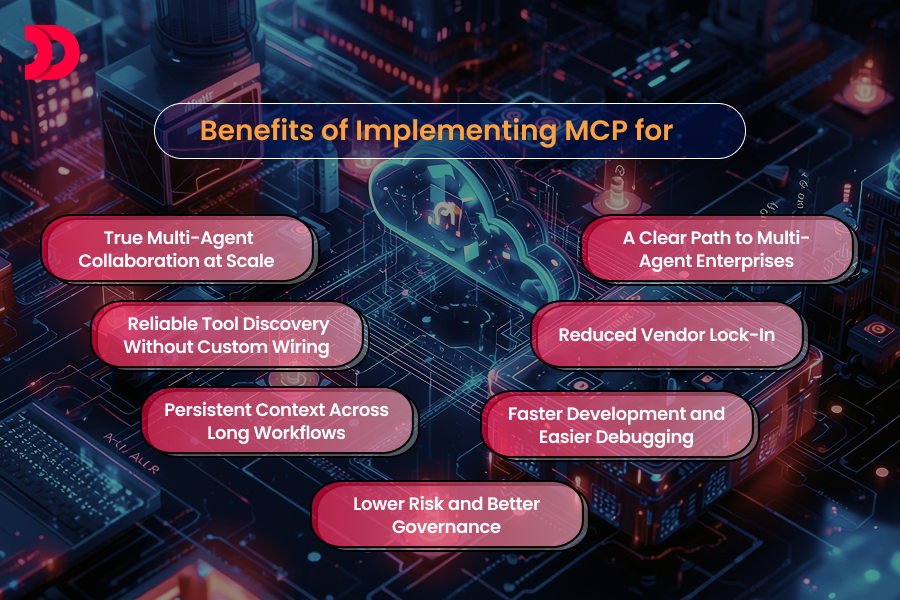
1. True Multi-Agent Collaboration at Scale
Most enterprises today experiment with one powerful AI agent and quickly hit a wall. A single agent cannot plan, execute, verify, and comply at the same time without becoming slow and unreliable.
With MCP, I can design role-based agents that behave like a real enterprise team. One agent focuses on research, another handles execution, another checks compliance, and another monitors outcomes. Each agent does its job well and shares context through a common protocol instead of passing brittle handoffs.
This changes AI from a smart assistant into a coordinated workforce. Enterprises move from isolated automation to connected intelligence that actually mirrors how real teams operate.
2. Reliable Tool Discovery Without Custom Wiring
In traditional setups, every agent needs to be hardwired to tools. Every API change breaks workflows. Every new tool requires fresh integration work.
MCP removes that chaos by introducing standardized tool registration and discovery. Tools describe themselves once, using clear schemas. Any MCP-compliant agent can discover, understand, and use them without custom logic.
For enterprises, this means faster onboarding of internal systems, fewer broken automations, and a dramatic reduction in engineering overhead. Tools stop being fragile dependencies and start becoming reusable building blocks.
3. Persistent Context Across Long Workflows
One of the biggest failures of agentic AI today is memory loss. Agents forget earlier decisions, lose track of goals, and repeat work that was already done.
MCP enables structured context sharing across agents and tools. This allows long-running workflows to stay coherent. Decisions made in step one still matter in step ten.
For enterprises, this unlocks long-horizon planning. Monthly reporting, multi-step compliance checks, customer lifecycle workflows, and strategic analysis all become feasible because context does not reset every time an agent switches tools.
4. Lower Risk and Better Governance
Custom integrations are not just expensive. They are risky. Every one-off connector introduces security gaps, unclear data handling, and audit challenges.
MCP standardizes how context, commands, and data flow between agents and systems. This makes security controls, authentication, logging, and compliance enforcement far easier to implement consistently.
For regulated industries like healthcare, finance, and legal services, this is critical. Enterprises gain confidence that AI systems behave predictably and transparently instead of acting like black boxes stitched together by scripts.
5. Faster Development and Easier Debugging
When everything is custom-built, debugging becomes guesswork. Engineers chase failures across APIs, wrappers, and agent logic with no shared structure.
With MCP, interactions follow a known protocol. Context passing is explicit. Tool calls are standardized. Errors are predictable.
This makes development faster and debugging far simpler. Teams spend less time fixing glue code and more time improving actual business logic. Enterprises ship agentic workflows faster without burning engineering resources.
6. Reduced Vendor Lock-In
Most AI stacks today are tightly coupled to specific frameworks or vendors. Switching tools often means rebuilding everything.
MCP breaks that dependency. Because it is a protocol, not a platform, enterprises can swap agents, models, or tools without rewriting integrations.
This gives long-term flexibility. Enterprises protect their investments and avoid being trapped by any single vendor or ecosystem while still moving fast.
7. A Clear Path to Multi-Agent Enterprises
The biggest benefit is strategic.
MCP makes it realistic for enterprises to move from experimental AI projects to organization-wide agent ecosystems. Sales, finance, compliance, operations, and support agents can all collaborate through a shared language.
This is how AI stops being a demo and starts becoming infrastructure.
Hmm… Time for Takeaway: MCP Enables the Multi-Agent Enterprise
Enterprise AI is not about smarter individual agents. It is about coordinated systems that behave like real organizations.
MCP provides the protocol layer that allows AI agents to collaborate, discover tools, and retain context over time. This transforms experimental AI into a scalable enterprise infrastructure.
Organizations that adopt MCP early will move faster, build with confidence, and avoid the architectural debt that limits the capabilities of agentic systems.
Design Scalable Multi-Agent Systems with MCP
Build AI architectures that grow with your enterprise, not against it.
Why do single-agent AI systems fail at enterprise scale?
Single-agent systems struggle with complex responsibilities, tool overload, and long workflows. As the scope increases, reliability and consistency decline.
What is a multi-agent AI system in simple terms?
A multi-agent system divides work across specialized AI agents, each responsible for a clear role such as research, execution, or compliance.
How does MCP enable multi-agent collaboration?
MCP provides a shared protocol for context exchange and coordination, allowing agents to work together without custom integrations.
Why is tool discovery important for scaling AI systems?
Hard-coded tool logic breaks as systems grow. MCP allows agents to dynamically discover and use tools through standardized schemas.
What does persistent context mean in enterprise AI workflows?
Persistent context allows AI systems to retain memory across long workflows, ensuring consistency, traceability, and better decision-making.
How does MCP help with long-horizon planning?
MCP enables structured context sharing across agents and time, allowing plans to evolve without losing historical decisions or intent.
Can MCP-based multi-agent systems work in regulated industries?
Yes. MCP supports controlled context sharing, auditability, and predictable behavior, which are critical for healthcare and finance.
Is MCP only useful for large enterprises?
No. Even growing teams benefit from MCP by avoiding early architectural debt and building scalable agent systems from the start.
How does MCP reduce maintenance and debugging effort?
By standardizing communication and tool interaction, MCP removes fragile custom logic and simplifies system-wide troubleshooting.
What is the biggest advantage of MCP for multi-agent enterprises?
MCP turns complex agent coordination into a manageable, scalable architecture that mirrors how real organizations operate.
Have You Ever Wondered Why Tooling Decides Whether MCP Succeeds Every protocol succeeds or fails based on its tooling ecosystem. TCP/IP scaled because developers could debug, monitor, and evolve systems with confidence. HTTP thrived because testing tools, logs, and standards...
Why Agentic AI Must Be Evaluated Through a Business Lens Enterprise leaders are no longer asking whether AI works. They are asking whether it pays off. As organizations move beyond pilots and proofs of concept, the focus shifts from technical...
Enterprise AI is entering a new phase. What started as isolated experiments in chatbots, copilots, and automation scripts is now moving into connected, cross-system workflows.The challenge is that most enterprise tools, models, and agents still cannot communicate with each other...
We all know the fact that enterprise AI adoption is moving faster than ever, but still, most companies, including us, are struggling to make their systems truly intelligent. The advanced tools such as the chatbots, automation bots, and internal APIs...
If you think deeply, the last decade of software has been built on APIs, SDKs, and endless custom connectors. Yes, definitely, they were the bridge that helped applications talk to one another. But today, as AI systems evolve into multi-agent...
Well, do you know what truly makes the Model Context Protocol (MCP) work? It is not just the idea of standardization. It is the architecture that allows AI agents and tools to communicate smoothly. Or we can say a design...









 Jan 09, 2026