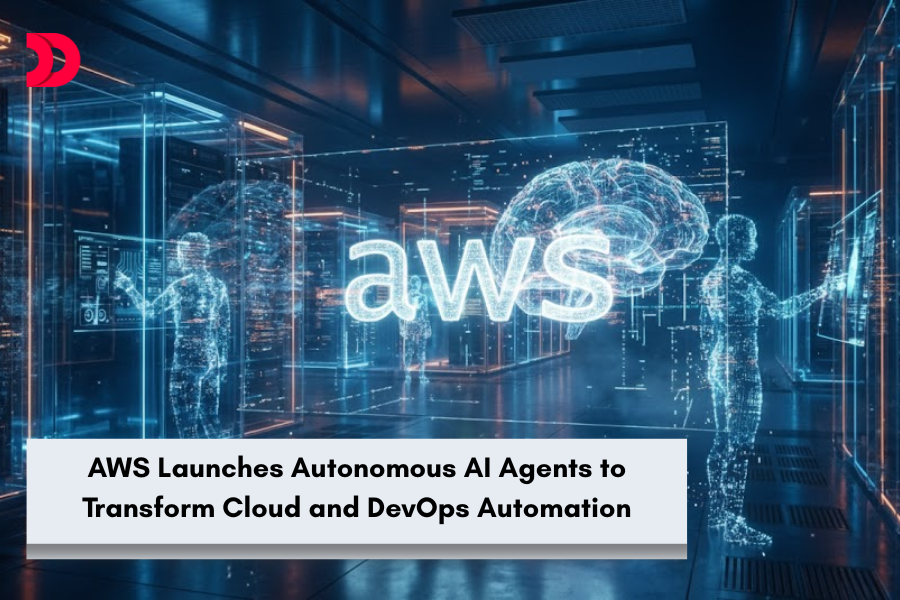
At its 2025 flagship conference AWS re:Invent, AWS introduced a new category of AI-driven tools called “frontier agents” aimed at transforming the way software is built, secured and operated. These agents are not simple helpers; they are designed to act like autonomous team members, working independently across development, security, and operations workflows.
What Are Frontier Agents?
Frontier agents are a class of AI systems built to operate continuously for hours or even days without needing constant human supervision. They do more than one-off assistance; they take on entire tasks or projects, maintain context across sessions, and scale to tackle multiple tasks simultaneously.
In this initial rollout, AWS introduced three agents that target core aspects of software lifecycle management:
- Kiro autonomous agent : a virtual developer agent that writes and refactors code, triages bugs, and can manage changes across multiple repositories. It learns a team’s coding standards and workflow patterns, and can autonomously handle backlog items.
- AWS Security Agent : a security-oriented agent that reviews design documents, scans pull requests, runs automated penetration tests, and helps catch vulnerabilities early in the development cycle.
- AWS DevOps Agent : an operations agent built to handle incident response, performance monitoring, and infrastructure management. It integrates with observability tools and tracks relationships among services to pinpoint root causes and propose or apply fixes.
Together, these agents promise to dramatically streamline software workflows by embedding development, security, and operations as continuous and partially automated processes.
How Kiro and Other Agents Work What’s New
What sets these frontier agents apart from previous AI tools is persistence, context and autonomy. For example, Kiro does not operate on a single prompt or isolated snippet; instead it maintains persistent context across sessions, builds a “mental model” of the team’s codebase, style, and preferences, and can orchestrate complex tasks like updating multiple parts of a system across various repositories with a single instruction.
AWS touts this as a shift from “assistive AI” to “agentic AI”: rather than artificial-intelligence features that need constant human input, frontier agents aim to be virtual teammates capable of taking goals and fully executing them over time.
The Security and DevOps agents extend this paradigm: rather than periodic, ad-hoc interventions, they integrate into the continuous development lifecycle — proactively scanning code, running security tests, managing incidents, and delivering actionable results as soon as issues arise.
Why This Matters : Potential Benefits for Teams & Organizations
Faster delivery cycles & reduced overhead: By delegating routine or repetitive tasks bug triaging, refactoring, code reviews, security scans, incident detection to agents, teams free up human developers and engineers to focus on higher-value, creative, architectural work. Kiro’s multi-repo capabilities mean even large-scale code updates can be handled with minimal human coordination.
Improved security and reliability: The AWS Security Agent embeds security reviews and testing early and continuously in the development lifecycle reducing the risk of vulnerabilities going unnoticed until deployment. The DevOps Agent’s monitoring and automated root-cause analysis can drastically cut incident resolution times, helping maintain uptime and stability.
Scalability with autonomy: Because agents are built to scale and run concurrently on multiple tasks, small teams can behave like larger ones, and large organizations can streamline workflows with fewer human bottlenecks.
For service providers, this shift means there may be growing demand for agent-integration services, AI-governance consulting, and custom configurations particularly for clients who want to adopt agentic workflows but need help with setup, standards, compliance, or scaling.
Cautions & What to Watch Out For
Though promising, agentic AI is not a silver bullet. As with any powerful automation:
- Governance and oversight remain critical. Autonomous agents still need guardrails, audit logs, and human-in-the-loop checkpoints especially for security, compliance, and major structural changes. AWS has introduced tooling like policy controls and evaluation frameworks for agents, but organizations must invest in responsible deployment.
- Reliability and trust issues: While agents can manage routine tasks, complex or creative work may still require human judgment. Early adopters may need time to calibrate agent behavior and build trust.
- Not a replacement for all teams: As emphasized by AWS leadership, agents are meant to augment not replace human developers and engineers. They are helpers, accelerators and enablers not substitutes for domain expertise, architecture design or strategic decision-making.
What This Means for IT Service Providers and Developers (Especially in Today’s Market)
For IT service companies, companies building SaaS, or firms offering managed services and DevOps support especially in markets like India this development is a game-changer. You could:
- Offer agent-onboarding consulting, helps clients integrate frontier agents into their CI/CD pipelines, define coding standards, and set security & compliance policies.
- Provide managed agent services: running, monitoring, and maintaining agents on behalf of clients optimally configured for their specific workflows.
- Deliver code-audit and review services, ensuring agent-generated code meets quality, performance, and security standards.
- Use agents to accelerate internal development, reduce time-to-delivery, and cut costs when building tools, internal platforms, or client projects.
In short: frontier agents lower the bar for building and maintaining complex software and position AI as a long-term, operational collaborator rather than a mere novelty.
Conclusion
AWS’s introduction of frontier agents starting with Kiro, AWS Security Agent, and AWS DevOps Agent represents a major shift: from one-off AI assists toward persistent, proactive, scalable AI teammates. For development, security, and operations teams, this could mean faster delivery, better reliability, and less manual toil. For IT service providers and organizations worldwide, this opens up new opportunities and responsibilities around integrating, governing, and leveraging AI agents effectively.
As with any powerful tool, the key to success will lie not just in adoption, but in responsible implementation: defining standards, ensuring oversight, and combining human judgment with autonomous capabilities. The future of software development may well be agent-augmented and for those ready to embrace it, the next few months and years could be transformative.










 Sep 19, 2025