


Chat on WhatsApp

Hospital Pharmacy Intelligence Platform: AI-Driven Pharmaceutical Operations Optimization

Info

Impact: 38% reduction in stockouts | 58% decrease in expiries | 89% supplier on-time delivery

Industry: Pharma & Procurement

Introduction

A 200-bed multi-specialty hospital faced critical pharmacy challenges – stockouts causing treatment delays, $680K tied up in excess inventory, 8.5% monthly expiry rates, and unreliable supplier performance. Operating across inpatient (IP) pharmacy, outpatient (OP) pharmacy, and procurement departments with fragmented systems and no predictive capabilities, the organization was losing an estimated $850K annually.

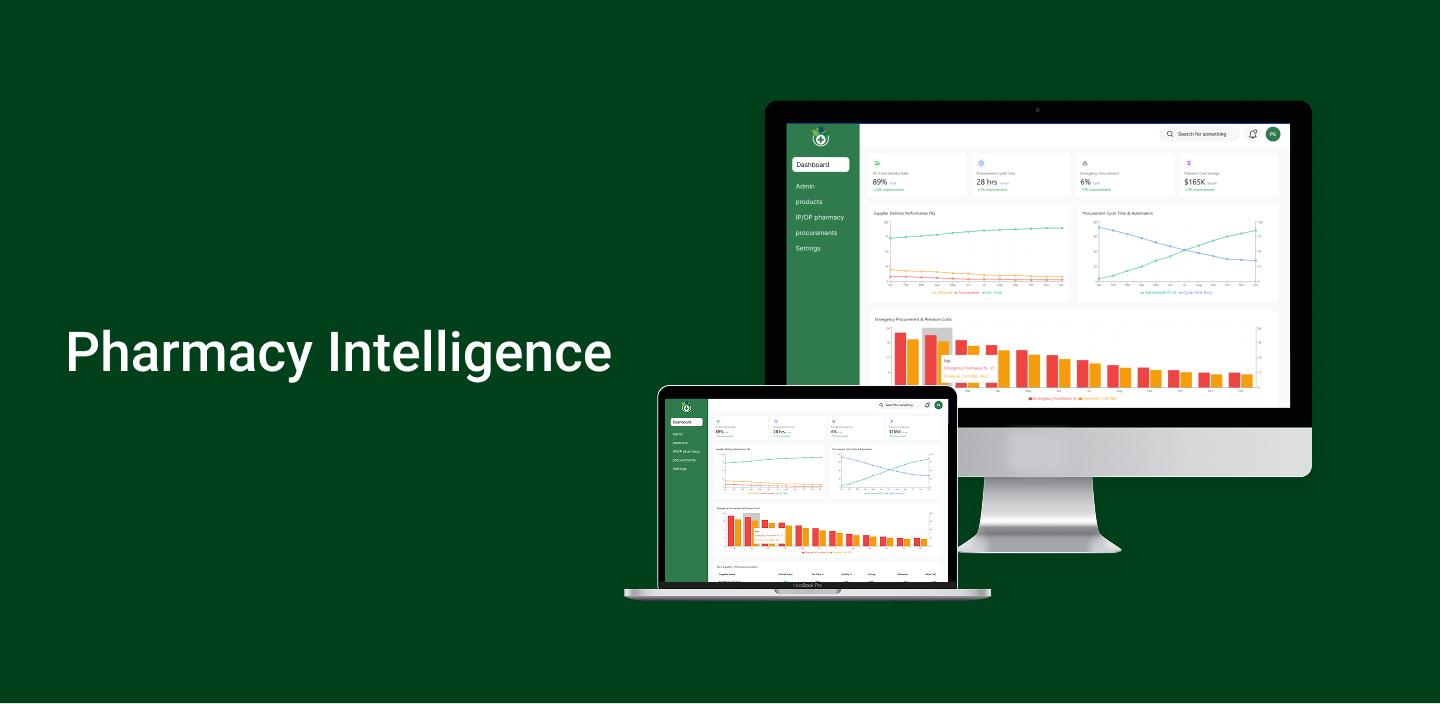
We deployed the Hospital Pharmacy Intelligence Platform – a unified analytics solution integrating advanced statistical modeling and machine learning to transform reactive pharmacy operations into a proactive, data-driven ecosystem.

Client Requirements

The client required an integrated Pharmacy Intelligence Platform that unifies inpatient, outpatient, and procurement data into a single ecosystem. They needed real-time stock visibility, predictive demand forecasting, expiry and batch tracking, automated procurement workflows, and supplier performance analytics to eliminate stockouts, reduce waste, cut patient wait times, and transform pharmacy operations from reactive to fully data-driven.

Intelligent Dashboard Suite for Pharmacy Intelligence

01

Executive Dashboard

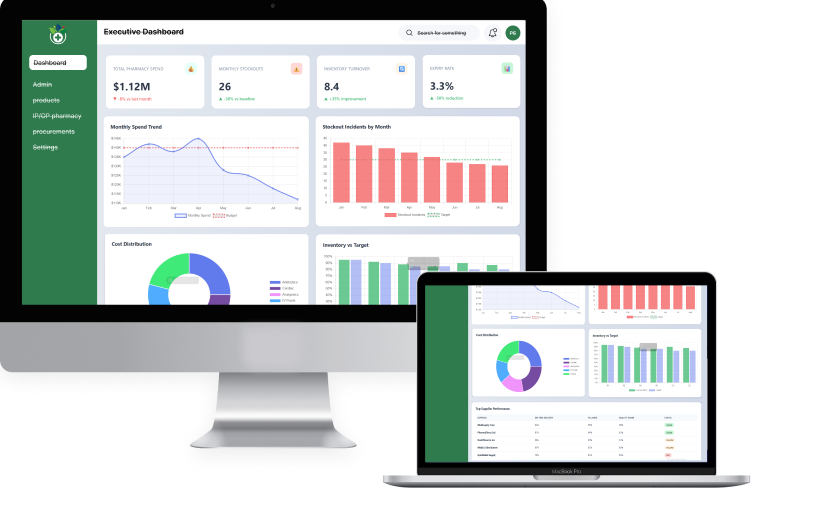
The Executive Dashboard (Power BI) gives Pharmacy Directors, COOs, and CFOs a consolidated view of pharmacy performance, showing spend (MTD/QTD/YTD), cost per patient day, budget variance, stockouts, inventory turnover, expiry rates, and supplier on-time delivery. It also highlights top cost-drivers, slow-moving inventory, contract renewals, and provides forecasted spend with confidence intervals.
02

IP Pharmacy Operations Dashboard

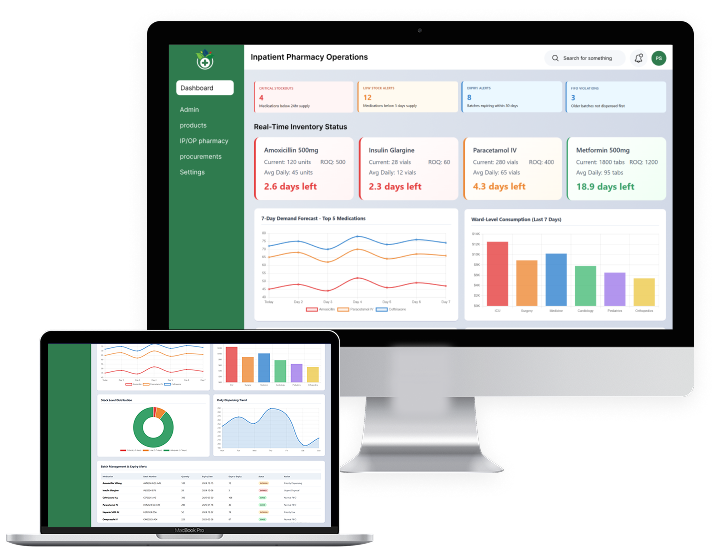
The IP Pharmacy Operations Dashboard gives inpatient pharmacists and supervisors real-time inventory visibility with color-coded alerts, ward-level consumption analytics, and unusual pattern detection. It provides a 7-day demand forecast for the top medications with predicted stockout dates, supports batch management through expiry alerts and FIFO compliance scores, and issues critical stockout warnings with automated PO recommendations.
03

OP Pharmacy Operations Dashboard

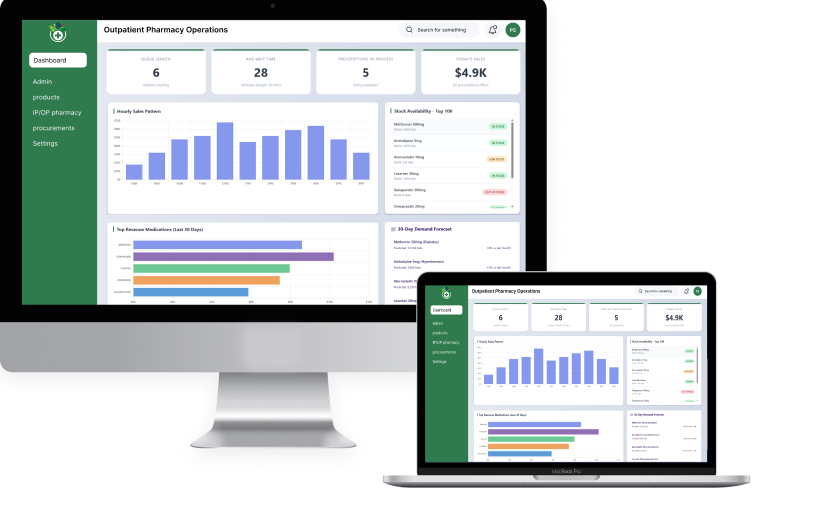
The OP Pharmacy Operations Dashboard equips outpatient pharmacists and front desk teams with live visibility into queue length, wait times, and prescriptions in process. It shows stock availability for the top medications with suggested alternatives, provides sales analytics such as hourly patterns and top revenue drugs, delivers a 30-day forecast for chronic disease medications, and issues seasonal preparation alerts.
04

Procurement Command Center Dashboard

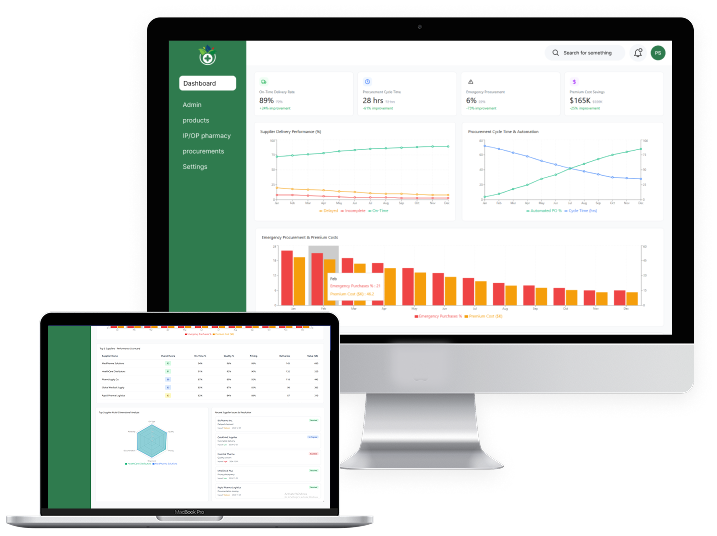
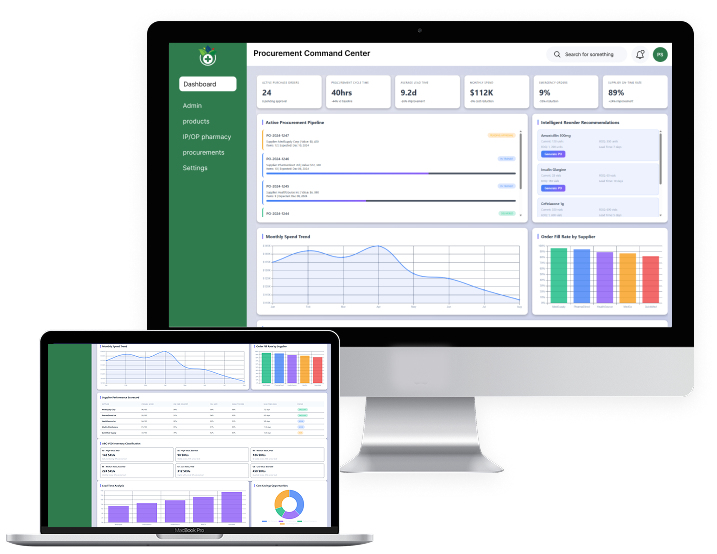
The Procurement Command Center Dashboard gives procurement managers and supply chain teams a real-time view of active POs and pending approvals, intelligent reorder recommendations with auto-PO options, and supplier scorecards for delivery, fill rates, quality, and lead times. It supports inventory planning with ABC-VED, safety stock tracking, and aging analysis, provides cost insights like spend trends and price inflation, and enables one-click PO generation with automated supplier emails.
05

Expiry & Batch Management Dashboard

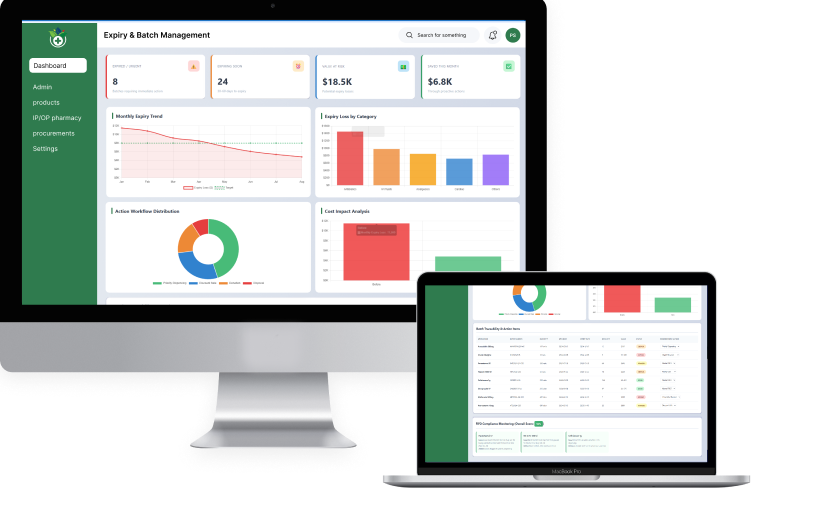
The Expiry & Batch Management Dashboard helps inventory controllers and QA teams track expiry risks through a heatmap with financial exposure, monitor FIFO compliance with violation alerts, and manage automated workflows for disposal, discounting, donation, or priority dispensing. It also provides full batch traceability with an audit trail and delivers monthly compliance reports with cost impact insights.

Challenges and Approach

Critical Operational Gaps

The hospital’s pharmacy departments faced interconnected challenges that compounded inefficiencies:

Inpatient Pharmacy:

  • Unpredictable demand causing 42 monthly stockout incidents
  • 14% of scheduled procedures delayed due to medication unavailability
  • Manual inventory processes consuming 40% of pharmacist time
  • No ward-level consumption visibility

Outpatient Pharmacy:

  • 45-minute average patient wait time for prescription fulfillment
  • 12% prescription abandonment due to stockouts ($115K annual revenue loss)
  • Inability to anticipate seasonal demand fluctuations
  • No forecasting for chronic disease medications

Procurement & Supply Chain:

  • 28% of supplier deliveries delayed or incomplete
  • 22% emergency purchases at 18-35% price premiums
  • 72-hour procurement cycle time with manual PO processing
  • Zero data-driven supplier performance measurement

Inventory Management:

  • $680K in working capital tied up in excess and slow-moving stock
  • 7.8% monthly expiry rate representing significant waste
  • Manual batch tracking with FIFO violations
  • No systematic ABC classification for differentiated management

Data Environment:

  • Siloed systems across IP, OP, and procurement with no integration
  • Month-end reports taking 10+ days to generate
  • Completely reactive management with no predictive capabilities
  • No centralized supplier intelligence

Financial Impact: $485K annual losses from expiries, emergency procurement premiums, and stockout-related revenue leakage.

Financial Outcomes


Metric Before After Improvement Annual Value
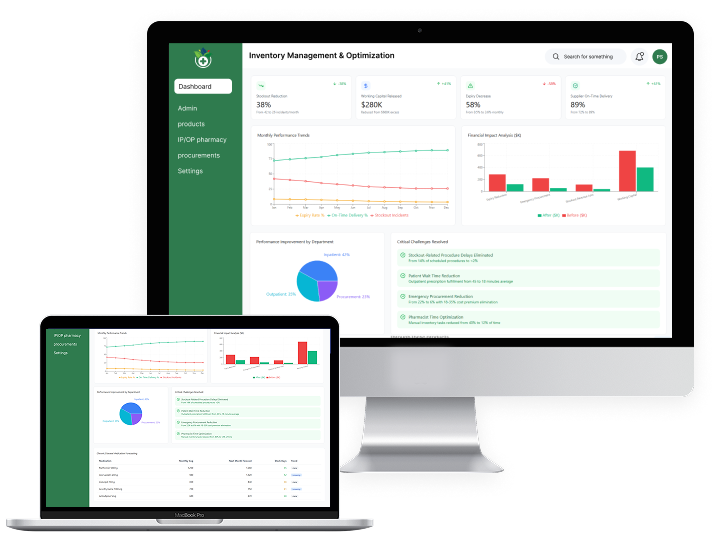
Working Capital in Inventory $1.4M $1.12M -20% $280K released
Monthly Expiry Loss $11,500 $4,830 -58% $80K saved
Emergency Procurement Premiums $125K/year $81K/year -35% $44K saved
OP Stockout Revenue Loss $115K/year $58K/year -50% $57K recovered
Procurement Cost Reduction Baseline -8% -8% $145K saved
Total Annual Benefit $606K


ROI: 130% over 2 years (Project cost: $465K including implementation and infrastructure)

Supplier Management Success


Metric Before After Change
On-Time Delivery Rate 72% 89% 0.24
Average Lead Time 12.4 days 9.2 days -26%
Order Fill Rate 87% 94% 0.08
Emergency Orders (Supplier delays) 22% 9% -59%


Key Achievements:

  • Replaced 3 chronically underperforming suppliers
  • Renegotiated 8 supplier contracts with 5–9% cost reductions
  • Implemented performance-based penalty clauses in new contracts

Key Outcome

Technology Stack

Technologies we used

Apache Spark

Polars

MLflow

Apache Superset

Conclusion

The Hospital Pharmacy Intelligence Platform transformed a reactive, fragmented pharmacy into a proactive, data-driven operation. Delivering $606K annual value and 130% ROI, it optimized inventory, reduced stockouts and expiries, improved supplier performance, and freed pharmacists for patient care. By combining domain expertise with AI-driven analytics and intuitive dashboards, the hospital now operates a scalable, efficient, and future-ready pharmacy ecosystem.